Resonance
XXII — Stress and Strain
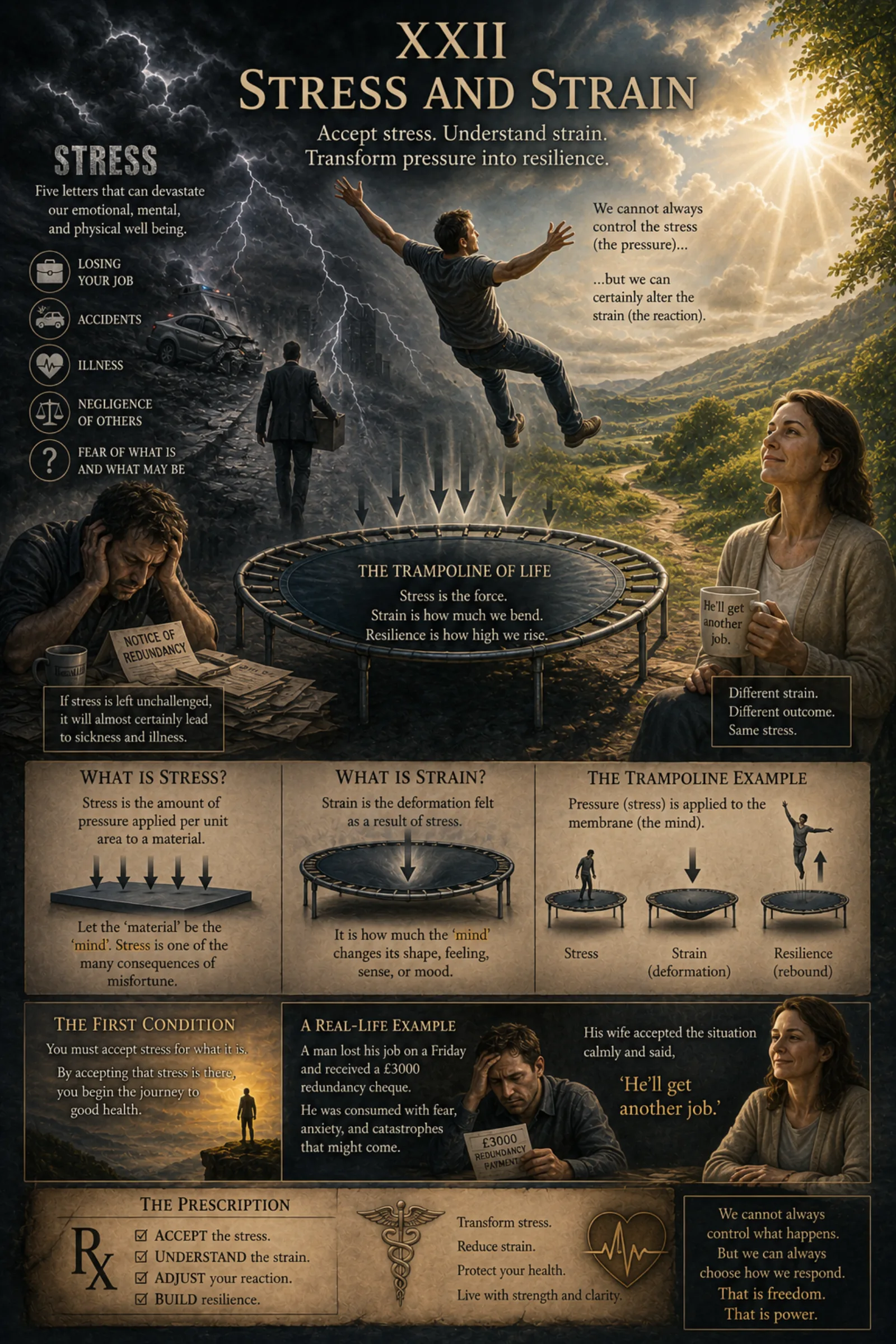
STRESS – Five simple letters, but possibly it is the most destructive and emotive force that can devastate our beings. It releases the fear of what is and what may be, and this, in turn, can unleash further catastrophes on your emotional, mental, and physical well being. If stress is left unchallenged, it will, almost certainly, lead to sickness and illness. There are untold libraries of books instructing on how to deal with stress. Admittedly, there are certain precautions and prophylactic actions we can take to avoid misfortune penetrating our lives, but we cannot really, wholly avoid stress. We, the authors and creators of our lives can encase our lives as much as is practically possible to avoid having to deal with stress. However, stress often comes from arenas and fields, not of our own making such as losing one's job, being involved in an accident, or becoming ill because of the negligence of others. It is then that we have to face up to life's misfortunes and sometimes darkest moments.
This is the first condition: you must accept stress for what it is, and by doing so, when you accept the visitation of stress, and you accept that stress is there, you are on the first journey to giving yourself the first prescription to the bastion for good health.
Stress is the amount of pressure applied per unit area to a material. Let us call the 'material' the 'mind' for clarity's sake, and let us say that stress is one of the many consequences of misfortune.
Now, before we can proceed, we have to understand that stress invariably does not act alone. There is another side to stress and this is 'strain.'
STRAIN is the deformation felt as a result of stress, or in other words, it is how much a 'material', or the 'mind' changes its shape, feeling, sense, or mood. Imagine a simple trampoline in life. Pressure, stress, is applied as a force to the membrane, and as the membrane endures the force, it changes its shape, and the depression, which the trampolinist applies, soon becomes elastic, and the jumper is catapulted back high into the air.
We cannot always control the stress, but we can certainly alter the strain caused by the stress. Using the earlier example: imagine the trampoline is the mind, and imagine the stress is the act of losing one's job because of redundancy.
A friend once lost his job on a Friday, and he was given a £3000 redundancy cheque. He was fraught with untold anxiety about what was going to happen, what catastrophes awaited him, his wife and children. His wife, on the other hand, coolly accepted the redundancy money and merely commented, 'He'll get another job.'
Prefer to listen? Watch the video reading below.
Reader Comments
Leave a Comment
We would love to hear your thoughts on this chapter.

About Karl Swainston
Karl Swainston is a writer and storyteller whose work is forged from a life lived across the North of England and far beyond. Growing up on a Leeds council estate in the 1960s, Karl's journey was anything but linear. By the age of thirty, he had already lived a dozen lives: from the rigors of grammar school to a degree in Latin, a stint as a fishmonger, a period of discovery living in Marseille, and a return to the hustle of London. Whether working as a postman, a builder, or competing as a county-level chess player, he was, above all, an avid reader—constantly documenting the world around him. This restless spirit continued into his professional life. Karl later taught in Bradford, where he ran a specialist unit for 244 of the most excluded students from across the region—young people whom even the local Pupil Referral Units could not accommodate. Working alongside his old friend Malcolm, Karl spent his days navigating the volatility of Bradford's most aggressive and dysfunctional teenagers. Throughout his life, Karl has been an avid runner and has always shared his home with a rotating cast of beloved dogs and cats—companions who have been constant witnesses to his work. As a writer, Karl's range is as expansive as his history. He works across a wide breadth of genres, including fiction and short stories, autobiography and memoir, biography, non-fiction, and metaphysical writing, as well as providing sharp commentary, opinion, analysis, and essays. Whether writing about his years managing the Harrogate Arms or offering insights from his current adopted home in South East India, where he lives in a simple village with his dog, Bambi, Karl's voice reflects the full, untidy, and deeply human breadth of life. He continues to draw on the rich, decades-long tapestry of his experiences to tell stories that matter, proving that no matter where you live, the human story remains the same.
Author Page