Resonance
II — A Way of Life and Neuroscience
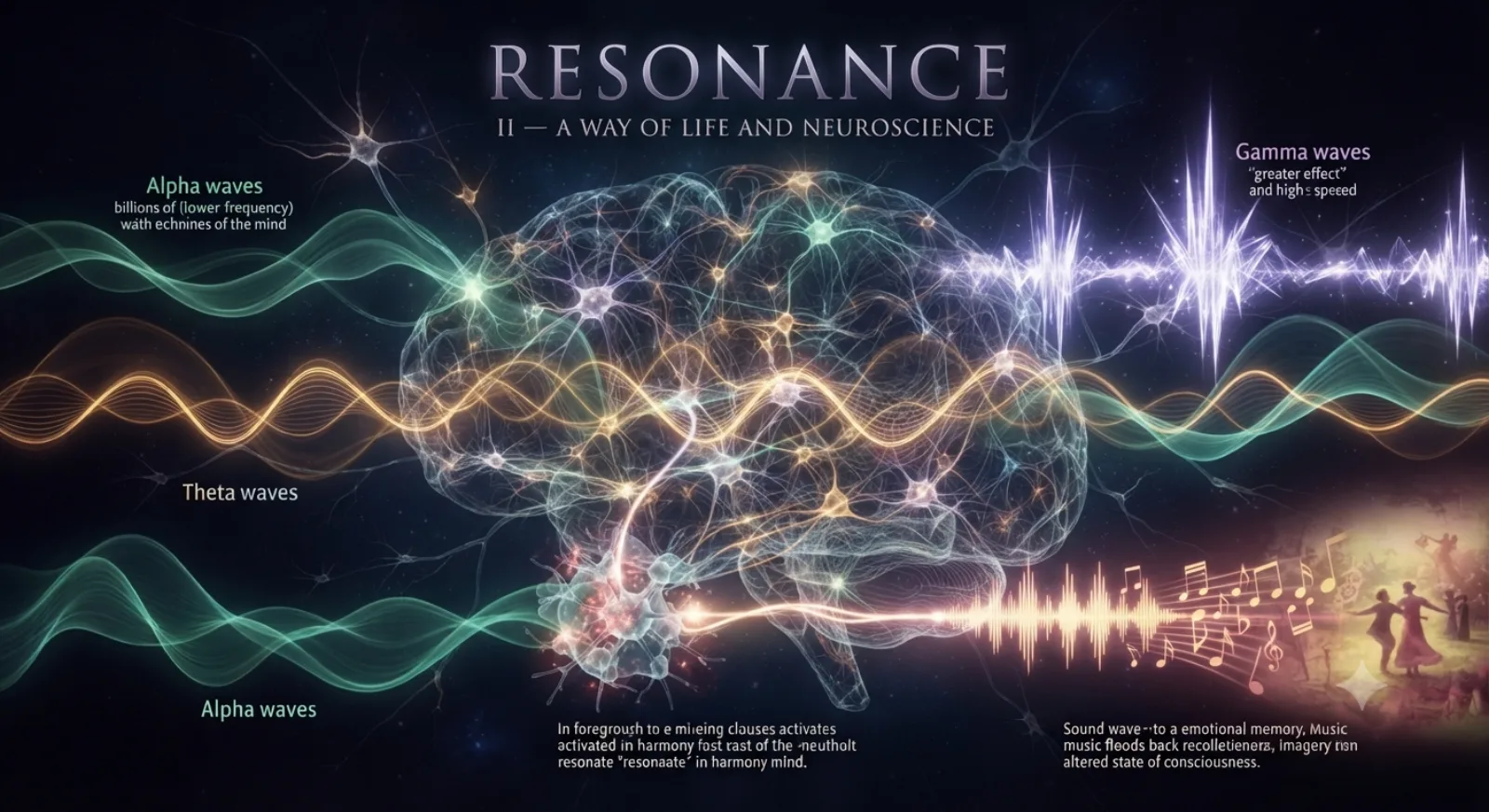
Resting deep within the darkest confines of our brain there is a network of the mind, which possesses in excess of a hundred billion neurons, and these electrically charged cells constantly send and receive a vast array of both chemical and electrical pulses and signals in their vibrations.
These waves can oscillate at different frequencies, waves with the addition of time, and the greater the frequency, the greater the effect they have upon our beings. The different frequencies are measured as alpha, theta, and gamma. Each of the brain waves travelling through our minds has particular tasks that they assign to the brain cells to address and deal with. The different frequencies allow the appropriate cells to tune into their corresponding wavelength, just at the common radio tunes in to the frequency and channel desired and ignores the other frequencies. And just like the radio when it is clear without distortion, so do the cells and their corresponding frequencies become synchronised and in harmony together all; they resonate together. They are each filled with sound and in turn, vibrate with sound. This evolutionary process of adapting our beings to the most propitious avenues of life ensures the greatness of our well-being.
The neurons are alive and forever changing their power. They can be become stronger or weaker in their voltage of energy as the ions, charged molecules or atoms, passing through the neuron communicate. If there is enough potency of power within the cell, it will fire off in directions to connect with other cells, and as it does so, information is carried across, and this interchange of energy at the resonant level begins the engine of charging and changing other cells, and so begins the process of altering our states of consciousness of the moment, or of the now. Science can detect when many of these neurons are firing with energy at the same time as a wave, an oscillation carrying energy through a mass or space.
Many of us are completely unaware of this resonant frenzy in our daily existences in life. And in our lives, different experiences, different thoughts and feelings can excite the neurons to attach and behave in particular ways. Consider, for example, how you can be doing something totally innocuous, and you hear a piece of music, which almost instantaneously changes your mood from one state to another: whether one from indifference to being spirited, or from joy to poignancy as recollections and feelings flood back. The neurons respond with speeds unfathomably faster than that of light, and this new frenzy of neurons brings upon us altered states of consciousness.
Prefer to listen? Watch the video reading below.
Reader Comments
Leave a Comment
We would love to hear your thoughts on this chapter.
About Karl Swainston
Karl Swainston is a writer and storyteller whose work is forged from a life lived across the North of England and far beyond. Growing up on a Leeds council estate in the 1960s, Karl's journey was anything but linear. By the age of thirty, he had already lived a dozen lives: from the rigors of grammar school to a degree in Latin, a stint as a fishmonger, a period of discovery living in Marseille, and a return to the hustle of London. Whether working as a postman, a builder, or competing as a county-level chess player, he was, above all, an avid reader—constantly documenting the world around him. This restless spirit continued into his professional life. Karl later taught in Bradford, where he ran a specialist unit for 244 of the most excluded students from across the region—young people whom even the local Pupil Referral Units could not accommodate. Working alongside his old friend Malcolm, Karl spent his days navigating the volatility of Bradford's most aggressive and dysfunctional teenagers. Throughout his life, Karl has been an avid runner and has always shared his home with a rotating cast of beloved dogs and cats—companions who have been constant witnesses to his work. As a writer, Karl's range is as expansive as his history. He works across a wide breadth of genres, including fiction and short stories, autobiography and memoir, biography, non-fiction, and metaphysical writing, as well as providing sharp commentary, opinion, analysis, and essays. Whether writing about his years managing the Harrogate Arms or offering insights from his current adopted home in South East India, where he lives in a simple village with his dog, Bambi, Karl's voice reflects the full, untidy, and deeply human breadth of life. He continues to draw on the rich, decades-long tapestry of his experiences to tell stories that matter, proving that no matter where you live, the human story remains the same.
Author Page