Resonance
I — The Power of Resonance
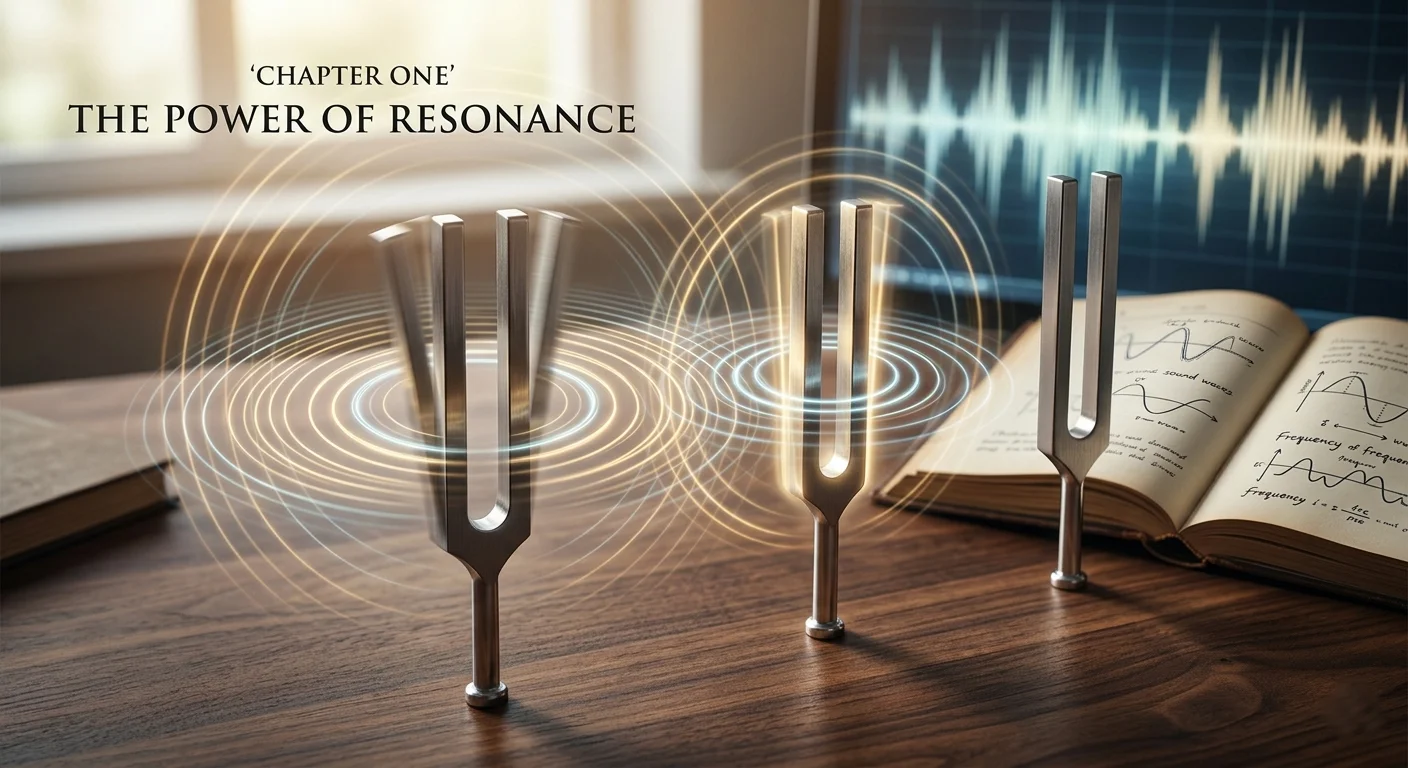
Resonance is the endeavourment of the human mind and spirit to understand how the smallest and most significant particles of our beings shape our life and make our existence what it is.
Imagine sitting upon a hotel balcony in the heart of a Spanish city upon a fine, hot afternoon in the month of July. You are three floors up, and you can hear the buzz and hubbub of Spanish life, but there is nothing particular to strike upon the ear and arrest the mind.
And then.
Bang.
What do you think?
The sound emanated from a drum. It took less than a fleeting second to reach your ears, enter your being, arrest your present state of mind, and bring upon you another state of mind - for however long. For the briefest of seconds through to minutes, your consciousness changed from one reality to another reality brought about by an external factor.
The vibrational energy of the drumbeat traveled with extraordinary speed and had the ability to penetrate beyond the fullness of life in the Spanish city and enter into the very heart and soul of your being.
There is nothing extraordinary in this; it happens all the time. What is extraordinary is the ability of energy vibration to pass from one creative expression: the drum, and enter into another creative force: the mind and its thoughts within the single passing of a second. The vibrational energy force is a fundamental, unseen power. We can measure the force, amplitude, and radiance of energy, but we have yet not the science to fully comprehend how the particles of vibrating energy affect our beings, and how our beings are affected by the energy - let alone how the powers of attraction can alter our lives and change every - nay all aspects - of who we are and what we are.
And it is not only sound that can physically, mentally, and emotionally change the way we think. Thought alone can possess the power to do this. The celebrated Masaru Emoto composed a series of experiments with water, whereby he filled different containers with the same water. He then labelled each of the containers with different thoughts: ‘love, peace, hate, war’ etc. The water was then subjected to points of freezing, and their crystal formations were microscopically viewed. Aesthetic formations arose out of the ‘peaceful’ containers, whilst ugly and disfigured formations emerged from the ‘hateful’ containers. If thought alone can alter the aesthetic and ugly states of water, what can it do to us, who are composed of no less than 60% of water?
What Emoto’s experiment reveals to us is that there is a power which is infinitesimally small in and around our lives: a world at the core level of existence that we are not yet conscious of and do not understand. This journey is a path through to this world, revealing how we can become conscious of ourselves at the most fundamental level, and how, having harnessed an understanding of these forces, we can alter our lives and bring upon us a whole new life of living.
Between neuroscience, the dimensions of the metaphysical realm, and the philosophies and religious beliefs abundant in life, there is an unalienable inter-connection that binds them all to the universe and its ungovernable laws. And within our minds, at this core level, we can begin to understand how this connection can work for us and give to us the ability to control the interconnection in a positive way. In order for us to begin to understand ourselves, our true selves, it is necessary to journey through the core matter of the mind; by doing so, we can possess the beauty of truth which is ourselves.
Prefer to listen? Watch the video reading below.
Reader Comments
Leave a Comment
We would love to hear your thoughts on this chapter.

About Karl Swainston
Karl Swainston is a writer and storyteller whose work is forged from a life lived across the North of England and far beyond. Growing up on a Leeds council estate in the 1960s, Karl's journey was anything but linear. By the age of thirty, he had already lived a dozen lives: from the rigors of grammar school to a degree in Latin, a stint as a fishmonger, a period of discovery living in Marseille, and a return to the hustle of London. Whether working as a postman, a builder, or competing as a county-level chess player, he was, above all, an avid reader—constantly documenting the world around him. This restless spirit continued into his professional life. Karl later taught in Bradford, where he ran a specialist unit for 244 of the most excluded students from across the region—young people whom even the local Pupil Referral Units could not accommodate. Working alongside his old friend Malcolm, Karl spent his days navigating the volatility of Bradford's most aggressive and dysfunctional teenagers. Throughout his life, Karl has been an avid runner and has always shared his home with a rotating cast of beloved dogs and cats—companions who have been constant witnesses to his work. As a writer, Karl's range is as expansive as his history. He works across a wide breadth of genres, including fiction and short stories, autobiography and memoir, biography, non-fiction, and metaphysical writing, as well as providing sharp commentary, opinion, analysis, and essays. Whether writing about his years managing the Harrogate Arms or offering insights from his current adopted home in South East India, where he lives in a simple village with his dog, Bambi, Karl's voice reflects the full, untidy, and deeply human breadth of life. He continues to draw on the rich, decades-long tapestry of his experiences to tell stories that matter, proving that no matter where you live, the human story remains the same.
Author Page