Resonance
III — Neuroplasticity and the Grieving Mother
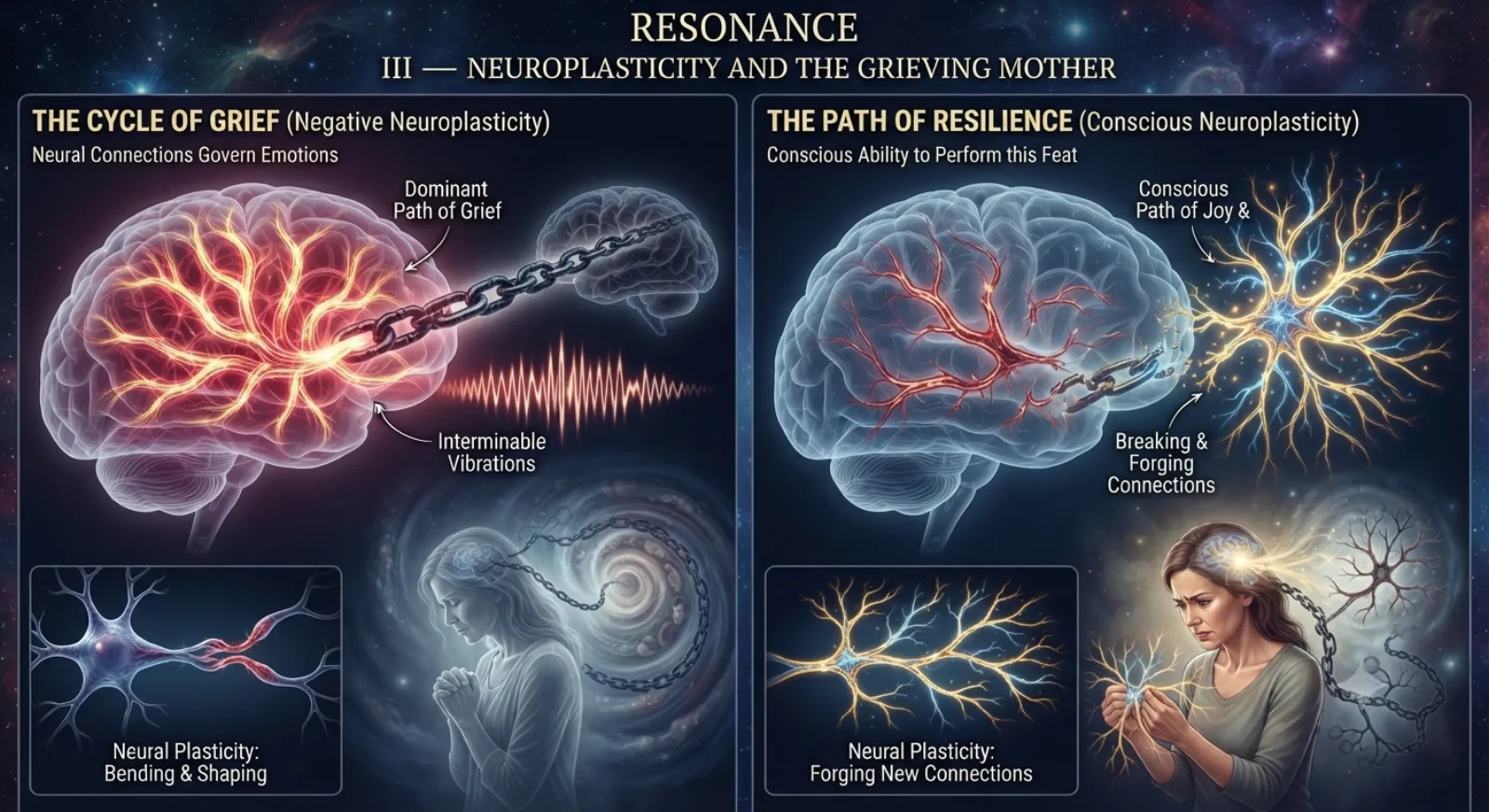
In the exercise of this process, certain neural connections can become stronger while other attachments become weaker, and this is why when we feel bad, say, the neural connections are exercised in that particular field, and they are exercised to such an extent that the connection can flare up at any time as of its own free will and take us from joy to sadness in the passing of a second. In extreme cases such as a mother grieving over the loss of her child, the neural connections are that strong with interminable vibrations that they do not let the attachment break, and the woman must suffer all the pain of her grief. Science calls this new neuron, or nerve cell attachment and activity neural-plasticity. At the resonant level, the cells are able to bend, shape and form new connections, and those connections now govern the grieving mother's emotions.
Now while some will say it necessary for the mother to feel and taste the grief over the loss of her child, it is also a fact that the mother has entered into a new state of consciousness, whereby the new neuron connections reign within her being. But let us move somewhat away from this example, and take the mother's sadness to be that of any kind of sadness, and the more we allow the resonant matter within our minds to concentrate upon that sadness, the attraction of greater sadness will come to call, even at times when we deem the calling to be most unpleasant. Imagine what life would be like were we able to control such unruly visitations, and rather than exercising negative neural connections, we could exercise their contrary, and bring positive, upbeat connections and networks within our mind, and then we really would feel a sense of completeness and contentedness and even of happiness. Neuroplasticity is a double-edged sword whose neural activity cuts both ways: in this case of sadness and of happiness. But as with all exercise, - and exercising the resonant matter of the mind is no different from exercising one's arms or legs – the more we exercise, the stronger the cells and limbs become. Whatever we are doing in any second of the day, any hour in the day, the resonant mechanics of our mind is modifying itself, so that it may adjust to the challenges it has to face. The mind is flexible and can change; your mind is flexible and possesses the plasticity to be altered only upon the positive.
Resonant attraction at an intensely personal level is the ability to forge desired and happy connections and to loosen, break, and snap the bonds and the ghosts of our past negative connections. When we are resilient, strong, and possess the fortitude of mind, we can be conscious of our ability to perform this feat; we have to hold an unbounded faith in our gift to do this, and by so doing, we will achieve complete mastery of our beings. This new consciousness, this new ability to create connections can enrich our lives in their present existence.
Prefer to listen? Watch the video reading below.
Reader Comments
Leave a Comment
We would love to hear your thoughts on this chapter.
About Karl Swainston
Karl Swainston is a writer and storyteller whose work is forged from a life lived across the North of England and far beyond. Growing up on a Leeds council estate in the 1960s, Karl's journey was anything but linear. By the age of thirty, he had already lived a dozen lives: from the rigors of grammar school to a degree in Latin, a stint as a fishmonger, a period of discovery living in Marseille, and a return to the hustle of London. Whether working as a postman, a builder, or competing as a county-level chess player, he was, above all, an avid reader—constantly documenting the world around him. This restless spirit continued into his professional life. Karl later taught in Bradford, where he ran a specialist unit for 244 of the most excluded students from across the region—young people whom even the local Pupil Referral Units could not accommodate. Working alongside his old friend Malcolm, Karl spent his days navigating the volatility of Bradford's most aggressive and dysfunctional teenagers. Throughout his life, Karl has been an avid runner and has always shared his home with a rotating cast of beloved dogs and cats—companions who have been constant witnesses to his work. As a writer, Karl's range is as expansive as his history. He works across a wide breadth of genres, including fiction and short stories, autobiography and memoir, biography, non-fiction, and metaphysical writing, as well as providing sharp commentary, opinion, analysis, and essays. Whether writing about his years managing the Harrogate Arms or offering insights from his current adopted home in South East India, where he lives in a simple village with his dog, Bambi, Karl's voice reflects the full, untidy, and deeply human breadth of life. He continues to draw on the rich, decades-long tapestry of his experiences to tell stories that matter, proving that no matter where you live, the human story remains the same.
Author Page