The Duke of Atlantica
Chapter II — The Garden of Shadows
← Jackie Hilloughby / The Duke of Atlantica
The following spring, London seemed to Edward a different city.
It was not that anything had changed. The same hansom cabs rattled over the same stones; the same politicians made the same promises; the same ladies walked through Hyde Park beneath the same parasols while their husbands read newspapers and pretended not to watch them.
Yet Edward had changed.
He had begun to live for the hours in which he could cease to be a duke.
With Lily he was simply Edward.
That transformation was intoxicating.
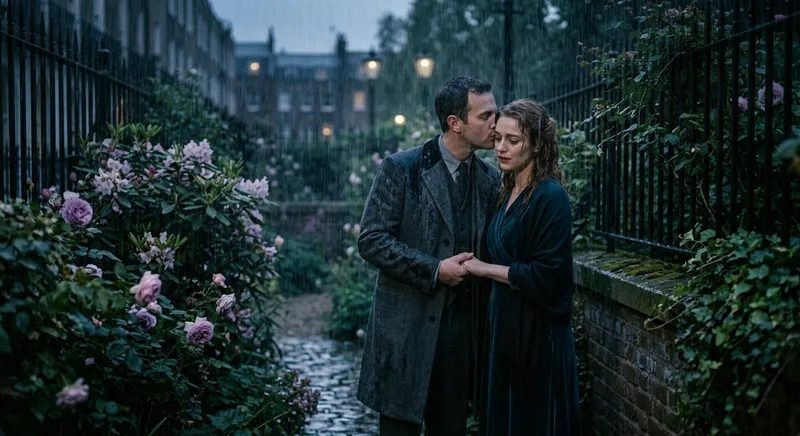
They met secretly in gardens, drawing rooms and quiet restaurants where nobody was likely to recognise them. Sometimes they spoke for hours. At other times they sat together without speaking, enjoying the strange intimacy of two people who had discovered that silence could be more revealing than confession.
Lily never asked him to leave his wife.
She never asked him for money.
She never demanded promises.
This made Edward love her more.
Or believe that he did.
The distinction would later become important.
“You should go away,” Lily told him one evening.
“Where?”
“Anywhere.”
“With you?”
She looked at him.
“No.”
The answer wounded him.
“Why?”
“Because if we went away together, you would eventually remember who you are.”
“And who am I?”
“A duke.”
“I am a man.”
“For a little while,” she said.
He took her hand.
“Then let me have the little while.”
She allowed him to hold it.
That was their first kiss.
Afterwards Lily wept.
Edward, frightened by the sight, asked her what was wrong.
“Nothing,” she said.
But it was not nothing.
She knew what Edward did not yet understand: that their happiness depended upon a lie.
Edward believed the lie could be maintained indefinitely.
That was his second act of hubris.
At Atlantica House, meanwhile, Lady Helena had begun to notice changes.
Edward was absent more frequently. He had acquired habits of distraction. Letters arrived which he concealed. He sometimes returned home with rain upon his coat when there had been no rain in the district through which he had travelled.
She did not accuse him.
Lady Helena had been raised to believe that dignity consisted partly in suffering without making other people uncomfortable.
One afternoon she entered his library and found a theatre programme upon his desk.
She read the name.
Lily.
She placed the programme exactly where she had found it.
Then she sat by the window.
For the first time in seven years, she allowed herself to consider that her marriage might not be what she had believed it to be.
Meanwhile, Edward's attachment deepened into obsession.
He began to imagine a future with Lily.
Not a practical future.
An impossible one.
He pictured himself abandoning society, leaving London and living somewhere abroad where nobody knew his title. He imagined that he and Lily might begin again.
He never asked whether Lily wanted such a life.
He had begun to confuse his desire with destiny.
One night he told her that he loved her.
Lily closed her eyes.
“Don't say that.”
“Why?”
“Because once you say it, it becomes something that must be answered.”
“I am answering it.”
“No, Edward. You are declaring it.”
“What is the difference?”
“Everything.”
He took a step towards her.
“I would give up everything for you.”
Lily looked at him with an expression of such sadness that he almost recoiled.
“You say that because you have never had to give it up.”
He became angry.
“You think I am incapable of sacrifice?”
“I think you have mistaken desire for courage.”
He left.
For three weeks they did not meet.
Then Edward received a letter.
He returned to her.
Neither apologised.
That was how the affair continued.
The secret grew.
And with it grew the danger.
A gentleman called Lord Ashcombe had begun to take an interest in Lily. He was younger than Edward, unmarried and possessed of none of the Duke's restraints.
Edward despised him.
“You are jealous,” Lily said.
“I am concerned.”
“You are jealous.”
“I have every right.”
“No.”
Edward stared at her.
She smiled sadly.
“That is the tragedy of us, Edward. You think love gives you rights.”
He said nothing.
That night he kissed her farewell.
Neither of them knew it would be the last peaceful evening they would share.

About Jackie Hilloughby
Jackie Hilloughby lives in the Worcestershire countryside with her husband and two children. She has been writing for over fifteen years and has a particular love of Victorian fiction, its drawing rooms, its secrets, and the quiet tragedies that unfold behind closed doors. Her work explores the tension between duty and desire, the weight of inheritance, and the cost of a life lived according to other people's expectations. The Duke of Atlantica was her first novella for Tales From A Harrogate Caravan; The Duke of Rutland is her second.
Author Page
Reader Comments
Leave a Comment or a Book Review
We would love to hear your thoughts on this chapter, or even a complete book review.