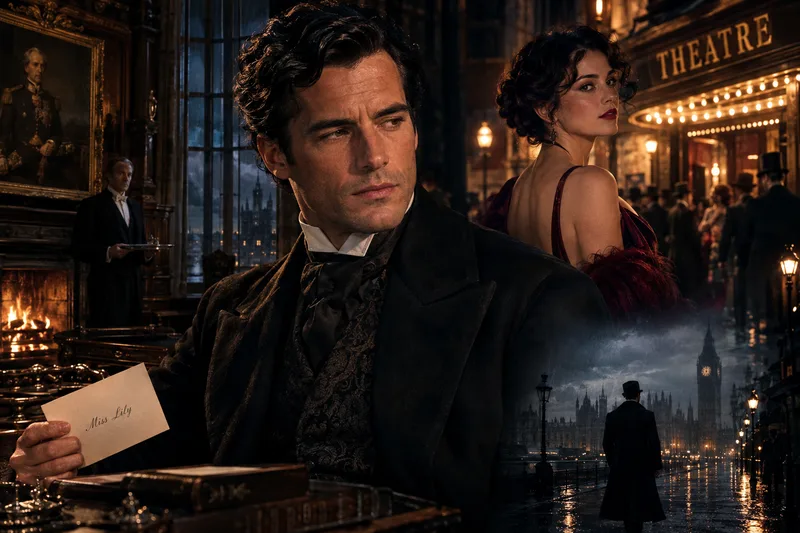
The Duke of Atlantica
Chapter I — The House of Atlantica
← Jackie Hilloughby / The Duke of Atlantica
There are families which appear to have been created by Providence for the particular purpose of demonstrating to the rest of mankind the advantages of good breeding, inherited wealth and an almost supernatural capacity for concealing misery. The Rovers of Atlantica belonged to this distinguished class. For more than two centuries their name had stood upon deeds, monuments, parliamentary records and the brass plates of gentlemen who had been buried with considerably more dignity than happiness. They possessed land in three counties, a London residence large enough to require a map, a portrait gallery filled with ancestors who looked as though they had never laughed in their lives, and, above all, the ancient title of Duke of Atlantica.
The present holder of that title was Edward Rover, a man of thirty-eight years, handsome in the severe fashion which becomes a gentleman accustomed to being painted, photographed and observed, and possessed of that particular melancholy which is sometimes mistaken for wisdom. He had inherited the dukedom when his elder brother died unexpectedly abroad, and with it the enormous obligations which the dead so conveniently leave to the living. From the moment the coronet descended upon his head, Edward had been told what he must preserve, what he must protect, what he must marry, where he must appear, whom he must receive and, above all, what he must never do.
He had obeyed.
That, perhaps, was the beginning of his trouble.
For seven years he had been married to Lady Helena, daughter of the Earl of Wexborough, a woman whose virtues were so numerous that even her enemies were forced to admit them. She was dignified, charitable, composed and unfailingly correct. She had never raised her voice to Edward, never embarrassed him at dinner, never appeared in public improperly dressed and never, so far as he could remember, had she once asked him what he actually wanted from life.
Their marriage was therefore considered a success.
The Duke himself was less certain.
On a November evening in 1878, he stood before the great windows of his library in Grosvenor Square, watching the rain descend upon London. Behind him burned a fire of enormous logs. Around him stood books which had been purchased by men who had died before reading them. Above the mantel hung a portrait of his grandfather, the fifth Duke, whose painted eyes seemed to follow Edward wherever he went.
His secretary, Mr Bellweather, entered carrying a silver salver.
“Your Grace, the invitations for next week.”
Edward did not turn.
“Leave them.”
“There is also a note from Lady Wexborough.”
“Leave that too.”
“And a message from the theatre.”
Edward turned at last.
“The theatre?”
“Yes, Your Grace.”
Bellweather placed the envelope upon the desk.
Edward looked at it without touching it.
“From whom?”
“Miss Lily.”
There are moments in the life of a man which, examined afterwards, appear to have contained the whole of his future. At the time, however, they seem insignificant. A hand upon a door. A letter upon a desk. A name spoken by a servant. A glance which lasts no more than a second.
Edward opened the envelope.
Miss Lily thanked His Grace for his attendance at the theatre and hoped that he had enjoyed the performance.
It was a perfectly innocent note.
Edward read it three times.
“Who is she?” he asked.
Bellweather, who had the irritating habit of knowing rather more than he said, replied, “Miss Lily is an actress, Your Grace.”
“I know that.”
“She is very celebrated.”
Edward looked again at the note.
“Is she?”
“Indeed.”
“What sort of woman is she?”
Bellweather paused.
“The sort of woman about whom everybody has an opinion.”
Edward smiled faintly.
“Then she must be interesting.”
Bellweather did not smile.
That evening the Duke attended a dinner at the Wexborough residence. Lady Helena sat opposite him at the long table beneath a chandelier of Venetian glass. Around them were men discussing Parliament and women discussing other women, all of them performing the intricate social dance by which the upper classes concealed their private thoughts from one another.
Edward participated when required.
He answered questions. He laughed at the proper moments. He listened to Lord Wexborough's account of a dispute concerning railway shares. Yet throughout the dinner, beneath all this outward obedience, there remained another image: Lily standing beneath the theatre lights.
He had seen beautiful women before. London contained hundreds. But beauty was not what had disturbed him.
It was vitality.
She had appeared to possess something which he had somehow misplaced during the years between his youth and his dukedom.
When he returned home, Lady Helena was already asleep.
Edward stood for some time outside her bedroom door.
Then he went downstairs and wrote a letter.
He did not send it.
He burned it.
The next evening he attended the theatre again.
Lily saw him.
Their acquaintance began.
It progressed with that deceptive gentleness by which the greatest disasters enter respectable houses. First came conversation. Then friendship. Then confidences which ought never to have been exchanged. Edward discovered that Lily was not merely beautiful but intelligent, observant and possessed of a fierce independence which both attracted and frightened him.
She, in turn, discovered that beneath the Duke's dignity was a man profoundly tired of being the Duke.
One night, after the performance, they walked together through the darkened theatre.
“You have everything,” Lily said.
Edward laughed.
“That is precisely the difficulty.”
She looked at him.
“No. The difficulty is that you have been taught to believe everything belongs to you.”
The words struck him.
“You think me arrogant?”
“I think you are a duke.”
“That is not an answer.”
“It is the only answer that matters.”
He stopped.
She continued towards the stage door, then turned.
“Goodnight, Your Grace.”
“Lily.”
She waited.
“Will I see you again?”
“You are the Duke of Atlantica,” she said. “You generally obtain what you desire.”
Then she disappeared into the night.
Edward remained where he was.
He had been warned.
He simply believed that warnings applied to other men.
That was his first act of hubris.

About Jackie Hilloughby
Jackie Hilloughby lives in the Worcestershire countryside with her husband and two children. She has been writing for over fifteen years and has a particular love of Victorian fiction, its drawing rooms, its secrets, and the quiet tragedies that unfold behind closed doors. Her work explores the tension between duty and desire, the weight of inheritance, and the cost of a life lived according to other people's expectations. The Duke of Atlantica was her first novella for Tales From A Harrogate Caravan; The Duke of Rutland is her second.
Author Page
Reader Comments
Leave a Comment or a Book Review
We would love to hear your thoughts on this chapter, or even a complete book review.