The Anchored Dead
Chapter 13: The Salt in the Well
← Terry Farland / The Anchored Dead
Arthur dropped the plate onto the padded workbench with a sharp gasped curse. He wiped his thumb frantically against his wool trousers, but the skin where the brine had touched was already numb, turned a dull, chalky white like frostbite.
He slammed the brass bolt of the darkroom door shut, leaning his back against the timber, his chest heaving.
From inside the darkroom, behind the thin wooden panel, came a sound that made his stomach drop.
It was not knocking, nor the scraping of iron chains. It was the soft, rhythmic sound of liquid dripping onto stone—a steady, relentless drip, drip, drip that seemed to be accelerating, growing heavier with every passing second.
Arthur ran out of the shop into the freezing alley of Grape Lane, heading straight for the harbor side where Caleb Ward kept his night watch in the coastguard station.
He found the old constable sitting by a cast-iron stove, cleaning the lock of his service carbine. Caleb looked up, seeing the terror in Arthur's face and the pale, dead-white stain on his thumb.
"It’s not over," Arthur gasped, leaning against the doorframe to steady himself. "The plate... the varnish won't hold it. The heat of the lamp made the water rise out of the silver."
Caleb set his oiling rag down, his expression hardening. "Show me."
They hurried back through the dark alleys to Arthur’s workshop. When Arthur unlocked the outer door, a layer of gray water two inches deep rolled out over the threshold, spilling into the stone gutter of Grape Lane.
Caleb stepped into the shop, holding his lantern high. The floorboards were covered in a film of thick sea-silt. But what drew Caleb's attention was the water itself. It was flowing out from beneath the darkroom door, not in a stagnant pool, but in a steady, pulsing stream, as if a spring had broken through the floorboards.
"The foundations of these old shops rest on the river shale," Caleb said, his voice grim. "If sea water is coming up through the darkroom floor, it means the tide is forcing its way through the old coal seams beneath the harbor."
Arthur unlocked the darkroom door and pushed it open.
The small pantry was half-flooded. The ceramic chemical trays on the workbench were overflowing with clear, icy brine. Sitting in the middle of the bench, completely submerged in three inches of salt water, was the glass plate.
The silver emulsion had not dissolved. Instead, the image on the glass had expanded.
The dark outlines of the Dolphin were no longer contained within the nine-by-seven-inch pane. The black lines of the spars, the rigging, and the anchor chain seemed to extend outward from the edges of the glass, projected into the water that covered the bench like dark, ink-like tendrils spreading through clear gelatine.
"It’s using the water as the medium now," Arthur realized, his voice trembling. "The glass was just the seed. If this water reaches the harbor..."
"It connects back to the sea," Caleb finished, his eyes wide. "And the anchor drops again."
Caleb reached down into his coat pocket and pulled out a heavy iron hammer he used for fixing line-cleats. "Break the glass, Arthur. Shatter it to dust."
"No!" Arthur cried out, grabbing Caleb’s wrist. "If you smash the glass while the silver is wet, you don't destroy the image—you scatter it! Every single fragment of glass will hold a piece of the conduit. We'd have a hundred portals instead of one!"
Caleb lowered the hammer, his knuckles white. "Then how do we destroy what isn't fully in this world?"
Arthur looked at the overflowing tray, then at the satchel containing his chemical bottles. "We don't destroy it with force. We fix it permanently. We have to take the plate back to where the silver was first exposed—to the deep water off the Bay Scars—and seal it beneath the shale before the spring tide turns at midnight."
About Terry Farland
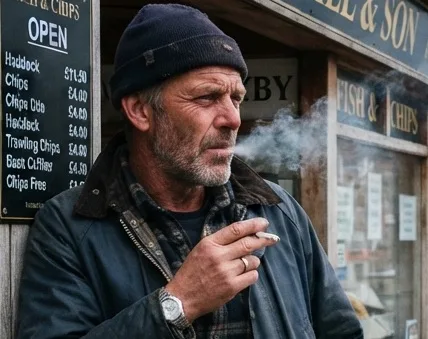
Terry Farland writes gothic fiction set on the North Sea coast. His work draws on the photography, fishing and folklore of Yorkshire's coastal villages, and the uneasy line between what the camera records and what the sea returns. The Anchored Dead is his first novel for Tales From A Harrogate Caravan.
Author Page
Reader Comments
Leave a Comment or a Book Review
We would love to hear your thoughts on this chapter, or even a complete book review.