We Are All Vampires
IV — The Lustful Vampire - Sandra (Part 1)
← Karl Swainston / We Are All Vampires
Sandra was a mystery of a woman. She could be utterly charming, expressive, and expansive one moment but very dark and completely introverted the next.
She didn’t seem to tick like the rest of the human population but like an engine without a heart, beating a pulse of mechanical movement.
She was in her early thirties, had a fine figure and chose clothes which showed her body to full advantage.
Sandra was an extremely successful saleswoman for a national printing firm and had held the job for over ten years.
The company let her alone, and she let the company benefit from her skills in sales.
The more independence the company gave Sandra, the more trade and business she generated for them.
Her job took her across the length and breadth of the country; there were few places she had yet to visit.
Sandra was married, but the marriage was utterly loveless and merely accommodated her ‘dark’ lifestyle.
Her husband, Clive, was an extremely mild-mannered man who existed in his own world.
Sandra had selected Clive as the ideal husband to complement her ‘dark’ lifestyle.
Aged 25, Sandra’s parents constantly questioned their daughter about her relationships and asked whether she would get married and have a family.
Sandra’s parents were both teachers and both nearing the age of retirement.
They doted unreservedly upon their only daughter and harboured great hopes that Sandra would marry, have children, and they’d become happy, loving grandparents.
The thought of having children, though, repulsed her very mind. The very idea of giving birth to another almost made her physically sick.
Through various stratagems, she managed to keep this revulsion from her parents.
Still, in the end, their attack became incessant, and the only way to ensure her lifestyle and accommodate her parents’ hopes was to get married.
‘But to whom?’ she struggled.
Sandra had never had a ‘normal’ relationship with a man.
She had had countless sexual encounters but had no desire to enter into a relationship, let alone fall into love, a concept she held in utmost contempt.
On one of her visits to Manchester, she called at a small family-owned banner and poster manufacturing firm.
Clive, son of deceased Emily and Frank, ran the company.
He administered to clinical precision the running of the business; for every decision he made, he would think of a general conducting his army in battle.
However, he always looked after his staff and was always fair in any concerns of theirs.
This business-quality made his trade successful; Clive was an independently wealthy man at thirty-four.
Clive’s personal life mirrored the mathematical manner in which he ran his business.
He woke at 5.30am every morning, except on Sunday, when he rose at 5.45am.
He would fastidiously dress and preen himself, address domestic issues, and then set off to work to run his business with meticulous attention.
This complete mechanical lifestyle excluded any notion of love, although it did not crush such a desire either; it merely set it aside as not being as important as other more pressing matters.
Even up to his thirty-fourth year, he had never had a whole relationship with a woman.
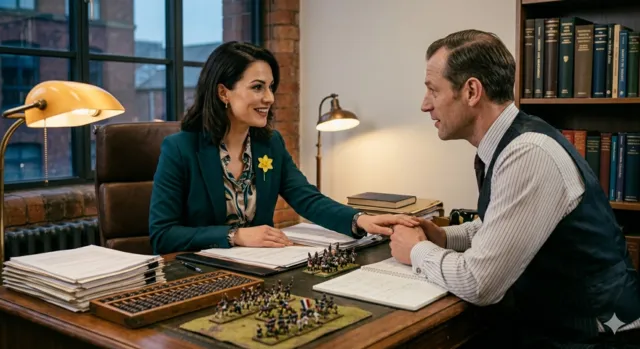
In his early twenties, he had had a couple of brief encounters, but they came to nothing, and he simply gave up the desire for the opposite sex and plunged himself ever deeper into his work and his hobby of war games.
It was at this time he met Sandra.
From the moment Sandra met Clive, she knew he was the man she would marry; she instinctively knew that he would allow her to maintain her present ‘dark’ lifestyle whilst giving her parents the hope of fulfilling their desire for grandchildren and happy retirement.
‘Hello, my name’s Sandra from a national printing firm, and by the manner of your smile, you must be Clive.’
Sandra held out her hand, accompanied by a smile with so much candour and charisma that Clive could not resist being warmed by the address of the woman in front of him.
‘Please, Sandra, proceed this way, and I will immediately order some refreshments, and you can tell me how I can help you.’
The pair then disappeared into Clive’s office.
They remained there for over two hours; in those two hours, Sandra had quickly concluded her business affairs and secured, without much objection, a contract from Clive’s firm.
Sandra had then set about eliciting all manner of information from Clive: his interests, especially his passion for war games and his eternal pursuit of creating a mathematical formula that could equal Einstein’s E=mc².
Sandra mustered every conceivable and reserved ounce of mental and physical energy to remain interested in what Clive’s life was immersed in.
At the end of the meeting, Clive, being somewhat intoxicated by the narration of his autobiography to Sandra and emboldened, too, asked Sandra whether she would like to have lunch with him.
Her tactic was to say, ‘Yes,’ but she faltered and felt she couldn’t take another two hours of his autobiography and replied, ‘I would much prefer to have dinner tonight with you, Clive, if that’s fine by you?’ and she touched the top of his hand ever so gently.
Clive became somewhat overwhelmed and stammered back, ‘Of course, Sandra. Yes! Of course!’
They agreed to meet at 7pm at a select Manchester restaurant.
Prefer to listen? Watch the video reading below.
Reader Comments
Leave a Comment
We would love to hear your thoughts on this chapter.

About Karl Swainston
Karl Swainston is a writer and storyteller whose work is forged from a life lived across the North of England and far beyond. Growing up on a Leeds council estate in the 1960s, Karl's journey was anything but linear. By the age of thirty, he had already lived a dozen lives: from the rigors of grammar school to a degree in Latin, a stint as a fishmonger, a period of discovery living in Marseille, and a return to the hustle of London. Whether working as a postman, a builder, or competing as a county-level chess player, he was, above all, an avid reader—constantly documenting the world around him. This restless spirit continued into his professional life. Karl later taught in Bradford, where he ran a specialist unit for 244 of the most excluded students from across the region—young people whom even the local Pupil Referral Units could not accommodate. Working alongside his old friend Malcolm, Karl spent his days navigating the volatility of Bradford's most aggressive and dysfunctional teenagers. Throughout his life, Karl has been an avid runner and has always shared his home with a rotating cast of beloved dogs and cats—companions who have been constant witnesses to his work. As a writer, Karl's range is as expansive as his history. He works across a wide breadth of genres, including fiction and short stories, autobiography and memoir, biography, non-fiction, and metaphysical writing, as well as providing sharp commentary, opinion, analysis, and essays. Whether writing about his years managing the Harrogate Arms or offering insights from his current adopted home in South East India, where he lives in a simple village with his dog, Bambi, Karl's voice reflects the full, untidy, and deeply human breadth of life. He continues to draw on the rich, decades-long tapestry of his experiences to tell stories that matter, proving that no matter where you live, the human story remains the same.
Author Page