Tales From A Harrogate Caravan
Chapter 22 — The Wrong Turn to London
← Karl Swainston / Tales From A Harrogate Caravan
It wasn't just in Leeds we played chess. The Saturday League was every other Saturday, and on the Saturday you weren't playing, you were travelling the length and breadth of Britain playing in tournaments in the hope of beating a 200+ grade player, and the chance of winning some money as well. In the end, though, I only entered the Open tournaments, as I relished the prospect of beating a good player, and found the lower tournaments too depressing when you didn't win anything.
To those who don't play chess, or are not familiar with the structure of a tournament, I think it proper to say a few words. A weekend chess tournament generally started at 7pm on a Friday night and finished at 11pm. The following day would start at 9am and finish either at 7pm or 11pm. Sunday started at 9am and finished around 7pm.
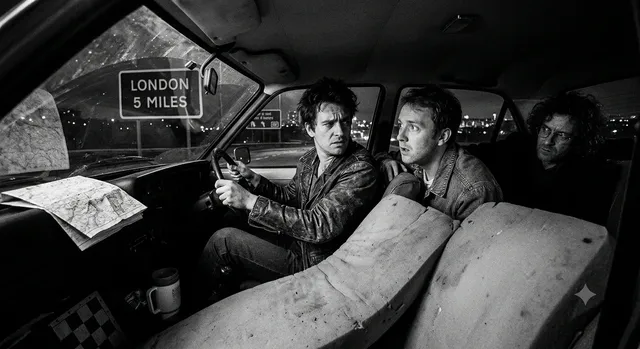
On Fridays I'd wait for John to turn up in his old, yellow Vauxhall Viva to go to some tournament or other. Sometimes there'd be Pete, or Steve, but more often than not it was only John and I. We'd taken out the passenger seat, and in its place there was a single, long piece of foam, and we'd take it in turns to have a sleep whilst the other one drove.
In the early days we'd either camp out near a venue or simply doss it out in some supermarket car park if money was tight. But when we started working in London, John bought the most abused caravan you could ever imagine, and that was when the Doctor came with us to Swansea.
People tell me you must be intellectual if you play chess? Bullshit. There were three chess players in the Viva that day, and all we had to do was to drive down the M6 and M5, and we'd be in Wales and Swansea just in time for the opening game.
I'd driven over the Pennines on the M62, and when we got to the M6, I'd swapped with John and decided to get my head down for an hour. The Doctor was in the back complaining that he should be allowed to have a lie down.
'You don't drive, Billy, so don't bother asking,' stated John.
Bennie mentioned earlier about the skill of being able to play blindfold chess: that is without pieces and a chess board in front of you: the only accoutrement being your mind. I once played fifteen games simultaneously at Pudsey Chess Club blindfold. I lost most, but I was still proud of my achievement.
The reason I mention blindfold chess is because that's what John and the Doctor started to do when I fell asleep. We always passed the time in the car playing blindfold chess driving to venues across the country.
I must have been asleep for a good hour or so because when I stirred, it was already dark. The Doctor and John were still playing, but were arguing viciously too – which was quite usual – about whether the pawn was on b6 or b7, or some such point.
I never bothered to get involved when they were arguing, and I sat up and started to look out of the window as the Viva went flinging it down the motorway with the poor caravan rattling behind, looking as though it was about to disintegrate.
'London: 10 miles,' said a sign.
I'd still not fully woken up. London: 10 miles? I thought. I knew Swansea was in Wales, but didn't know London was only ten miles away from Wales. I said nothing and continued to gaze out of the window into the darkness.
'London: 7 miles.'
'What the fuck! John, there's a sign back there that said we're only seven miles from London!'
'It can't be. We're in Wales.'
They stopped arguing at this point, and we all sat quiet in the car thinking as the Viva sped on with her poor caravan in tow.
London: 5 miles.
'You fucking dopey bastard,' screamed the Doctor. 'You've driven onto the M1 and not the M5.'
The Doctor was right, and here we were: three intellectual chess players belting it towards London in a yellow Viva with a caravan when we should have been driving into the tournament car park in Wales. So, no, chess players are not clever people: they're a bunch of idiots.
The journey to Wales from London was a wearisome one. It was late when we finally drew up into Swansea Sports Centre car park with the caravan in tow.
'There's some gypsies just parked their caravan in the car park, Stuart,' a timid woman exclaimed to the Tournament organiser.
'I'll go and investigate,' he replied.
We'd no sooner got out of the clapped-out Viva when Mr Reuben appeared from behind a wall.
'Oh, it's you two,' he muttered, capturing a sight of me and John.
We knew the Tournament organiser, a small man with a bald head, because John and I used to play in all the Chequers tournaments he held in London.
'I don't think they're going to let you keep that thing there. Why can't you find a caravan site or something?' he complained.
The caravan stayed where it was, and we had to negotiate with the official for half-point byes in the first round, which you were allowed. We related what had happened, and also the embarrassing point that we didn't have enough money to pay for all our entry fees because most of it had been spent on the extra petrol.
He wasn't a bad man, though, and waived what shortage of money there was, and gave us the half-point byes as well, which was tremendously decent of the fellow. Later in the tournament, the Doctor, as was his want, started to argue with another chess player, and the official had to intervene.
'Oh, it's you again,' he snapped as he saw the Doctor. He was given a warning.
It wasn't a good tournament for the Doctor in more ways than one.
Prefer to listen? Watch the video reading below.
Reader Comments
Leave a Comment
We would love to hear your thoughts on this chapter.
About Karl Swainston
Karl Swainston is a writer and storyteller whose work is forged from a life lived across the North of England and far beyond. Growing up on a Leeds council estate in the 1960s, Karl's journey was anything but linear. By the age of thirty, he had already lived a dozen lives: from the rigors of grammar school to a degree in Latin, a stint as a fishmonger, a period of discovery living in Marseille, and a return to the hustle of London. Whether working as a postman, a builder, or competing as a county-level chess player, he was, above all, an avid reader—constantly documenting the world around him. This restless spirit continued into his professional life. Karl later taught in Bradford, where he ran a specialist unit for 244 of the most excluded students from across the region—young people whom even the local Pupil Referral Units could not accommodate. Working alongside his old friend Malcolm, Karl spent his days navigating the volatility of Bradford's most aggressive and dysfunctional teenagers. Throughout his life, Karl has been an avid runner and has always shared his home with a rotating cast of beloved dogs and cats—companions who have been constant witnesses to his work. As a writer, Karl's range is as expansive as his history. He works across a wide breadth of genres, including fiction and short stories, autobiography and memoir, biography, non-fiction, and metaphysical writing, as well as providing sharp commentary, opinion, analysis, and essays. Whether writing about his years managing the Harrogate Arms or offering insights from his current adopted home in South East India, where he lives in a simple village with his dog, Bambi, Karl's voice reflects the full, untidy, and deeply human breadth of life. He continues to draw on the rich, decades-long tapestry of his experiences to tell stories that matter, proving that no matter where you live, the human story remains the same.
Author Page