Tales From A Harrogate Caravan
Chapter 21 — Students at 255 and the Grey Goose
← Karl Swainston / Tales From A Harrogate Caravan
As I've hitherto mentioned, around all the study and chess, financial problems of paying the rent, buying my own food and the dog food and getting enough to go out with was a chronic problem. One day I had the idea, sat at one of the few computers in those days within the university, to print out an advertisement offering cheap accommodation for students wishing to share a house at 255. Within a week, I'd got three mature students tenanted, and one of them was a chess player from Uganda who was rated 210, which to those ignorant is a strong grade.
The other two occupants were a Plymouth Brethren fellow of most taciturn nature, and it was difficult to extract his board money from, and the other was a dissolute, drunk student from Wales, studying for a Masters.
I don't think – actually I'm sure – they wouldn't have stayed at 255, but the rent was a pittance, and because of this they tolerated the dogs, cats, and many strange characters coming through the doors. All I was concerned with was that their board money paid the rent and kept a roof over mine and the dogs’ and cats' heads. Of all the three tenants, I liked Matty, the Welsh student, the best. Although he was rarely sober, he was the friendliest, and would always have a pint in the local pub: The Grey Goose.
The Grey Goose was your typical council estate pub. To any outsider it was intimidating and full of brutal faces wishing to crack in your skull for the merest peep at them. But as with all characters in a pub, once you got to know them, you found them no worse than any of your friends. In all my years frequenting that downbeat establishment, I only once ever saw one fight, and that was between two friends who'd fallen out because the wife of one had thrown her kid's little pram at the girlfriend of the other earlier in the week, or so the story went.
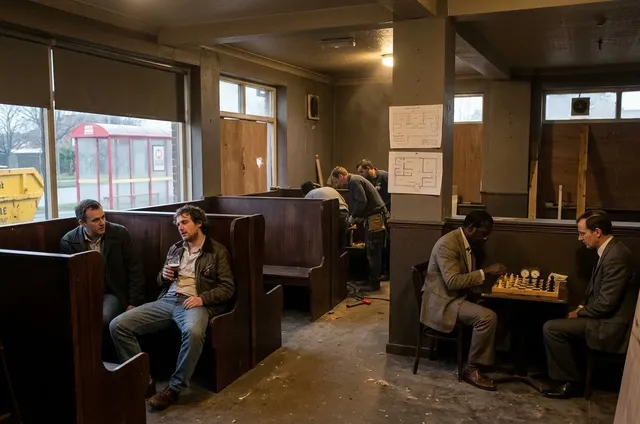
The décor inside the Grey Goose was certainly grey and matched its name, and only brown competed with the colour's dominion. In the early days, the pub had tables placed all around its rectangular shape, and there was no dividing space. Men and some women used to shout banter across the pub, and there was that great feel of a community, albeit pissed. That all changed when the tenancy changed, and the new landlady decided it was time to bring the décor of pubs and bars of town to Belle Isle.
She had workmen carve up the open atmosphere, and almost overnight, claustrophobic booths were installed all around the perimeter. When you sat in one, you could only see directly opposite, and that was the start of the downfall for the Grey Goose. The landlady stripped away the character of the pub with her grand designs of delusion, and many of the locals, over a period of time, began to frequent the 'open atmosphere' of the club up the road, or they went further afield in their quest for a community which suited their spirit.
The Grey Goose shut down many years back now, and in its place is a Polish shop, which sells almost everything. Even if the booths hadn't been installed, the pub would have closed anyway; such are the changing winds of time.
Reader Comments
Leave a Comment
We would love to hear your thoughts on this chapter.

About Karl Swainston
Karl Swainston is a writer and storyteller whose work is forged from a life lived across the North of England and far beyond. Growing up on a Leeds council estate in the 1960s, Karl's journey was anything but linear. By the age of thirty, he had already lived a dozen lives: from the rigors of grammar school to a degree in Latin, a stint as a fishmonger, a period of discovery living in Marseille, and a return to the hustle of London. Whether working as a postman, a builder, or competing as a county-level chess player, he was, above all, an avid reader—constantly documenting the world around him. This restless spirit continued into his professional life. Karl later taught in Bradford, where he ran a specialist unit for 244 of the most excluded students from across the region—young people whom even the local Pupil Referral Units could not accommodate. Working alongside his old friend Malcolm, Karl spent his days navigating the volatility of Bradford's most aggressive and dysfunctional teenagers. Throughout his life, Karl has been an avid runner and has always shared his home with a rotating cast of beloved dogs and cats—companions who have been constant witnesses to his work. As a writer, Karl's range is as expansive as his history. He works across a wide breadth of genres, including fiction and short stories, autobiography and memoir, biography, non-fiction, and metaphysical writing, as well as providing sharp commentary, opinion, analysis, and essays. Whether writing about his years managing the Harrogate Arms or offering insights from his current adopted home in South East India, where he lives in a simple village with his dog, Bambi, Karl's voice reflects the full, untidy, and deeply human breadth of life. He continues to draw on the rich, decades-long tapestry of his experiences to tell stories that matter, proving that no matter where you live, the human story remains the same.
Author Page