Tales From A Harrogate Caravan
Chapter 11 — London and the Pub Violence
← Karl Swainston / Tales From A Harrogate Caravan
Going to work in London when I wasn't yet twenty wasn't really a decision, but it happened quite by accident.
In Leeds, in the early eighties, there was nothing but cheap jobs with no other purpose than to exploit your labour. I'd just done a week's work, had a little money, and I decided to go to France again, hitch-hiking. I'd been hitch-hiking it up from Marseille and was picked up in Lyon and dropped off in London by an amazing Irish woman and her husband. I remembered Malcolm's address and set off to stay the night there: Matthews House, Burgess Street, Limehouse, E14.
Malcolm was an old family friend, who always lodged with us at 955 whenever he was in Leeds. The abode rested among another thousand grim flats. The stairwell stank of urine, and somehow you never saw people along the endless concrete corridors. They were like insects disappearing into their holes when you happened by chance to encounter one.
Unlike Leeds, it didn't take long to find work in London, and the following day I was in a job, working for a small landscaping outfit. On the way home on Fridays, Ronnie, the boss, would drive by the side of Brent Cross Shopping Centre, drop me off, and I'd hitch-hike back home for the weekend and a game of chess. On Sundays, I'd hike it back down, and that's how it was every weekend.
I never really knew London until that Sunday when I reached the capital earlier than usual. Val, the landlady, was out and had gone to her sister's in Maidstone. I didn't have a key and turned around and decided to walk back to Mile End station. I don't know why, but when you're aimless, anything and anywhere will do.
Reaching the East End, I bought a paper and headed for the nearest pub, which was across the road. The pub was small, dark and dingy and had little groups of people scattered around it. I ordered a beer, which was never nice in London, and then I went to sit down in some corner, away from the cackling locals, and began to read the paper. It's strange how you can simply switch off from reality when you read. The background noise simply disappears and you're in another world.
I'd been in this other world for ten minutes or so when something unusual happened, and it brought me back to the reality of London. The cackling suddenly ceased, and there was a palpable change in the atmosphere. People began to leave quietly, heads down, not rushing but with a determined purpose. I was in the corner and couldn't see the cause of such an exodus, but then I did.
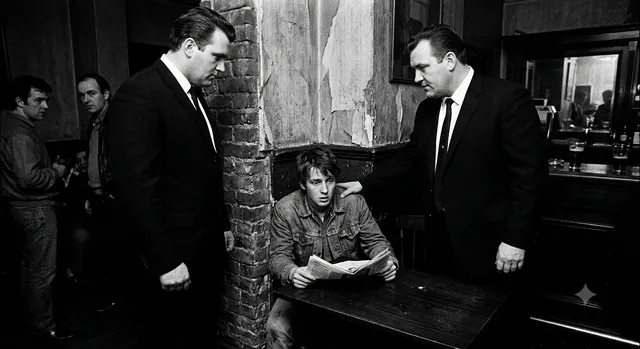
Two men very smartly dressed in black, both big, six foot three easily, and built for a single purpose. The first one rounded by the side of a man stood at the bar, seemingly unable to move, while the other man flanked the stranger from the other side. I can still hear that first crunch as the first blow landed on his face. I should have scrambled out of there then, at that point, but there are times when you simply freeze and can't think about undertaking any action but merely stare at the spectacle, or horror, being enacted before your eyes.
Five or six more punches were delivered, and by this time the stranger was on the floor groaning. No words or shouts were uttered by the two large men, as each grabbed an arm of the man on the floor and began to ram his head against the brickwork of the bar. Time and time again they smashed that poor fellow's head against the stone, and when they stopped, there was only a twitching from the man, but no groaning.
I can remember trying to swallow, but couldn't. Then one of the men noticed me in the corner, tapped his accomplice on the shoulder and pointed at me. Both walked slowly towards the corner where I was sat.
A chess player can display amazing powers of analysis, and in the next few seconds I must have thought about every conceivable means of escape, but I was behind a table and had no chance with both men now flanking me.
'Can you see?' asked the man to my right, calmly, but with menace.
'I'm blind,' I stammered. 'I can't see a fucking thing.'
'Then off you go, little one,' said his mate.
I couldn't jump up quick enough, but the first man placed his hand on my shoulder and said again, calmly, 'Finish the last of your beer. We don't want you Northerners to think us Londoners are rude, do we?' His request was not to be denied, and you can imagine the horror of raising glass to your face with those two villains stooping over you.
'There, off you go now, and remember: you can't see, can you?'
I didn't reply but headed for the door and nearly fell onto the pavement outside. I don't know to this day whether the poor sod lying at the bar ever did rise to his feet again. As for the two thugs, I never saw them again either.
Prefer to listen? Watch the video reading below.
Reader Comments
Leave a Comment
We would love to hear your thoughts on this chapter.
About Karl Swainston
Karl Swainston is a writer and storyteller whose work is forged from a life lived across the North of England and far beyond. Growing up on a Leeds council estate in the 1960s, Karl's journey was anything but linear. By the age of thirty, he had already lived a dozen lives: from the rigors of grammar school to a degree in Latin, a stint as a fishmonger, a period of discovery living in Marseille, and a return to the hustle of London. Whether working as a postman, a builder, or competing as a county-level chess player, he was, above all, an avid reader—constantly documenting the world around him. This restless spirit continued into his professional life. Karl later taught in Bradford, where he ran a specialist unit for 244 of the most excluded students from across the region—young people whom even the local Pupil Referral Units could not accommodate. Working alongside his old friend Malcolm, Karl spent his days navigating the volatility of Bradford's most aggressive and dysfunctional teenagers. Throughout his life, Karl has been an avid runner and has always shared his home with a rotating cast of beloved dogs and cats—companions who have been constant witnesses to his work. As a writer, Karl's range is as expansive as his history. He works across a wide breadth of genres, including fiction and short stories, autobiography and memoir, biography, non-fiction, and metaphysical writing, as well as providing sharp commentary, opinion, analysis, and essays. Whether writing about his years managing the Harrogate Arms or offering insights from his current adopted home in South East India, where he lives in a simple village with his dog, Bambi, Karl's voice reflects the full, untidy, and deeply human breadth of life. He continues to draw on the rich, decades-long tapestry of his experiences to tell stories that matter, proving that no matter where you live, the human story remains the same.
Author Page