Tales From A Harrogate Caravan
Chapter 12 — Christmas Eve in Pew
← Karl Swainston / Tales From A Harrogate Caravan
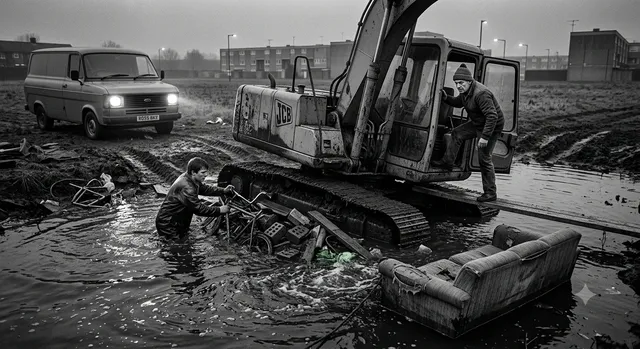
It was 1986, winter and it was desperately cold; the day was Christmas Eve, and down in London, in Pew, we had to line a dried out pond with clay. The day had started well enough, and there was only a heavy, grey leaden sky, but no rain. Most of the water had been drained from the pond, and all that was left were old scraps of prams, bikes, and miscellaneous bits of plastic bobbing up and down in the puddles and pond that was left.
The plastic pieces, at one time would have displayed colour, but the toxins in the water had many a year ago burnt off the colour, and all that was left were green, ghostly shades of what the advertisers and manufacturers once intended them to be.
Ronnie and I had cleared most of the rotten sludge off the bed of the diseased pond with a little digger and cleverly sealed the base with new clay, and on the face of it, the foundation gave the visage a completely new countenance, and we were pleased. All that was left was to clear the north-west side and repeat the cosmetics to that, and then home, to Leeds, and a good Christmas was waiting.
'Right, Lenny and Marlon. You clear out the rest of the rubbish and fence off that old sludge of shit we've got out, and that'll take you a couple of hours. Karl and I are off to see to that other job, and we'll be back before two. See you then.' What could go wrong?
It took Ronnie and me no more than an hour or so to repair some path and to haunch up the side and return to Lenny and Marlon. We'd no sooner pulled in through the gates when we saw those two Irish lads shouting at one another. They'd decided to 'have a go on the digger' while we were gone and completely messed up, and the digger was now fastened tight in the middle of remaining pond water, desperately struggling to try and free itself from the black, slimy sludge of that pond. The tracks of the machine could purchase no grip, and the more they'd driven the poor thing, the more it had sunk into the mire.
'For fuck's sake!' screamed Ronnie. 'What the fuck are you playing at? I told you not to touch that machine and to only clear out the rubbish.'
The two were unceremoniously discharged of their duties and didn't wait to get paid.
'We can't leave it in here, Karl, and I'm done for if Derek finds out, as he'll get someone in to get it out, and they'll deduct money from the contract. You can't afford it, and I can't either. We'll have to get it out.'
We knew that wading out to the machine and trying to manoeuvre it out was useless and would only condemn the wretched thing to deeper depths of sludge; we had to find something solid with which the tracks could purchase a grip and heave itself out.
'I'll go this way, Ronnie, and you go the other way, and bring back whatever we can find. All those old bikes over there will do for a start.'
'Good thinking, Karl, but let's take the van and drive around instead, as we can simply fling it onto or into the van.'
We set off round that wretched council pond in Pew. Anything and everything we could find which would help remedy our plight was taken: bricks, blocks, prams, planks, doors, tables, even an old sofa resting on the adjacent field was flung on or in the van. I didn't understand why Ronnie was so desperate to have the sofa included in the rescue mission, and my first impression was that desperation had clouded the man's senses. How wrong I was.
After a good half hour, we'd gathered from around the perimeter of the pond everything worth having and had dumped it all at the side of the pond, just yards away from the blighted, yellow digger looking at us with its arm bent in front of it. To the side of the digger, there was a scaffold plank leaning from a bit of dry land to the door of the digger, and you could just about walk along it to get inside the digger without going into the dirty pond.
'One of us, Karl, is going to have to wade out there and ram as best we can all that lot,' which was a substantial amount of rubbish, 'in front of the tracks and beneath them too. One of us can sling from here to the other one, and there's no point in both of us getting wet?'
This was Ronnie's polite way of saying, 'I'm the boss, and I'm not going in, Karl.'
I waited a moment and let the silence bring a little more sense to that head of Ronnie's.
'Alright, for fuck's sake. You go in, Karl, and I'll give you £40 for the last job, and I'll keep the tenner.' Well, he had to keep something; he always did.
I didn't mind doing the work and knew Ronnie would only knacker himself out, and I'd have to go in anyway, so off I set, but not after first securing the £40, which I put in my jacket in the van.
The water was freezing, and when it reached those delicate bits, the aforesaid delicate bits shrank away to the sanctity of the warmth deep within.
Ronnie began to chuck all the old rubbish towards me, and I in earnest began to sink it down before that poor digger. The light was now falling fast, and my poor bollocks, even in the sanctity of my body, were beginning to shiver. I couldn't feel my toes, and were they to have been cut off, I wouldn't have known.
'I'll pass you the sofa last, Karl, as if the digger grabs a foot on all that lot, it hopefully will nip all the old tatters hanging off the arm of this and pull it under the water and pull itself out. Put it in sideways and then get out of the way.' I still wasn't convinced. It was now nearly dark.
Ronnie ran round to the other side and like an agile sailor scootered along the plank and disappeared into the digger. Shortly after, the digger began to turn her engine.
'Karl,' Ronnie shouted from the digger, 'we missed a baton behind you. Grab that and throw it in and see if you can get it crossways under the water, just in front of the tracks, but keep out of the way. Grab that old iron bar from the van, and hold it down with that, as that should be safe enough.'
The bar was had, and the baton shoved down and held down before those digger's tracks.
'Right, here goes, Karl, and once the digger moves and you can feel that baton get dragged under the tracks, you get the fuck out of there.'
The engine gathered its power, and the clutch was let out. Nothing happened in those first instants, and I think we both had a moment of dejection, and then it happened. I could feel the baton beneath that stinking, black water disappear slowly.
'She's going, Ronnie!'
'Get out, then,' and he let the engine roar still louder. I didn't fancy getting dragged in down there, and I was wet through anyway, and I flung myself out towards the land, crashing down in the water as I did so, but with enough momentum to clear my hapless body out of the way of the machine.
I stood on the land and watched Ronnie and that machine struggle in the darkening night with only the street lamps and the headlamps of the van to see the act in process. The digger didn't appear to move at first, and there was only a crashing sound of its engine, but then it began to shuffle in the water. Ronnie could feel the shuffle, and he hit the throttle harder. Bubbles of toxic froth began to appear in front of the digger from all the disturbed methane and chemicals from the land and rubbish. No sooner had it done than the digger began to move forward.
Although the light was poor, I caught an unmistakable glint in the eye of Ronnie's red face in that digger, and I swear a smile began to appear. Ronnie began to bounce up and down on his seat like a kid, as if the movements of his little body would have aided the three-ton machine to move forward, but there's always magic in the will.
The machine slowly came towards me and even began to move quicker, but, suddenly, right before that old, decrepit settee, it stopped, and even though the engine was straining with all its might, it appeared once again to labour and become stuck and stranded.
I looked at Ronnie, but he didn't look back, and merely shouted at his machine, 'Come on, baby, come on, and bite that fucking sofa.'
I can still see in my memory to this day and hour how that old, neglected, and disused sofa slowly disappeared beneath the tracks of the digger, and as it did so, the machine pulled out onto the good purchase of land and out of the water.
Christmas Eve, 1986, and there we both stood by the side of that pond in Pew, looking at our feat. The time was now knocking on, and I had to get back to Leeds. I quickly changed into some spare clothes I had in the back of the van, and we drove to Brent Cross, North London, and the start of the M1 motorway north to Leeds, and Christmas. Although I had to hitch-hike it back, I didn't mind as I always travelled between London and Leeds in those days in that way.
Prefer to listen? Watch the video reading below.
Reader Comments
Leave a Comment
We would love to hear your thoughts on this chapter.

About Karl Swainston
Karl Swainston is a writer and storyteller whose work is forged from a life lived across the North of England and far beyond. Growing up on a Leeds council estate in the 1960s, Karl's journey was anything but linear. By the age of thirty, he had already lived a dozen lives: from the rigors of grammar school to a degree in Latin, a stint as a fishmonger, a period of discovery living in Marseille, and a return to the hustle of London. Whether working as a postman, a builder, or competing as a county-level chess player, he was, above all, an avid reader—constantly documenting the world around him. This restless spirit continued into his professional life. Karl later taught in Bradford, where he ran a specialist unit for 244 of the most excluded students from across the region—young people whom even the local Pupil Referral Units could not accommodate. Working alongside his old friend Malcolm, Karl spent his days navigating the volatility of Bradford's most aggressive and dysfunctional teenagers. Throughout his life, Karl has been an avid runner and has always shared his home with a rotating cast of beloved dogs and cats—companions who have been constant witnesses to his work. As a writer, Karl's range is as expansive as his history. He works across a wide breadth of genres, including fiction and short stories, autobiography and memoir, biography, non-fiction, and metaphysical writing, as well as providing sharp commentary, opinion, analysis, and essays. Whether writing about his years managing the Harrogate Arms or offering insights from his current adopted home in South East India, where he lives in a simple village with his dog, Bambi, Karl's voice reflects the full, untidy, and deeply human breadth of life. He continues to draw on the rich, decades-long tapestry of his experiences to tell stories that matter, proving that no matter where you live, the human story remains the same.
Author Page