Tales From A Harrogate Caravan
Chapter 46 — Growth of the Unit and Anna Joins
← Karl Swainston / Tales From A Harrogate Caravan
Things trundled along slowly at the vocational unit, and by the following year, they hadn't really improved. We only had a handful of students, and I began to have thoughts about leaving and applying for a teaching post. But within a week or so, fortune and events began to turn quite sharply.
Rita had secured a meeting for me with a group called the Go-Live project, a scheme where students who hadn't achieved anything in their schooling years were given the opportunity to undertake construction diplomas with our centre. In the space of a single week, our student population doubled. And then something happened. Bradford District PRU, a Pupil Referral Unit, also contacted the centre and began to send students to us full-time.
The more students we took on, the more other schools contacted us, and before the year was ended, we had well over 200 students on roll, when, at the beginning of the year, there'd been less than 10.
People often ask how it's possible to manage over 100 excluded students on site at any one given day, but we learnt that it's easier to manage a hundred students than it is to manage ten. The more students you have, the more community you create, and the more community you create, the more distractions, the more interactions the students have with one another. When there are only a few students, it's hard, and the students become bored quite quickly, and they look around for trouble and vents for their complicated beings.
I'd been at the Unit now for around three years, and was finally taking home a very handsome wage. All the debts had been paid off, and for the first time in our lives we could be considered to have been comfortable. It was approaching autumn and half-term and that meant a week's holiday. We had never been on holiday together abroad during the years Anna and I had been together; the furthest we'd been was either Blackpool or Scarborough, whichever was furthest.
It was October when we set off early morning in the car to Manchester Airport. We'd left the key with John to stay at home, so that he could look after the dogs and the cat. I'd never been on a plane before; Anna had, but I hadn't. The evening before we'd ordered a takeaway, as there wasn't time to cook a full meal, and I, like a complete idiot, ordered my customary vindaloo. Oh, to God, I wish I hadn't. I must have spent most of the time on the plane in that toilet, and I can remember leaving the toilet and walking past the irate passengers in the queue. I didn't bother going back to my seat but stationed myself at the back of the queue, and waited once again for my turn.
Our destination was Greece and the beautiful island of Zante, or Zakynthos, as the Greeks say. Jack must have been around the age of 7 or 8, and Rachel was 15 or so. Rachel's friend, Jade, had come with us, and they stayed in another apartment. We stayed in the Christina apartments, and during one dusky night, there was a rumble of earthquake, which made the timber around the bar shake somewhat. The locals were used to such rumblings, but we foreigners were amazed by it.
The weather was perfect that first holiday, and Anna and I would walk through the groves of olives as the farmers shook them into nets from off the trees, and you could stroll beneath the great hills there and back down along the coast of that ancient sea. We found a wonderful stretch of deserted beach, and each day we'd all head off there, and laze around and swim in the clear waters. We had a great many holidays after that visit to Greece, but both Anna and I thought that holiday was, without doubt, the best of them all.
We returned back home to a cacophony of barks and squeals from the dogs, and life once again returned to everyday tasks. At work, the numbers of students had increased quite markedly, which was good, but it did present staffing problems and a shortage of capable persons to teach and supervise.
There were many different groups of students at the Unit, but there were two main divisions which determined where and what the students were taught. The first division were students who had a lively interest in construction or motor vehicle, and they were the easiest to cater for, as their enthusiasm for vocational studies facilitated success with them. The second division were much more difficult to engage, and even if you did get them into the workshop and on task, invariably, they'd become bored, distracted, and generally fall to messing about.
The second division compromised around 15% of our student population, and they came mainly from the PRU. Not only had they been permanently excluded from mainstream schooling, even the regular referral units couldn't cope with them, and that is why we were given them. Although the students were manageable, they were not good for the other 85% of the students and would regularly pull off task some of those students.
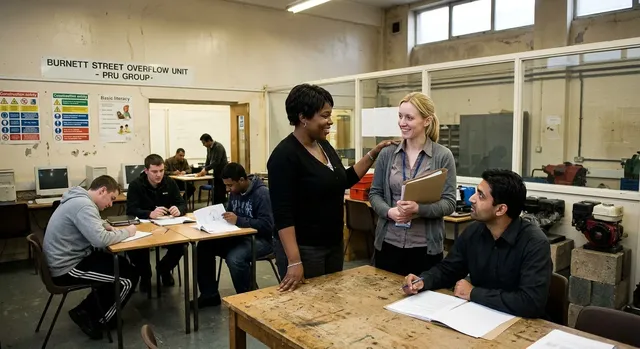
The answer was to separate them, and so we took on another building, further down Burnett Street, and down some steps. This hard-core band of students could be educated there, and if they wanted to do vocational studies, they only had a couple of minutes' walk to the big building at the top of the hill. The new unit also meant that we could move students down there who were not doing well at the main building.
The only problem we had was who was going to run the unit and manage these really difficult students. Both Rita and I were that busy now managing the unit and the students; she couldn't undertake it. We both knew Gary was good with these students, and he could work with them, but he wasn't good at managing all the structures and curriculum, and we needed someone to take on that responsibility.
'Does Anna still work at that sewing place, Karl?'
'She hasn't worked there for some time now, as we've paid everything off, and what she can earn as a seamstress isn't worth getting out of bed for. Why?'
'What does she look like?'
'She's thin, blonde, and small, and I'm sure you'd like her if you met her.'
'Is she a strong woman?'
'Yes, a much stronger character than me. What's on your mind, Miss Rita?'
'Why don't you ask her to come in on Monday, and we can have a chat?'
'I'll ask her, but I don't know if she will.'
And we said no more about it that week.
I had my reservations about Anna coming to the unit. We were happy enough at home without having to introduce complications such as working together. I did think about not telling her, but in the end I mentioned the conversation with Rita. Anna's reaction was, on the whole, very positive. She related that she was often bored at home and did want to go back to work now that Jack was making his own way to school and back.
The students, strangely, didn't bother her either, as she felt she had the character and humour to deal with them, which is essential with the ilk of students we had. It was arranged: Anna was to come with me to the Unit Monday morning, and she was to spend a day there.
I must admit that Monday to being more nervous than Anna going to work. The two women in my life were to meet for the first time. They'd exchanged words over the three years, but they'd done no more than that, and they certainly hadn't met.
The day went remarkably well, and as we were leaving at the end, Rita pulled me to one side, and said, 'I like her. Bring her back tomorrow.'
Tomorrow appeared and so did Anna, and then the next day was the same and the next too. Within the week the phone would ring, and I'd ask who'd been on the phone, and she replied, 'Rita. I've been chatting with Rita.'
Within the month, Anna and Gary were running a very efficient unit, which we'd now acquired, and Rita and Anna were now as thick as thieves, and they would always side against me when opportunity allowed, which gave them both great amusement to my annoyance. Years would pass and Anna and Rita became inseparable, and were the best of friends. Even though they worked together, they'd still be on the phone most evenings, and that deep friendship of theirs never tired once.
Prefer to listen? Watch the video reading below.
Reader Comments
Leave a Comment
We would love to hear your thoughts on this chapter.

About Karl Swainston
Karl Swainston is a writer and storyteller whose work is forged from a life lived across the North of England and far beyond. Growing up on a Leeds council estate in the 1960s, Karl's journey was anything but linear. By the age of thirty, he had already lived a dozen lives: from the rigors of grammar school to a degree in Latin, a stint as a fishmonger, a period of discovery living in Marseille, and a return to the hustle of London. Whether working as a postman, a builder, or competing as a county-level chess player, he was, above all, an avid reader—constantly documenting the world around him. This restless spirit continued into his professional life. Karl later taught in Bradford, where he ran a specialist unit for 244 of the most excluded students from across the region—young people whom even the local Pupil Referral Units could not accommodate. Working alongside his old friend Malcolm, Karl spent his days navigating the volatility of Bradford's most aggressive and dysfunctional teenagers. Throughout his life, Karl has been an avid runner and has always shared his home with a rotating cast of beloved dogs and cats—companions who have been constant witnesses to his work. As a writer, Karl's range is as expansive as his history. He works across a wide breadth of genres, including fiction and short stories, autobiography and memoir, biography, non-fiction, and metaphysical writing, as well as providing sharp commentary, opinion, analysis, and essays. Whether writing about his years managing the Harrogate Arms or offering insights from his current adopted home in South East India, where he lives in a simple village with his dog, Bambi, Karl's voice reflects the full, untidy, and deeply human breadth of life. He continues to draw on the rich, decades-long tapestry of his experiences to tell stories that matter, proving that no matter where you live, the human story remains the same.
Author Page