Scardale
I — The Widow Gossip of Scardale
"I've just had a telephone call about an old woman in a village up in Yorkshire who won't move, and whom the council is going to evict in the coming days.
What's her name again? Elsie? That's right. Elsie Davey, 102 years old.
She's the last person left living in the small mining village of Scardale.
I want you, Lucy, with your womanly and girly charm to get up there and interview the old girl.
The council will evict her, and I want you to get her story.
I don't just want the story of why she won't move, I also want the human story behind her and the history of her mining village before and after the Strike.
It's a tough one, as she may not speak to you, and we don't know whether her faculties are all there, too, but I do know she's lived in the village all her life.
There's a return ticket, there; off you go."
And with an unceremonious wave of the editor's hand, I was shown the door, so to speak.
And that was it; I was to journey to Yorkshire immediately on my first reporting assignment.
The year was 2014.
I was fresh out of university and had landed a minor role as an understudy reporter at Winchester's only newspaper, the Standard.
I had never been to Yorkshire before—only Lancashire, and that was grim.
Now, here I was, train ticket in hand, heading off to a Yorkshire backwater called Scardale to interview a pensioner called Elsie Davey.
She was 102, and I was 22; I wondered on the train hurtling through the drab fields of Nottingham. She was born in the last century, in the year 1912. She lived through the First World War and the Second World War and, no doubt will have some stories to tell of that great event, I thought.
I'd studied history for my degree and relished the prospect of hearing the old woman talk to me about real history, as it were. However, although I was eager to meet her, there was also the nagging doubt in my mind that a woman her age might have some impediment to communication. How wrong I was.
I alighted from the train in Doncaster and flagged a taxi to take me the rest of the way.
"Where is it you want to go?" the taxi man repeated.
"Scardale," I replied and pointed to a place on the map.
"Scardale, ah, yes, Scardale," the taxi man ruminated. "I remember that place from many years back. I thought it was long gone."
"There are only a couple of properties left, I think, and the local council are going to demolish them, too," I offered.
Idle chat spattered the remainder of the ride.
The journey took about 50 minutes. It was summer, and all day long, the sun had let fall its golden rays. It was just after the hour of 5 o'clock when the taxi meandered its way down a tiny country road.
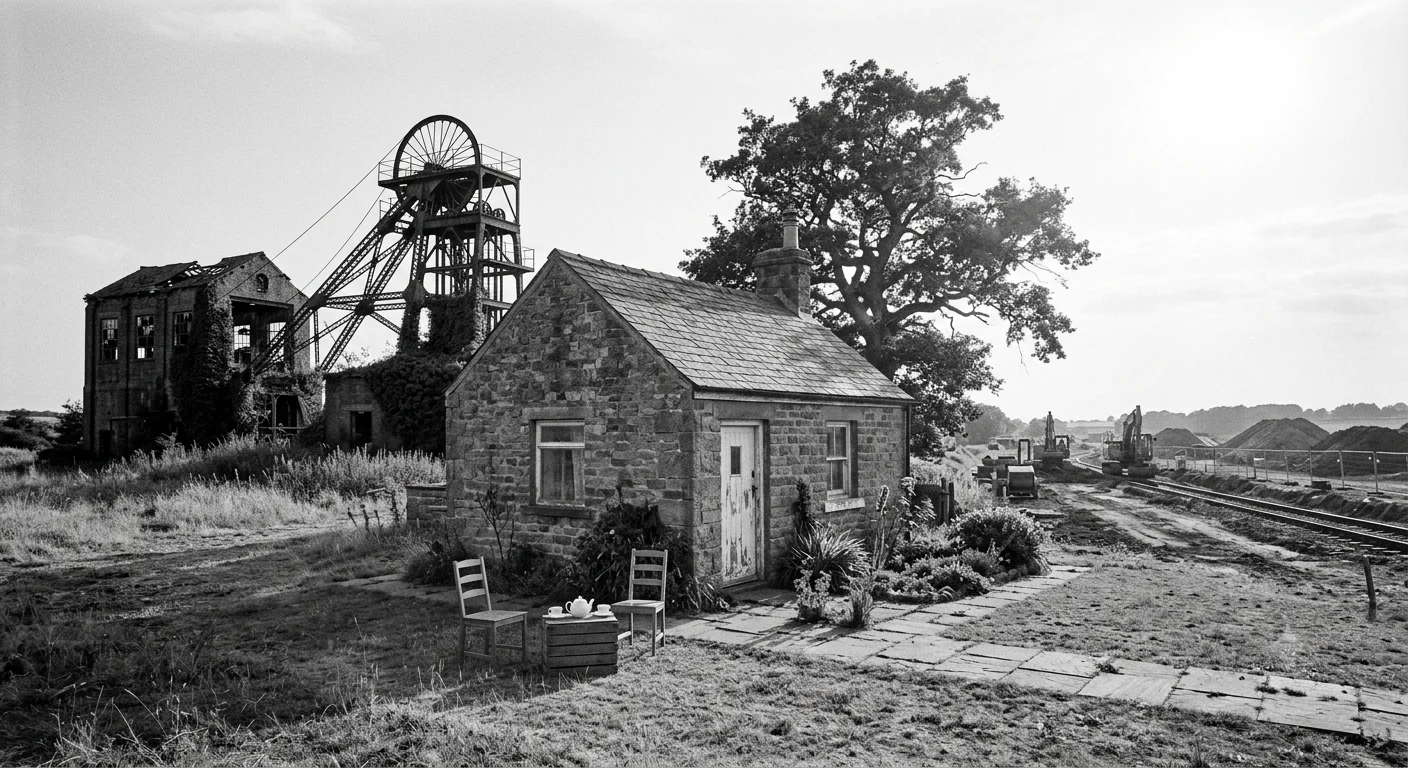
It was then I saw Scardale, or what was left of it that is. I was expecting some sort of a village, or at least a few houses, but there was only this one solitary cottage peeping out from behind a huge oak. All around the little cottage lay desolation.
Plant machinery had carved and scraped away everything as the antish workers laid the interminable lines of the railway. To my horror, I was not the only person visiting this cottage. Three other cars, each with occupants sat inside them, waited outside the old woman's abode. I quickly paid the taxi driver, and fairly leapt out of the car in my eagerness—and my naivety—to get to the old woman first.
"The old bag won't answer the door, so I wouldn't bother knocking if I was you," shouted one of the reporters from his car. Guffaws from the other two cars accompanied the finality of his statement, followed by a wolf whistle.
I persevered and made my way up the broken path, and rapped on the door. "Elsie Davey," I shouted and then waited. No reply.
I knocked again. "Miss Davey, my name is Lucy Sharp from the Winchester Standard."
More guffaws and sniggers came from the cars.
"I would like to interview you. Can you open the door, so we can talk?"
No reply. I was just about to walk around the property when one of the men stepped out of his car and called out, "We've all been around the house, girl, and there's no point trying."
"Well, if you don't mind, I want to try anyway," I snapped back.
"Do what you want," he added, "but you won't get to see the old cow."
"How dare you call her that?" I screamed. "She is an old age pensioner, and 102 years old, I might add. I don't think that bloated, alcoholically red and pockmarked face of yours will even see half her age before they bury the foul-looking thing!"
He was indeed ugly, and I know I should not have lowered myself to his insults, but you have to understand I was livid.
"Here, Dave," the man shouted to one of his fellow reporters, "a regular little bitch of a southern reporter, we have here."
"Piss off," I spat back between clenched teeth.
And then it happened.
Someone released a latch, catch, or something from the other side of the front door, and a withered hand beckoned me to come in.
There was no time to waste; the other reporters were fairly falling out of their cars to get to the door, but all was in vain. I jumped in the cottage, and the bolt and chain were again set in place.
"Elsie darling, let us in. We want to talk, too. We need to interview you, and we'll pay much more than that rag of paper of hers will. Open up."
The desperate reporters added more pleas, but they did not gain entrance.
I had not yet turned round to view Elsie Davey, but when I did, I was pleasantly surprised. Here was a woman who was 102 years of age and quite a remarkable, tiny creature; old age had dishevelled and grizzled her grey hair, but she had these sharp and piercing eyes, almost intelligent eyes, if one may use such an expression. Her clothes were shabby and hung off her little frame, and on her feet were a pair of pink, yet dirty slippers.
"Do I startle you, madam?" she asked in a soft but rural voice. Previously, I had only heard a Yorkshire accent on television, and then from some actor or such and not a real person, but listening to that old lady now and her strong drawl of accent made me halt in reply.
"You're gawping, girl. Come and sit down and have a cup o' tea," she insisted.
She motioned slowly towards a single table that stood in what resembled a kitchen, but somehow was not. All around the room was age. It was in the old oak and mahogany of the furniture, and in the threadbare curtains, whilst the net curtains had long since withered away. On the kitchen floor were Yorkshire flags that had slight depressions in them from the innumerable footsteps of time, and on the ceiling Artex clung with interminable strands of cobwebs hanging down. A smell of mustiness clung all around the room, and in the strangled, split rays of sunlight shining through the holes in the curtains one could see a veritable mist of dust dancing in the air of that aged room.
"My name is Lucy Sharp..."
"And you're a reporter from the Winchester Standard," the old woman interrupted. "I heard you from outside the door, and I heard of your altercation with those other barbarous reporters. They are like rats gnawing a living from people's misfortunes."
"Not all of us are mercenaries to people's pain," I interjected. "Some of us, like me now, want to cover the positive aspects of life. I came because I want to tell your story to the country."
"My story is a very long one, and I don't think you'll have time enough to listen, Lucy. As for this present story, I know that I will lose the battle with the railway industry, but I shall persist to the last; do you hear? To the last of my breath, will I persist, even if it kills me," the old woman concluded with a passion. She paused for a moment as if thinking deeply about something, but then shrugged her shoulders. "I can hear your fellow reporters leaving."
Elsie had remarkable hearing for one of her old age, as I could barely hear the engines of the cars, muffled against the background of bird song. The old woman moved with shuffled steps towards the window and drew back the curtain to confirm her statement.
"Yes, they've all gone, but they'll be back again in the morning, and will certainly return when I do finally leave this place. Come outside, and let's sit in the last bit of sunshine we have left in the day. Grab those two chairs there, and I'll open the door."
I tried to lift one of the chairs, but it was very cumbersome, and I ended up dragging it across the stone floor. I repeated the act with the second chair, whilst Elsie brought out the tea and made an impromptu tea stand with an old box, which Elsie had stationed outside the little cottage a couple of days ago. We both then sat down.
"Do you remember the Second World War?" I began, soon after sitting down.
"I do, but don't wish to talk about it if you don't mind. I don't wish to recall those dreadful years."
I was a little disappointed, but not wholly disheartened, as my purpose was to get her to talk about Scardale and its past. I was pleased this old woman of 102 had agreed to talk to me, and that, after all, was all that mattered.
The early evening was very beautiful. It was the start of June, and the sun still held its station well in the high sky. Elsie had been quiet for some minutes, as she sat gazing towards the distance and the brutal slaughter of the land by the machines, as they carved up the countryside.
"Do you know, Lucy, out there, surrounding this little mining cottage, there was once a village here? There were at least a hundred houses in the village of Scardale. I was born here in 1912. Growing up, I can recall all the men with blackened faces coming back from Scardale pit. All hours of the day, the miners would return. Look out there between those two aspen trees," as Elsie pointed with her bent and bony finger, "and there rose from out of the ground a great wheel, which sent the miners down the pit and carried them back again. It's all gone now, though; nothing is left of Scardale Colliery. I'm the last relic of Scardale, and once I've gone, nothing will be left of the memories and lives of the people who once lived and worked here."
Elsie paused a moment before continuing, "Before you now, Lucy, you see industry, the great railway with their monstrous machines carving out a passage for productivity. England was built on industry from the time of the Industrial Revolution, in the early 1800s, to the end of the millennium. Men and women have earned an income and life from working within that industry, but with the arrival of Thatcher and her laissez-faire policy of me, me, and me, industry gave way to finance, and Britain and her people began to lose their livelihood and that little bit of happiness they possessed. Shipyards began to close; mills and factories shut their gates for the last time; lack of Government subsidy sent car plants abroad, and the coal industry died; Scardale died. I think the new railway is good; construction is good. Admittedly, sometimes you have to deconstruct things to make them better. The crime of Margaret Thatcher and her merry band of Tories was they were very good at deconstructing, but did not have a clue about constructing. When you take something away from the great mass of people, you take away their livelihood, you must give them something in return; they expect something, and should expect and demand it, too. When Thatcher closed this colliery and all the other collieries, she put nothing in their place. The Government offered no alternative employment: nothing. A living being—and a village is a living being—cannot survive on nothing, and slowly it dies; Scardale died. What was once a happy village became a sad and lifeless village. Oh, don't get me wrong, the village did have its scandals and villagers their vicissitudes, but they were always interspersed with the good and simple things in life. I can remember a couple of families in particular, who had more than their fair share of fun and calamity in the village of Scardale."
"Tell me about those families, Elsie; I would like to hear of them," I asked. Although I would have listened with interest to her reminiscent reproach of Government policy on industry, for my report, I wanted to hear more of the human side to Scardale and its lost soul and characters.
Elsie was silent for some considerable time. It was as though she struggled in the remembrance of her past. She shuffled in her chair and blew her nose upon a piece of cloth.
"I don't suppose it will matter now," she muttered.
"Pardon, Elsie? What won't matter now?" I insisted.
"They're all gone now, and the village has gone, and, therefore, it won't matter if I tell you the story of the Hardakers and the Ardsleys. I won't tell you about me, as I've led a boring life, but I can tell you about them. I lost my husband soon after I was married and never remarried. The villagers called me the eternal widow and some of them referred to me as 'the widow gossip'. I didn't mind though, because I did like a bit of gossip," she cackled.
"I would love to listen to their story, Elsie," and I sat back upon that wonderful summer's evening in the lost village of Scardale and listened to that old woman reminisce.
"I suppose it all began back in the summer of 1960 and their trip to Scarborough," she began.
Prefer to listen? Watch the video reading below.
Reader Comments
Leave a Comment
We would love to hear your thoughts on this chapter.

About Karl Swainston
Karl Swainston is a writer and storyteller whose work is forged from a life lived across the North of England and far beyond. Growing up on a Leeds council estate in the 1960s, Karl's journey was anything but linear. By the age of thirty, he had already lived a dozen lives: from the rigors of grammar school to a degree in Latin, a stint as a fishmonger, a period of discovery living in Marseille, and a return to the hustle of London. Whether working as a postman, a builder, or competing as a county-level chess player, he was, above all, an avid reader—constantly documenting the world around him. This restless spirit continued into his professional life. Karl later taught in Bradford, where he ran a specialist unit for 244 of the most excluded students from across the region—young people whom even the local Pupil Referral Units could not accommodate. Working alongside his old friend Malcolm, Karl spent his days navigating the volatility of Bradford's most aggressive and dysfunctional teenagers. Throughout his life, Karl has been an avid runner and has always shared his home with a rotating cast of beloved dogs and cats—companions who have been constant witnesses to his work. As a writer, Karl's range is as expansive as his history. He works across a wide breadth of genres, including fiction and short stories, autobiography and memoir, biography, non-fiction, and metaphysical writing, as well as providing sharp commentary, opinion, analysis, and essays. Whether writing about his years managing the Harrogate Arms or offering insights from his current adopted home in South East India, where he lives in a simple village with his dog, Bambi, Karl's voice reflects the full, untidy, and deeply human breadth of life. He continues to draw on the rich, decades-long tapestry of his experiences to tell stories that matter, proving that no matter where you live, the human story remains the same.
Author Page