Scardale
II — The Miner and the Mother
The 1960s was a great decade of felicity and fun for the Hardakers.
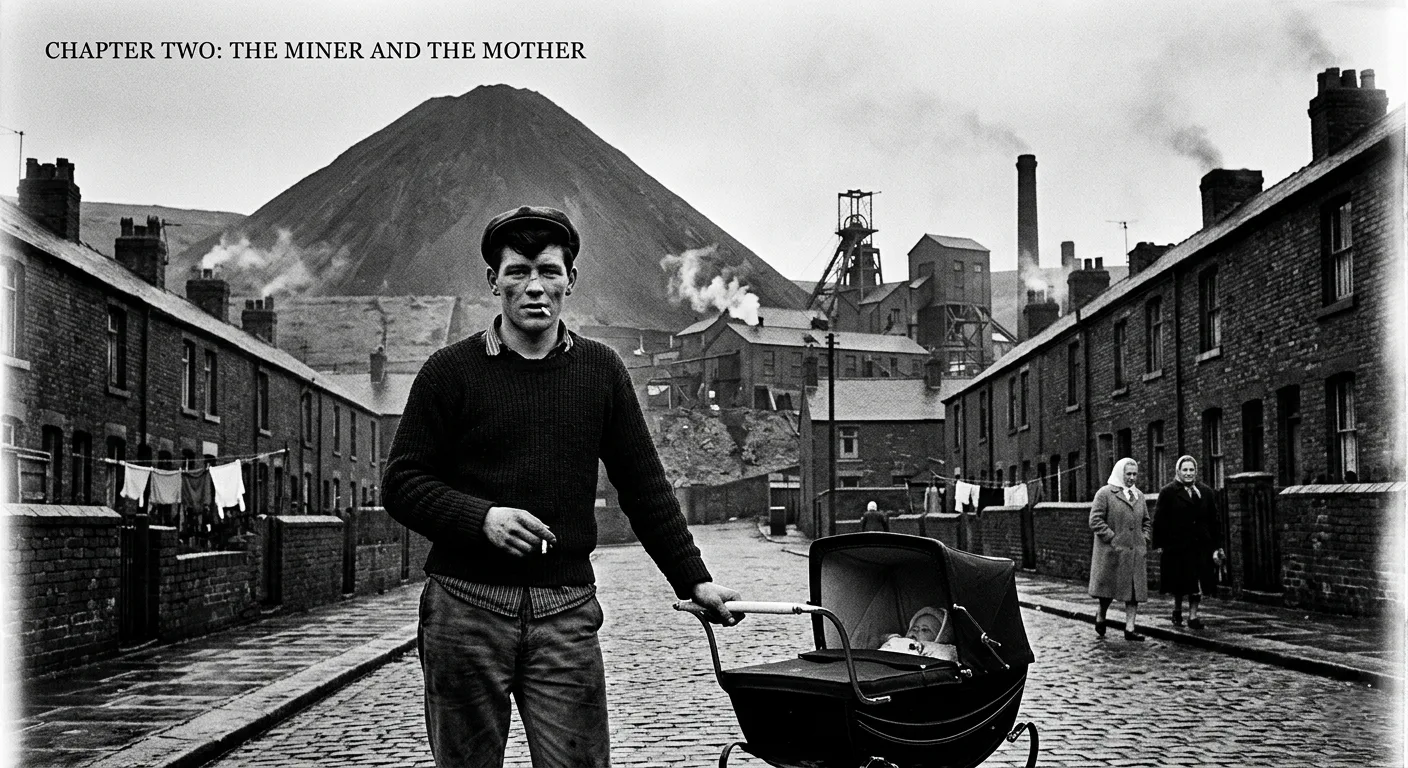
Ronnie Hardaker had been married to Mary Bainbridge for a little over a year, and, when barely into their second year, their matrimony was blessed with a little baby, whom they called Mark.
Upon Mark's birth, Ronnie babbled more than his son had. To any villager wandering too near the pram, Ronnie would unceremoniously pluck the baby from said pram and thrust it into the face of the villager. "He's a grand one, isn't he?" the new father would proudly declare.
Ronnie was 24 years of age and was a miner at Scardale Colliery. He stood an impressive 5ft 11in, but he would regularly inform anyone listening that he was over 6ft, such was his proclivity to bend the truth harmlessly.
He had coal-black hair, and when he rose out of the pit after a shift, covered in coal dust, he resembled some horrible spectre of blackness. His physique stoutly complemented his height, and the combination of both presented quite a powerful presence to the outsider.
However, it was his looks that added that extra stock of formidable character. Ronnie possessed a granite-like rock of a face—not particularly good-looking, but not bad-looking either. Deep in the stone of his face sat two childlike eyes, which would frequently dart about in their spheres when something amused them.
Ronnie's character added greater weight to his appearance; he was demonstrably loud, and he always endeavoured to be the centre of attention, even if that meant playing the buffoon. He did not mind, so long as people were looking at him.
Before his marriage to Mary—who shall be spoken of shortly—Ronnie had somewhat of a roving eye for the fair lasses. Along with his best friend, Thomas, he would regularly take a bus excursion to Doncaster, and, in the words of Ronnie, "Show the lasses what a great lover I am."
On most occasions, however, he did not score, but returned home drunk and, in the words of Thomas, "...without the wench."
When sober, though, Ronnie could be quite a charmer with women. He had the gift of making them feel comfortable and easy around him, and he made them laugh, which is, more often than not, an overture to more intimate relationships.
In female company, Ronnie would begin to tell a tale of something quite ordinary, but as the tale progressed, it would rapidly climb to the realms of the fantastic. His audience would easily perceive the childish fantasy in his stories, but because Ronnie believed in his outrageous tales, they came across as highly entertaining and completely prepossessing.
After he had finished one of his narrations, he would cheekily say to the girls, "Now which one of you lovely ladies wants to kiss this chin first?"
As hitherto mentioned, however, Ronnie's predisposition to debilitating bouts of drunkenness prevented him from possessing that completely rounded and lovable character he always tried to be.
He would often refer to beer as his 'seductive mistress,' but when events didn't move quickly enough to match his expectations, Ronnie would become sullen and often anxious.
His pints would disappear with startling speed; he would become irritable, awkward, and argumentative, and then fall further into the saturation of drink; finally, leaden and unable to drink any more, he would simply pass out into a deep slumber, no matter where he was.
Mary Hardaker's character rested in complete contrast to that of her husband. She was a solemn woman for a girl of 23, but her good looks covered any show of seriousness in her countenance.
She was 5ft 5in and possessed curves which complimented her figure marvellously. Great swirls of black hair naturally flowed from Mary's head, but in 1960, the beehive hairstyle was all the rage, and Mary followed the fashion of the time.
Prefer to listen? Watch the video reading below.
Reader Comments
Leave a Comment
We would love to hear your thoughts on this chapter.

About Karl Swainston
Karl Swainston is a writer and storyteller whose work is forged from a life lived across the North of England and far beyond. Growing up on a Leeds council estate in the 1960s, Karl's journey was anything but linear. By the age of thirty, he had already lived a dozen lives: from the rigors of grammar school to a degree in Latin, a stint as a fishmonger, a period of discovery living in Marseille, and a return to the hustle of London. Whether working as a postman, a builder, or competing as a county-level chess player, he was, above all, an avid reader—constantly documenting the world around him. This restless spirit continued into his professional life. Karl later taught in Bradford, where he ran a specialist unit for 244 of the most excluded students from across the region—young people whom even the local Pupil Referral Units could not accommodate. Working alongside his old friend Malcolm, Karl spent his days navigating the volatility of Bradford's most aggressive and dysfunctional teenagers. Throughout his life, Karl has been an avid runner and has always shared his home with a rotating cast of beloved dogs and cats—companions who have been constant witnesses to his work. As a writer, Karl's range is as expansive as his history. He works across a wide breadth of genres, including fiction and short stories, autobiography and memoir, biography, non-fiction, and metaphysical writing, as well as providing sharp commentary, opinion, analysis, and essays. Whether writing about his years managing the Harrogate Arms or offering insights from his current adopted home in South East India, where he lives in a simple village with his dog, Bambi, Karl's voice reflects the full, untidy, and deeply human breadth of life. He continues to draw on the rich, decades-long tapestry of his experiences to tell stories that matter, proving that no matter where you live, the human story remains the same.
Author Page