Scardale
IV — The Trip to Scarborough
It was July 1960. The sun had risen early that morning, and the skies were a royal panorama of deepest blue.
Beyond Scardale, rolling fields of wheat and corn swayed in the beauty of that early day; but in Scardale, the only landscape was one of black slag heaps, which rose like monstrous excrescences from the bowels of the earth.
Everywhere had the dust of coal clinging to the foundations; the cottage walls, once white, were now forever painted with a ghostly pallor of palpable grey.
Ronnie had a week's holiday from the labours of the pit, and along with his wife and his best friend, Thomas, they had arranged to go on a day trip to Scarborough, organised by the local Working Men's Club of Scardale.
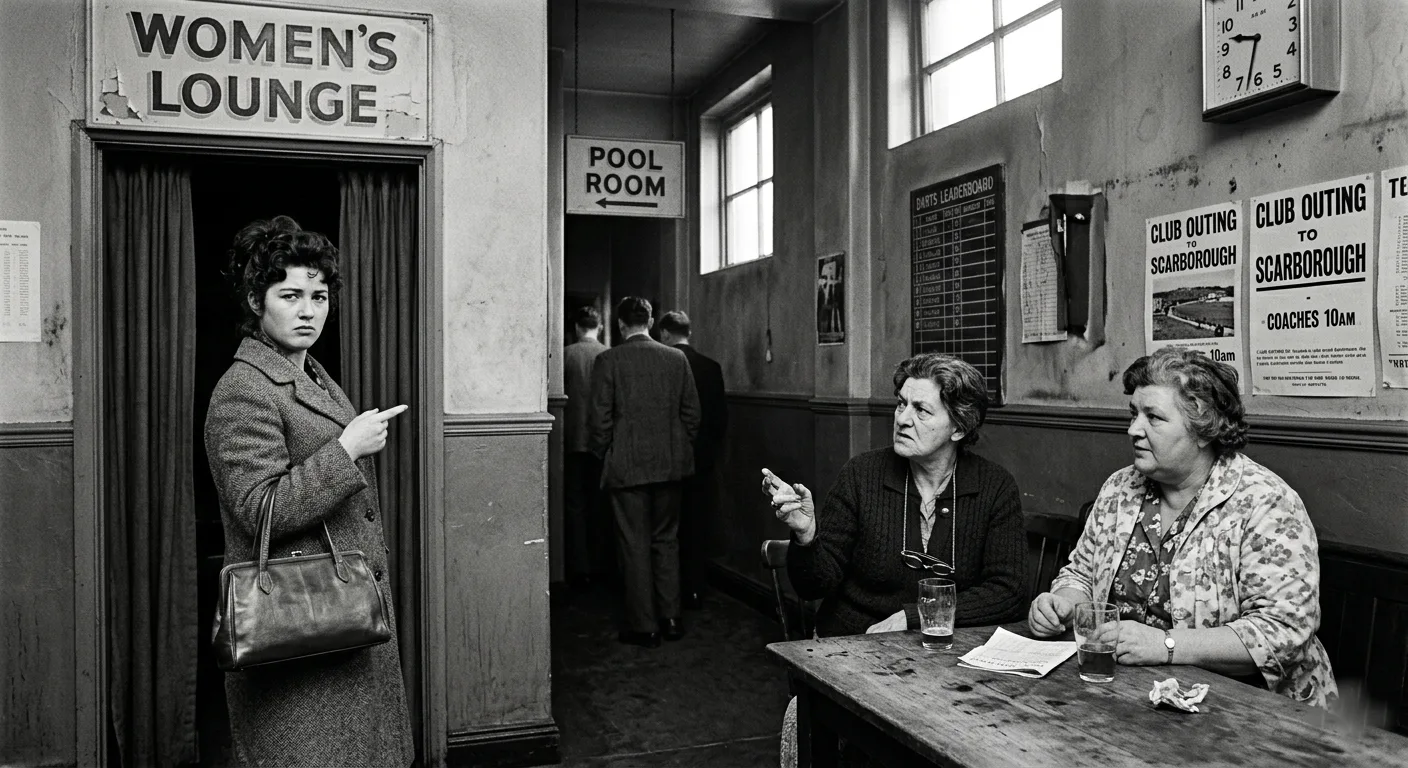
"Right, Mary, you go and wait in the Women's Lounge, and me and Thomas will go to the men's section and have a pint there whilst we're waiting for the coach. Baby Mark will be okay with his gran, and you can let your hair down a bit and have some fun in Scarborough," Ronnie laughed.
"Why do we always have to meet at this wretched club, Ronnie? I can't stand it," Mary complained.
"Men in this Pool Room and women in the room over there," she imitated one of the old, crabby officials sat at the entrance to the Club.
"And if that ain't enough, you have some jumped-up Hitler waving his grubby little finger around to women who dare wander into that holy of holies: the Pool Room. You can't go in there, love. It's men only in here. Women's Lounge is over there at the back."
"But that's how it's always been, love: men in here with the pool and darts and women in there. It won't change, so what's the point in moaning about it? It'll still be the same in a hundred years' time, just how it was a hundred years ago. Ain't that right, Thomas?" Ronnie asked of his friend.
"I suppose so, Ronnie; you know best. I need the toilet," he replied, and off he walked aimlessly toward the men's.
"Well you can have a pint in there with him, but I'm not sitting in there with this lot," and she threw a thumb back over her shoulder and pointed at a group of middle-aged women standing in the Women's Lounge.
The gesture did not go unnoticed by the Club's fierce-looking creature, Edna Biggins, accompanied by her haemorrhoidal complexion.
"I'll wait outside, since the weather's fine," muttered Mary, then walked with purpose toward the door and left. Ronnie strode the other way to the Pool Room.
"Just look at that fancy bitch, Ethel. Who does she think she is? Coming to Scardale and chucking her nose up at us, just cause the cow is from Doncaster. I mean, what sort of a shit-hole is Doncaster anyway?"
"They don't even wash their pavements in Doncaster, and the women are allus fighting," Ethel added.
"She won't last long with that Ronnie Hardaker either, from what I hear, Ethel. His dad had a roving eye and he does, too."
"His brothers had them roving eyes too, Edna, didn't they?"
"Yes, they did, Ethel. I bet before he leaves Scarborough today he's had it away with some tart from Leeds, and their marriage will be bust before September. I'm never wrong."
"You're never wrong, Edna," her comrade concluded.
"Anyway, enough of them, I've meself to think on, and my bleeding piles kept me awake all last night," which explained Edna's earlier haemorrhoidal complexion.
Prefer to listen? Watch the video reading below.
Reader Comments
Leave a Comment
We would love to hear your thoughts on this chapter.

About Karl Swainston
Karl Swainston is a writer and storyteller whose work is forged from a life lived across the North of England and far beyond. Growing up on a Leeds council estate in the 1960s, Karl's journey was anything but linear. By the age of thirty, he had already lived a dozen lives: from the rigors of grammar school to a degree in Latin, a stint as a fishmonger, a period of discovery living in Marseille, and a return to the hustle of London. Whether working as a postman, a builder, or competing as a county-level chess player, he was, above all, an avid reader—constantly documenting the world around him. This restless spirit continued into his professional life. Karl later taught in Bradford, where he ran a specialist unit for 244 of the most excluded students from across the region—young people whom even the local Pupil Referral Units could not accommodate. Working alongside his old friend Malcolm, Karl spent his days navigating the volatility of Bradford's most aggressive and dysfunctional teenagers. Throughout his life, Karl has been an avid runner and has always shared his home with a rotating cast of beloved dogs and cats—companions who have been constant witnesses to his work. As a writer, Karl's range is as expansive as his history. He works across a wide breadth of genres, including fiction and short stories, autobiography and memoir, biography, non-fiction, and metaphysical writing, as well as providing sharp commentary, opinion, analysis, and essays. Whether writing about his years managing the Harrogate Arms or offering insights from his current adopted home in South East India, where he lives in a simple village with his dog, Bambi, Karl's voice reflects the full, untidy, and deeply human breadth of life. He continues to draw on the rich, decades-long tapestry of his experiences to tell stories that matter, proving that no matter where you live, the human story remains the same.
Author Page