Scardale
V — The Coach Journey
The coach finally arrived and parked up outside Scardale Working Men's Club.
The eternal Club Secretary, Earnest Blackstock, called, in sergeant-like fashion, to the holiday-makers: "Right, coach is here. Everyone out and make a single file this way, and I'll get you all on the bus."
They all made their way out of the Club and toward the waiting coach.
"Give your bags to the driver and then make your way to the front of the bus for boarding. When you get there, Edna will tell you where to sit."
There was a gallery of colours, shapes, and characters which started to file onto the bus, all under the military eye of Edna.
A mining village with its surrounding carbuncles of black slag heaps and pit towers was generally a dark and dreary sort of place. The men reflected these sombre tones in the colour of their attire.
Their jackets and trousers rested beneath various shades of black, and only their shirts bore notes of brighter colours. The style of their haircuts, although differing in style, shade, and thickness, all bore lashings of Brylcreem to keep the look set in place.
When Ronnie stepped onto the bus, Charlie Hudd leant over to his wife and whispered, "What the fuck has he got on his head?" To which his wife replied, "That's the new Elvis look, with the quiff."
Ronnie did, indeed, sport the newest hairstyle from America, but there was something not quite professional about it, and the 'quiff', when its owner walked forward, seemed to wobble with a life of its own.
"Looks like Jack Priestley has thrown his dead dog on Ronnie's head," remarked Charlie back to his wife.
In contrast to the men, the women from Scardale took great abhorrence at reflecting the dour shades of the pit village, and they each took utmost pains to adorn their bodies in the gaudiest attire of colour.
Garishness wasn't crude in Scardale, but a sign of fashion. The more colours you could cram into a dress, the better.
Daisy Doodeck, an extraordinarily large woman of thirty—probably carrying a stone for every year of her life—outdid them all and wore a short, but extremely rounded dress comprising a thousand different dots of colour.
As she shuffled and struggled toward the middle of the bus, Brian, who suffered from myopia and had to wear glasses as thick as jam-jar bottoms, could have sworn someone had put a kaleidoscope up to his eye.
"Are we all on now?" gasped Edna after heaving herself onto the coach.
"Yesss!" they all cheered.
"Then Scarborough here we come," added Edna. "Off you go, driver."
The coach slowly made its way out of the car park and began its winding journey through the village and out into the waiting countryside.
It was a two-hour journey to Scarborough, and halfway through, the heat from both the engine and the summer sun was well into its task of heating up the inhabitants on the bus.
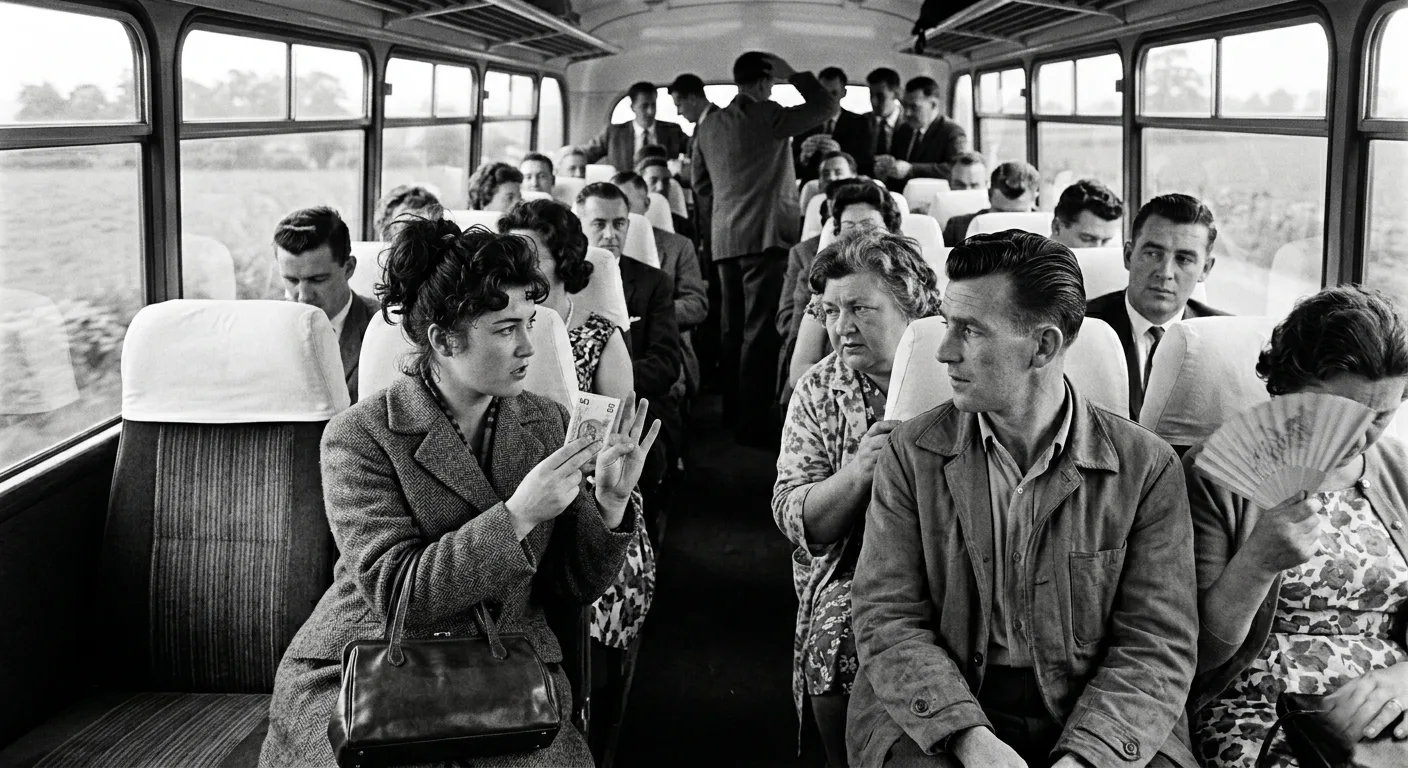
"Oh, you know, Ethel, I wish I had left me tights off today," moaned Edna; to which her eternal friend replied, "I'd lend you my fan, but I need it to cool my face, Edna. I don't want my mascara running all over my cheeks before I get there."
Ronnie was becoming restless in the heat and the frustration of not getting to Scarborough yet, and he rose to his feet and stretched out his arms and legs in the aisle of the bus, before shouting, "There's not a man here who will beat me at the hammer game today! I'm going to hit it that hard, it'll bust through the top and land in the sea."
A general groan emerged from the back of the bus.
"Come and have a game of cards with us, Ronnie. You won't win that," David shouted from the back.
"Ronnie, don't you go losing any money before we even get there," Mary hissed at him.
"I won't; don't be a spoilsport; it's only a bit of fun."
However, Mary knew he would lose money; he always did at cards, because he didn't have the ability to judge character and trickery. Before Ronnie set off for the card game, Mary had quickly moved from the window seat and jumped into Ronnie's vacant seat next to her, whilst grabbing a hold of his trousers to prevent his intended exit.
"Give me that five-pound note now, Ronnie," Mary snapped out between clenched teeth.
"Okay, Mary, don't cause a scene. Here, take it," and he flung the note towards her and then set off toward the back of the bus.
Mary grimaced hard at him leaving and reached down to retrieve the argued note. She felt a slight sense of abandonment, although, upon further thought, Mary recollected her husband hadn't been much of a conversationalist all the time he'd been sat there with her.
Mary glanced to the side of her and noticed Thomas from across the aisle looking at her. When he saw her look at him, Thomas quickly turned his head to look the other way. For a moment, Mary looked intently at the side profile of Thomas. She had never really observed him before.
"Has he always been like this, Thomas?" she inquired abstractedly.
"Ever since I've known him, Mary. Even as a kid, he would be forever clowning around and never serious about anything. At school he was always in trouble, and there wasn't a day when he wasn't outside the headmaster's office, waiting for the cane. He's a character who's in an endless search of fun. He somehow isn't like the rest of us; bad luck, or bad fortune, don't seem to register with him; he simply ploughs through them as though they were invisible. But, I suppose, it's better than being pessimistic."
Mary paused before replying, once again taking even more notice of Thomas.
"I've never known you speak so many words, Thomas. In fact, I don't think we've ever had a conversation in all the two years I've known you. You're right; Ronnie is like a regular child and always will be, I suppose. Sometimes it's hard, though, living in a frivolous bubble with Ronnie. Sometimes, you have to view life with a certain degree of seriousness, so that you don't make stupid mistakes, which cannot be remedied, and will be bitterly regretted later. Ronnie has no understanding of money whatsoever; he knows he has to work hard, and he does work hard to get money, but once he's in possession of money, he's hell-bent on losing it. See this fiver here," and Mary produced the five-pound note and held it up to Thomas betwixt four fingers, "he would have lost this in a matter of minutes; he would have lost something he'd grafted a whole week for down the pit. That's the sort of irresponsible man I married."
"He does have a good heart, though, Mary."
"Don't give me that cliché, Thomas. A 'good heart' is merely a burden and hindrance to happiness when it is bereft of sense at the time. A good heart bereft of sense is positively harmful to one's daily existence," she shot back.
There was a moment's quiet before Thomas changed the subject somewhat. "You're very wordy, aren't you, Mary? Did you get O'Levels?"
"No, like many girls in Doncaster, I left with nothing. My dad, who was a florist, was livid. '14 years of education, and you can't even bring home an O'Level,' he would reproach me with. I do like to read, and I suppose that's why I know a few more words than the average woman in Scardale."
Ethel and Edna, who were sat immediately in front of Mary, could hear every word and let out in unison two perfectly identical grimaces from their contorted faces.
"I left with no O'Levels too, but like you, I don't mind a good read and try to educate myself a bit, but I can understand many of the miners not wanting to bother, as they think, 'What's the point, as I'm only ever going to work down the pit, and no doubt, I'll end up dying down there, too.' But you never know what life holds in store for you nowadays, Mary, and, therefore, a little learning can't be bad."
"A little learning is a dangerous thing in Scardale, Thomas," replied Mary loudly, noticing Ethel and Edna craning their necks between the headrests to listen, "and I can name a couple of corpulent amoebas who would fairly burst, if they could understand what I was on about."
"I hope you're not talking about us, Mary Hardaker," winced Ethel, as she shoved her rounded and red face through the seat-rests.
"Would I do that, Ethel? You have such a charming, self-effacing manner, and insulting you would be tantamount to baseless indulgence in wicked sin, now wouldn't it? Anyway, I'm off to finish off my book on the adventures of an amorous gardener with his Lady, and it shan't be too long before we're in Scarborough," Mary concluded and shuffled back across to the window.
"What did she say?" Edna inquired of Ethel, when the latter had twisted back her face, which was now considerably redder than when it had been first turned round.
"Never mind, Edna," she spat. "Give me that fan, me legs in these tights can't take any more," and finally muttering, "I'll find out what the words mean in Scarborough. You bet I will."
Prefer to listen? Watch the video reading below.
Reader Comments
Leave a Comment
We would love to hear your thoughts on this chapter.

About Karl Swainston
Karl Swainston is a writer and storyteller whose work is forged from a life lived across the North of England and far beyond. Growing up on a Leeds council estate in the 1960s, Karl's journey was anything but linear. By the age of thirty, he had already lived a dozen lives: from the rigors of grammar school to a degree in Latin, a stint as a fishmonger, a period of discovery living in Marseille, and a return to the hustle of London. Whether working as a postman, a builder, or competing as a county-level chess player, he was, above all, an avid reader—constantly documenting the world around him. This restless spirit continued into his professional life. Karl later taught in Bradford, where he ran a specialist unit for 244 of the most excluded students from across the region—young people whom even the local Pupil Referral Units could not accommodate. Working alongside his old friend Malcolm, Karl spent his days navigating the volatility of Bradford's most aggressive and dysfunctional teenagers. Throughout his life, Karl has been an avid runner and has always shared his home with a rotating cast of beloved dogs and cats—companions who have been constant witnesses to his work. As a writer, Karl's range is as expansive as his history. He works across a wide breadth of genres, including fiction and short stories, autobiography and memoir, biography, non-fiction, and metaphysical writing, as well as providing sharp commentary, opinion, analysis, and essays. Whether writing about his years managing the Harrogate Arms or offering insights from his current adopted home in South East India, where he lives in a simple village with his dog, Bambi, Karl's voice reflects the full, untidy, and deeply human breadth of life. He continues to draw on the rich, decades-long tapestry of his experiences to tell stories that matter, proving that no matter where you live, the human story remains the same.
Author Page