Resonance
VI — Do Neurons Know What Is Real?
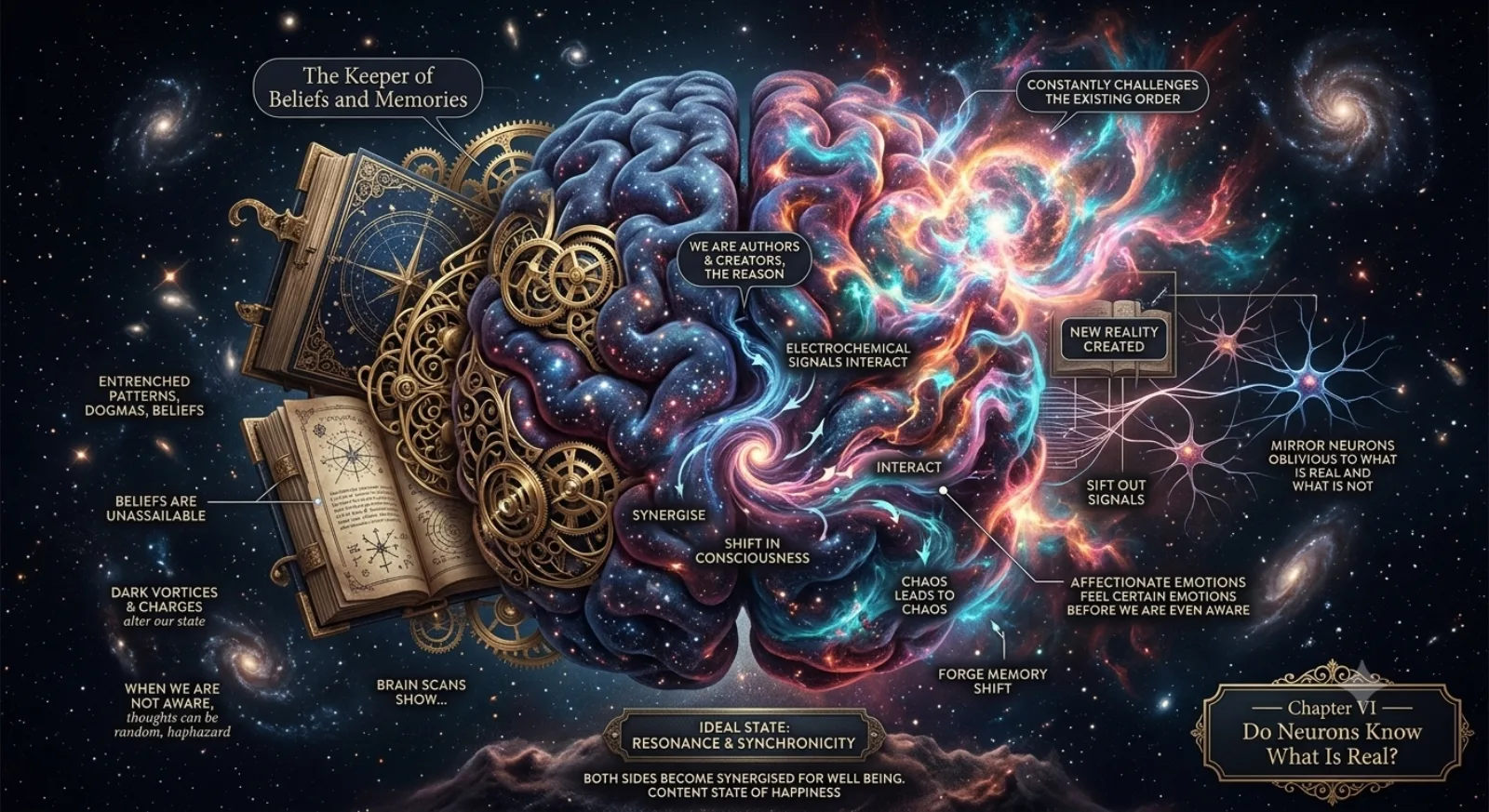
A much more probable reason behind the neurons firing when we are spectators to others' actions and events are that the neurons don't know the difference between what is and what is not. They don't possess any knowledge at all and simply respond to what we seek, what we think, or even what we imagine. The mirror neurons are oblivious to what is real and what is not, just like fear, which is an emotion, but yet can feel real.
The latter has important conclusions for how we see, perceive and imagine the world in our own reality. We are the reason, the authors, and the creators who allow the signals, the stimuli to be sent to the neurons. If we are not aware; if we are not in control of our thoughts, then we become different states of consciousness throughout each passing second of the day. The external world outside, seeing this unguarded state of being, enters in at random charges and alters our states of mind without us knowing. Most of the time we are not conscious that we are doing this, but if we were, we could sift out, as it were, the most unsavoury of signals, and in their place, we could substitute and allow the most favourable of thoughts to fire up the mirror neurons which bring us feelings of goodness, well being, and most importantly of happiness itself. Brain scans can show that in certain cases, we can sometimes feel certain emotions before we are even aware of them. When we not aware, and when we have not taken the care to be conscious what is created in us, thoughts can be random, haphazard, and this chaos will only lead to chaos in the mirror cells.
The brain is split into two parts: the left hemisphere and the right hemisphere. They interact electrochemically to synergise and make sense of the world outside and on the inside. The left hemisphere of the brain is the keeper of beliefs and memories, and when new experiences appear, they have to fit neatly into this world, and if they don't resonate enough in this new kingdom, they are lost until a new, similar experience brings them back. The right hemisphere of the brain constantly challenges this existing order of things, and if the left side is overwhelmed, the right side of the brain can determine the outcome, and it can forge upon its counterpart a memory shift in consciousness. But when the left hemisphere is implacable with its belief, no matter how much assail the right side can muster, the left hemisphere will not be denied, and the belief remains intact and for the present unassailable. The ideal state is when both sides of our brain hemisphere resonate in synchronicity and become synergised for the well being of our whole self. In this state, we can feel a content state of happiness.
Prefer to listen? Watch the video reading below.
Reader Comments
Leave a Comment
We would love to hear your thoughts on this chapter.
About Karl Swainston
Karl Swainston is a writer and storyteller whose work is forged from a life lived across the North of England and far beyond. Growing up on a Leeds council estate in the 1960s, Karl's journey was anything but linear. By the age of thirty, he had already lived a dozen lives: from the rigors of grammar school to a degree in Latin, a stint as a fishmonger, a period of discovery living in Marseille, and a return to the hustle of London. Whether working as a postman, a builder, or competing as a county-level chess player, he was, above all, an avid reader—constantly documenting the world around him. This restless spirit continued into his professional life. Karl later taught in Bradford, where he ran a specialist unit for 244 of the most excluded students from across the region—young people whom even the local Pupil Referral Units could not accommodate. Working alongside his old friend Malcolm, Karl spent his days navigating the volatility of Bradford's most aggressive and dysfunctional teenagers. Throughout his life, Karl has been an avid runner and has always shared his home with a rotating cast of beloved dogs and cats—companions who have been constant witnesses to his work. As a writer, Karl's range is as expansive as his history. He works across a wide breadth of genres, including fiction and short stories, autobiography and memoir, biography, non-fiction, and metaphysical writing, as well as providing sharp commentary, opinion, analysis, and essays. Whether writing about his years managing the Harrogate Arms or offering insights from his current adopted home in South East India, where he lives in a simple village with his dog, Bambi, Karl's voice reflects the full, untidy, and deeply human breadth of life. He continues to draw on the rich, decades-long tapestry of his experiences to tell stories that matter, proving that no matter where you live, the human story remains the same.
Author Page