Resonance
V — Mirror Neurons and the Spectator
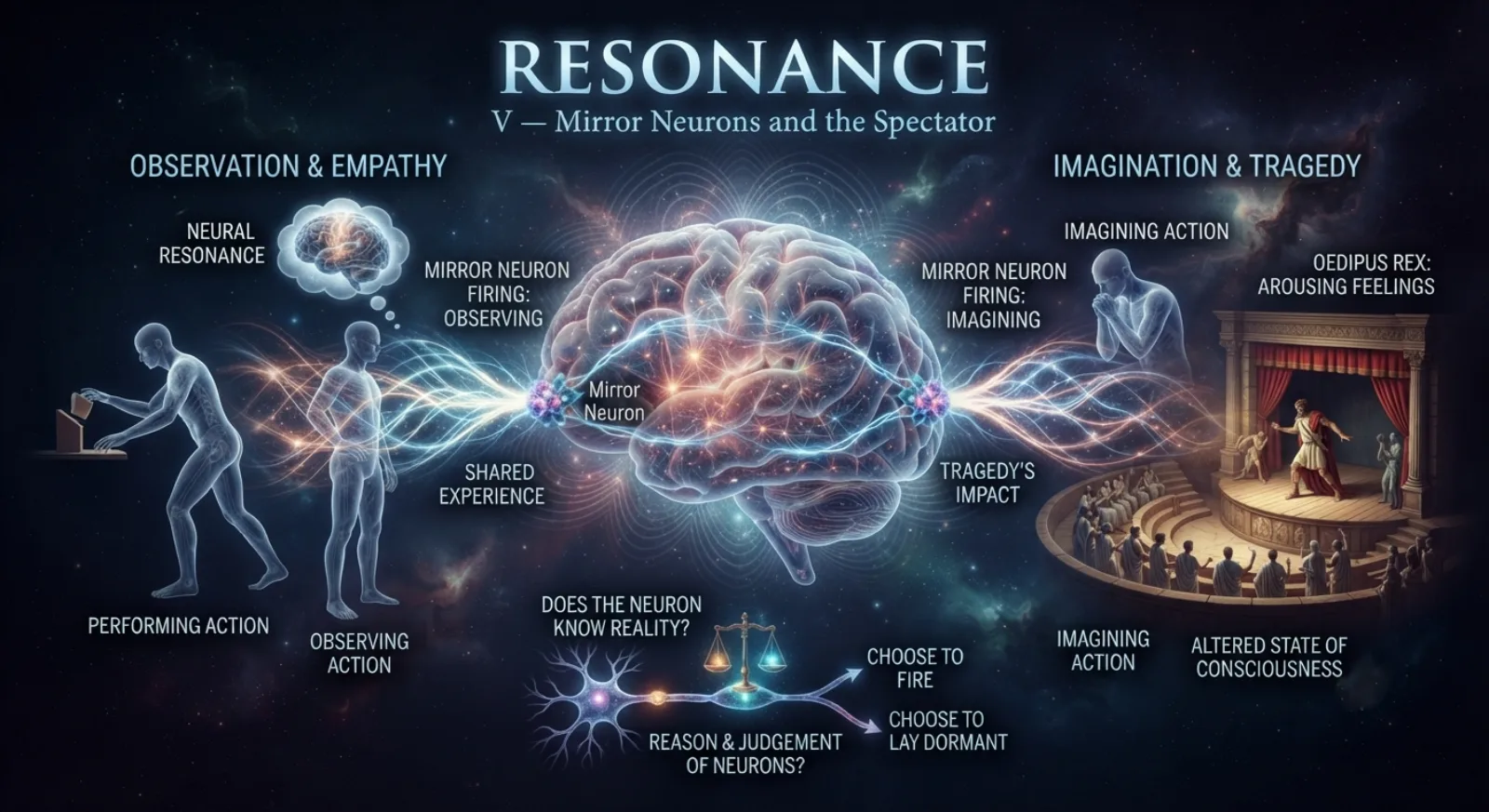
Recent advances in neuroscience are helping us to put together the picture of how we exist and adapt in the world, and how we are shaped by the neurons in our brain, and how they react to the changing fortunes of time outside us. Research has revealed that we all have empathetic mirror neurons. When we act in a particular way, certain neurons fire within the brain, causing us to think, feel, and behave in a different manner. We are an intrinsic part of that act. However, when we observe the same act, undertaken by others, you would think we have the necessary distance to become detached and divorced from that action so that the specific neurons don't fire. But this is not the case, and neuroscience shows that the contrary is often the case, and even when we observe an action that we are not part of in 'reality', as it were, the neurons still choose to fire. And, more importantly, even if we imagine within our beings the action, these neurons can still fire off their energy, so that altered states of consciousness are felt. The ancient Greeks knew all too well this ability of the spectator, the audience to feel another state of consciousness. They created tragedies to arouse our feelings and take us from our present reality to that of another more dreadful reality as happens in Sophocles' Oedipus Rex, whereby King Oedipus, seeking to alleviate the plague which is killing his people, seeks out with implacable determination the killer who has brought the plague and vengeance from the Gods, only to discover that he himself is the killer. In this case, the dramatist, through his creation, was able to alter the audiences' state of being and feel as though it were they themselves unfolding this awful truth about themselves.
But it is not only the act of watching others, which fires of specific neurons in our mind; even the very thought of thinking about some event or other in reflection can cause the neurons to become charged and thus become energised.
Now, all this begs the question as to whether or not these specific neurons know the difference between what is real and what is not? If on the first hand, we assume the neurons have the knowledge and have chosen the path to fire and to alter our states of consciousness, then by necessity, we must also admit that these neurons possess a reason and a judgement to do so, must we not? And if we admit to this conclusion, then we must also admit that other neurons, too, have the possibility to have a reason of their own, and also choose to lay dormant at certain times, or to fire at other times? It does appear to be highly unlikely, but as science shows, anything is possible.
Prefer to listen? Watch the video reading below.
Reader Comments
Leave a Comment
We would love to hear your thoughts on this chapter.
About Karl Swainston
Karl Swainston is a writer and storyteller whose work is forged from a life lived across the North of England and far beyond. Growing up on a Leeds council estate in the 1960s, Karl's journey was anything but linear. By the age of thirty, he had already lived a dozen lives: from the rigors of grammar school to a degree in Latin, a stint as a fishmonger, a period of discovery living in Marseille, and a return to the hustle of London. Whether working as a postman, a builder, or competing as a county-level chess player, he was, above all, an avid reader—constantly documenting the world around him. This restless spirit continued into his professional life. Karl later taught in Bradford, where he ran a specialist unit for 244 of the most excluded students from across the region—young people whom even the local Pupil Referral Units could not accommodate. Working alongside his old friend Malcolm, Karl spent his days navigating the volatility of Bradford's most aggressive and dysfunctional teenagers. Throughout his life, Karl has been an avid runner and has always shared his home with a rotating cast of beloved dogs and cats—companions who have been constant witnesses to his work. As a writer, Karl's range is as expansive as his history. He works across a wide breadth of genres, including fiction and short stories, autobiography and memoir, biography, non-fiction, and metaphysical writing, as well as providing sharp commentary, opinion, analysis, and essays. Whether writing about his years managing the Harrogate Arms or offering insights from his current adopted home in South East India, where he lives in a simple village with his dog, Bambi, Karl's voice reflects the full, untidy, and deeply human breadth of life. He continues to draw on the rich, decades-long tapestry of his experiences to tell stories that matter, proving that no matter where you live, the human story remains the same.
Author Page