Resonance
XIX — The Subconscious Reservoir
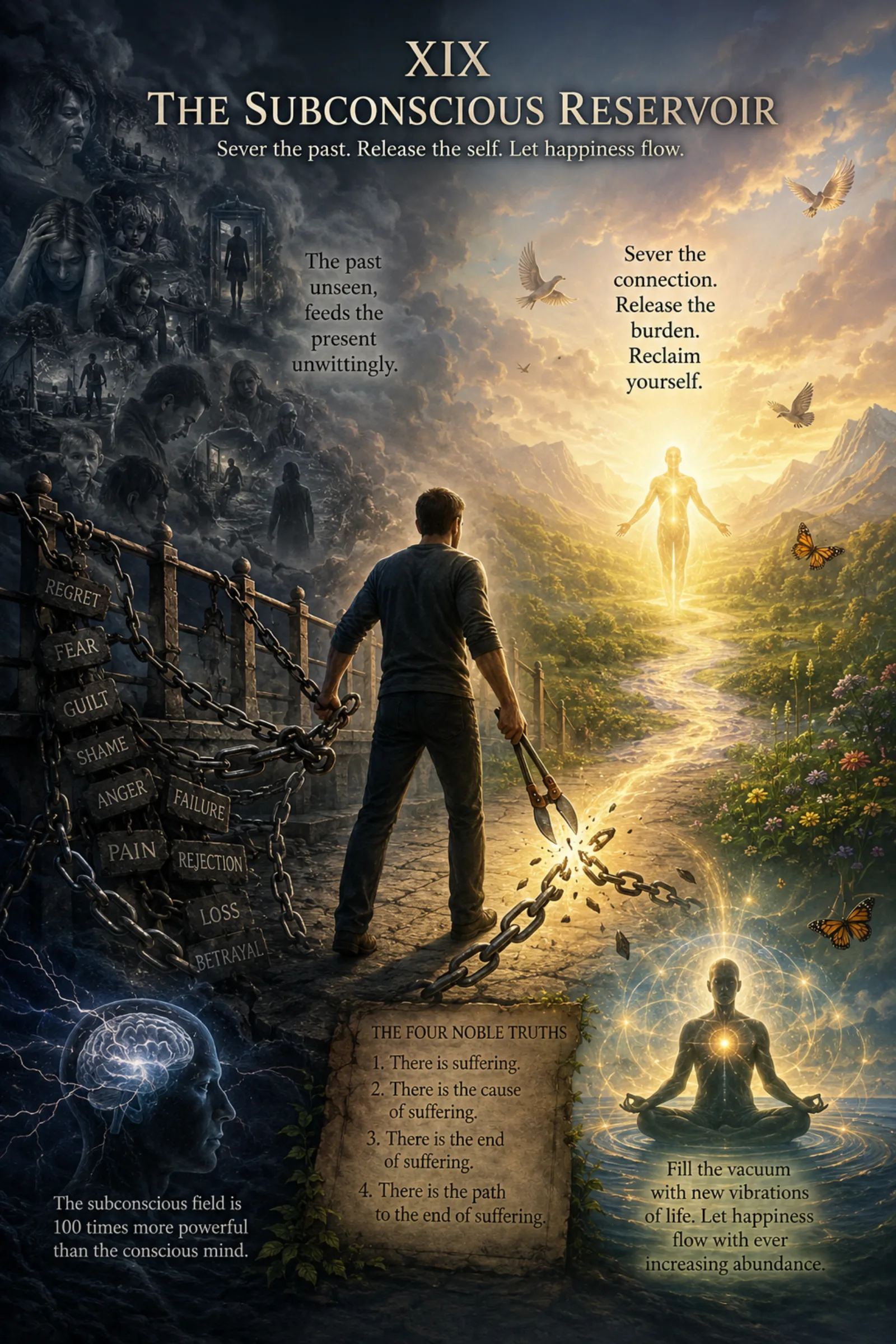
Trailing behind us all is a constant stream and line of past baggage, unwittingly and unwontedly connected to our present self. We have to begin to see this ungodly trail, and, by seeing it, we can severe irrevocably the connection pulling us to sadness and daily drudgery. Denying these past experiences allow them to fester in our subconscious field, and it is in this powerful subconscious field, a field a 100 times more powerful and potent than our conscious mind, it is here where they can resonate without censorship and cause havoc with the entirety of our being. Once we sever this dreadful connection to this subconscious reservoir of self sin – because allowing us to be made unhappy by us is tantamount to a sin against ourselves – we will feel the lightness of release, and rather than being weighed down by the drudgery of daily life, the vacuum in our whole being will begin to fill with new positive vibrations of life, and this, in turn, will allow happiness to flow within us with ever increased abundance.
In order to find this new self, we must first lose the old self, and we cannot do this by hiding away from it, but by obliterating it. The properties of these reservoirs of self sin are infinitesimally small pockets of energy, which, like loaded springs, can unleash their force and energy at the merest hint or connection to their existence. We know, science knows, that these thoughts and energies exist, and if they exist, then it's possible to cease their existence with the will. The Buddha taught us that there are 4 noble truths. In the first there is suffering, and in the second there is the cause of suffering; the third is the end of suffering, and, finally, there is the path to the end of suffering. What we can do at the resonant level to obliterate the suffering of the past is to understand its cause, and only by understanding its cause, can we reach for the upper air of enlightenment.
Ancient civilisations, communities existing in the depths of the past before the plethora of medicinal help we have today can be found to be perfectly happy societies living not off medication but off their own free and unfettered will not to be sick.
Our bodies continuously react to everyday situations, and our emotions are an intrinsic part of that theatre. The emotions are electrically charged pockets of energy which communicate with all the other functions of our being. Often times when we have to deal with situations which are new to us and don't have the fabric of previous experience or understanding for us to deal with them, the emotions draw on pockets of similar energy from our past experiences as a method of dealing with this new experience. The emotions don't understand the full depth of this present experience, and, because of this, a prophylactic measure to defend against anything that could be a threat is initiated. All creatures possess to some degree this capacity, but humans beings are unique in having the unenviable ability to hold on to this stress experience in their memory.
Prefer to listen? Watch the video reading below.
Reader Comments
Leave a Comment
We would love to hear your thoughts on this chapter.
About Karl Swainston
Karl Swainston is a writer and storyteller whose work is forged from a life lived across the North of England and far beyond. Growing up on a Leeds council estate in the 1960s, Karl's journey was anything but linear. By the age of thirty, he had already lived a dozen lives: from the rigors of grammar school to a degree in Latin, a stint as a fishmonger, a period of discovery living in Marseille, and a return to the hustle of London. Whether working as a postman, a builder, or competing as a county-level chess player, he was, above all, an avid reader—constantly documenting the world around him. This restless spirit continued into his professional life. Karl later taught in Bradford, where he ran a specialist unit for 244 of the most excluded students from across the region—young people whom even the local Pupil Referral Units could not accommodate. Working alongside his old friend Malcolm, Karl spent his days navigating the volatility of Bradford's most aggressive and dysfunctional teenagers. Throughout his life, Karl has been an avid runner and has always shared his home with a rotating cast of beloved dogs and cats—companions who have been constant witnesses to his work. As a writer, Karl's range is as expansive as his history. He works across a wide breadth of genres, including fiction and short stories, autobiography and memoir, biography, non-fiction, and metaphysical writing, as well as providing sharp commentary, opinion, analysis, and essays. Whether writing about his years managing the Harrogate Arms or offering insights from his current adopted home in South East India, where he lives in a simple village with his dog, Bambi, Karl's voice reflects the full, untidy, and deeply human breadth of life. He continues to draw on the rich, decades-long tapestry of his experiences to tell stories that matter, proving that no matter where you live, the human story remains the same.
Author Page