Resonance
XIV — The Resonant Realm
We previously touched upon the Law of Vibration, and for this most important law, it is necessary to understand the law at the resonant level.
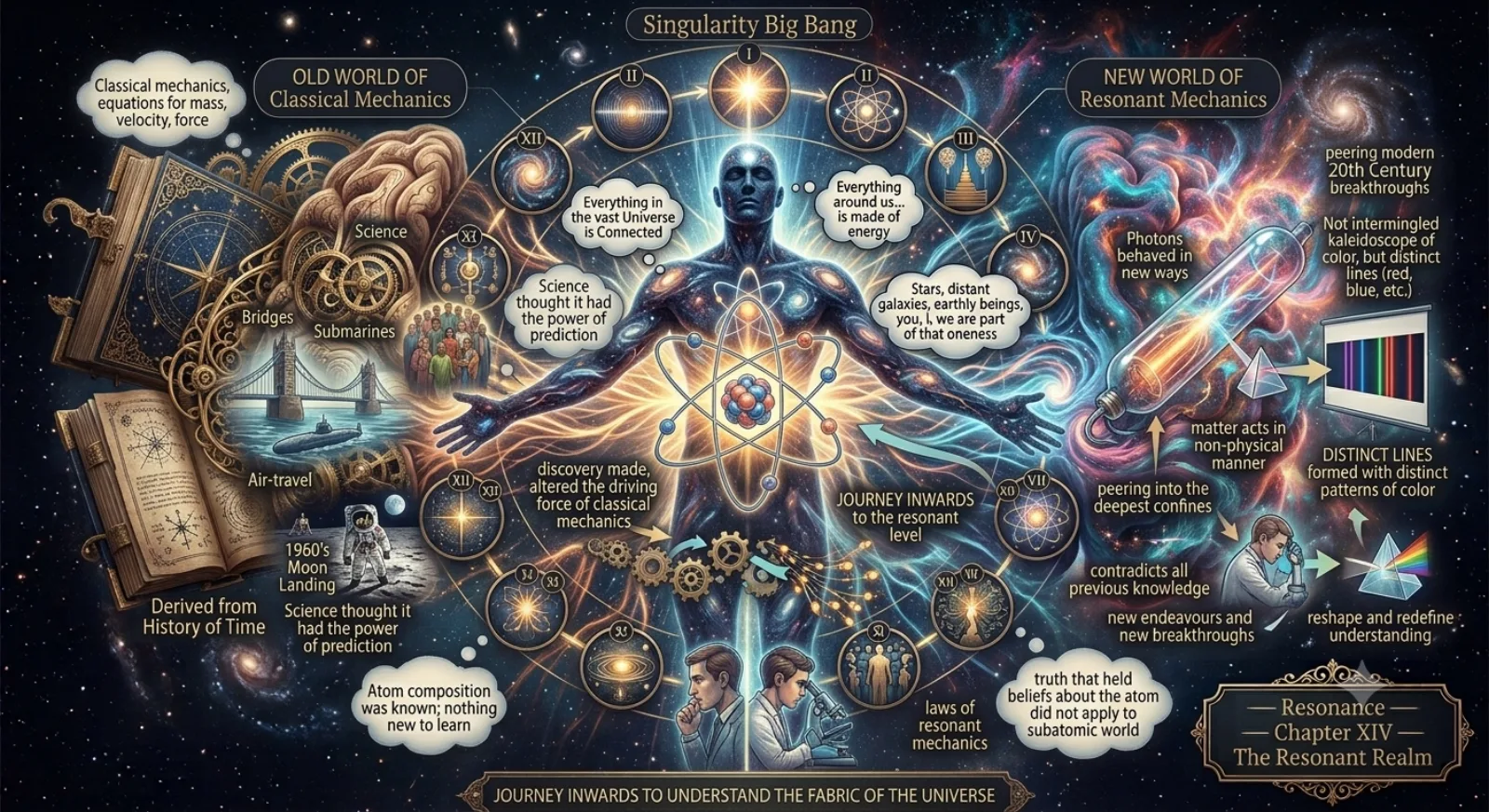
Since the beginning of consciousness within our distant ancestors, we have endeavoured to understand the vastness of the Universe and of our position within this awesome architecture. Modern science, however, rather than looking out into the vastness of space, has begun to journey inwards, to the resonant level in order to understand the fabric of the Universe. The resonant laws are helping us to reshape and redefine our previous understanding of this cosmic event. These are the laws of resonant mechanics.
Once upon a time, science and its many dilettantes believed the composition of the atom was known, and that there was nothing new to learn about its attributes. But with the turning of the modern 20th Century, new endeavourments and new breakthroughs began to see deeper within the subatomic particles, and there, acting within its deepest confines, a whole new and wonderful world was discovered. It uncovered the truth that hitherto held beliefs about the atom did not apply to the subatomic world. In this new world, matter acts and responds in a non-physical manner.
Resonant mechanics exist in all matter and contradict all previous physical knowledge our ancestors had of the world in which we live. Classical mechanics demonstrated a series of equations covering, mass, acceleration, force, velocity etc. For centuries, these laws have governed and driven both our understanding of the world and created new worlds of knowledge in a creative expression: bridges, submarines, air-travel, space travel and in the 1960's made it possible to move from Earth and step on to the Moon. Science thought they had it understood; science thought it had the power of prediction in relation to matter and how it would behave. But then, with the turning of the last Century, a discovery was made, which altered the driving force of classical mechanics.
Many experiments have been conducted on light, in particular on how photons of light behaved when they were heated in glass tubes. The scientists expected and predicted the light would behave in exactly the same way as it always had, but they were astonished to discover that it behaved in entirely new ways when they looked at the light through a prism. They beheld a series of very distinct lines being formed with very distinct patterns of colour. The light did not behave in the way they had predicted and expected. It was not the intermingled kaleidoscope of colour, but very distinct lines of red, blue etc. The race was now on to explain what indeed was happening to the light for it to behave in this peculiar way. They began to look at the fundamental structure and properties of the atom; they began to peer into the whole new world of the resonant realm.
Prefer to listen? Watch the video reading below.
Reader Comments
Leave a Comment
We would love to hear your thoughts on this chapter.
About Karl Swainston
Karl Swainston is a writer and storyteller whose work is forged from a life lived across the North of England and far beyond. Growing up on a Leeds council estate in the 1960s, Karl's journey was anything but linear. By the age of thirty, he had already lived a dozen lives: from the rigors of grammar school to a degree in Latin, a stint as a fishmonger, a period of discovery living in Marseille, and a return to the hustle of London. Whether working as a postman, a builder, or competing as a county-level chess player, he was, above all, an avid reader—constantly documenting the world around him. This restless spirit continued into his professional life. Karl later taught in Bradford, where he ran a specialist unit for 244 of the most excluded students from across the region—young people whom even the local Pupil Referral Units could not accommodate. Working alongside his old friend Malcolm, Karl spent his days navigating the volatility of Bradford's most aggressive and dysfunctional teenagers. Throughout his life, Karl has been an avid runner and has always shared his home with a rotating cast of beloved dogs and cats—companions who have been constant witnesses to his work. As a writer, Karl's range is as expansive as his history. He works across a wide breadth of genres, including fiction and short stories, autobiography and memoir, biography, non-fiction, and metaphysical writing, as well as providing sharp commentary, opinion, analysis, and essays. Whether writing about his years managing the Harrogate Arms or offering insights from his current adopted home in South East India, where he lives in a simple village with his dog, Bambi, Karl's voice reflects the full, untidy, and deeply human breadth of life. He continues to draw on the rich, decades-long tapestry of his experiences to tell stories that matter, proving that no matter where you live, the human story remains the same.
Author Page