Murder & the Devil
III - The Deception and the Demise
← Karl Swainston / Murder & the Devil
Earnest Ackroyd was 88 years old and had owned the farm all his life. His parents had passed it on to him, he had never married, and he had no children. The farm had fallen into disrepair, and he led a reclusive life. There was no livestock, only a few knackered, old horses that chomped endlessly upon the grass.
“I used to be able to look after the farm, but now I’m old I cannot. The kids keep getting through the fence and nicking things.”
Racid’s fingers began to twitch.
“I’ll sort out the fence, Mr Ackroyd; don’t worry about that.”
Racid did sort out the fence and everything else. He befriended the old man and curried his way into his favor and trust. Only a few weeks passed before Racid left his bed-sit and moved into the farm.
Racid’s plan was simple: get the farm. He bided his time, carrying out every conceivable task for the old fellow, making a point of ensuring Ackroyd noticed.
The Will
After a couple of years, Racid was convinced the time was right to discuss the will.
“You don’t have any children, Mr Ackroyd, do you? You’ve never mentioned any relatives; have you any?”
“I don’t think so, lad, and if I had, I wouldn’t know where they are, or who they are for that matter. There’s only me and you now, son.”
Racid smiled and pursued his line of attack. “I know I shouldn’t mention it, but what would happen to me should you…?”
“Die? Don’t shy away from the word, lad. We all must die one day. I’ve been thinking lately about that. I don’t have any money, and this farm, if you can call it that now, is all I have left. I have decided that you shall have it when I die.”
Racid tried to keep calm, but he trembled all over. “You will have to fill a will out for that to happen, Mr Ackroyd.”
“I will do the will tomorrow. Will do the will!”
Both men fell to laughing. Upon the next day, the will was signed, and Racid was now the sole beneficiary.
The Accident
A year passed without changes, but in the 91st year of the old man’s life, an accident occurred. On a cold night in January 1968, a 999 call from a phone box on Dewsbury Road was made to the Leeds Ambulance Service.
Racid made the call. When the ambulance men arrived, they were met by Racid, who escorted them to the bottom of the stairs where Ackroyd’s body lay. A paramedic quickly confirmed the old man was dead, stating the most probable cause was a combination of falling down the stairs and his advanced age.
“I’ve seen many dead bodies before in my job,” commented one of the paramedics, “but look at the horror, shock, and the twisted anger on that old man’s face. It makes you wonder what he was thinking at the time of his death, doesn’t it?”
Racid concealed a smile.
The Investigation
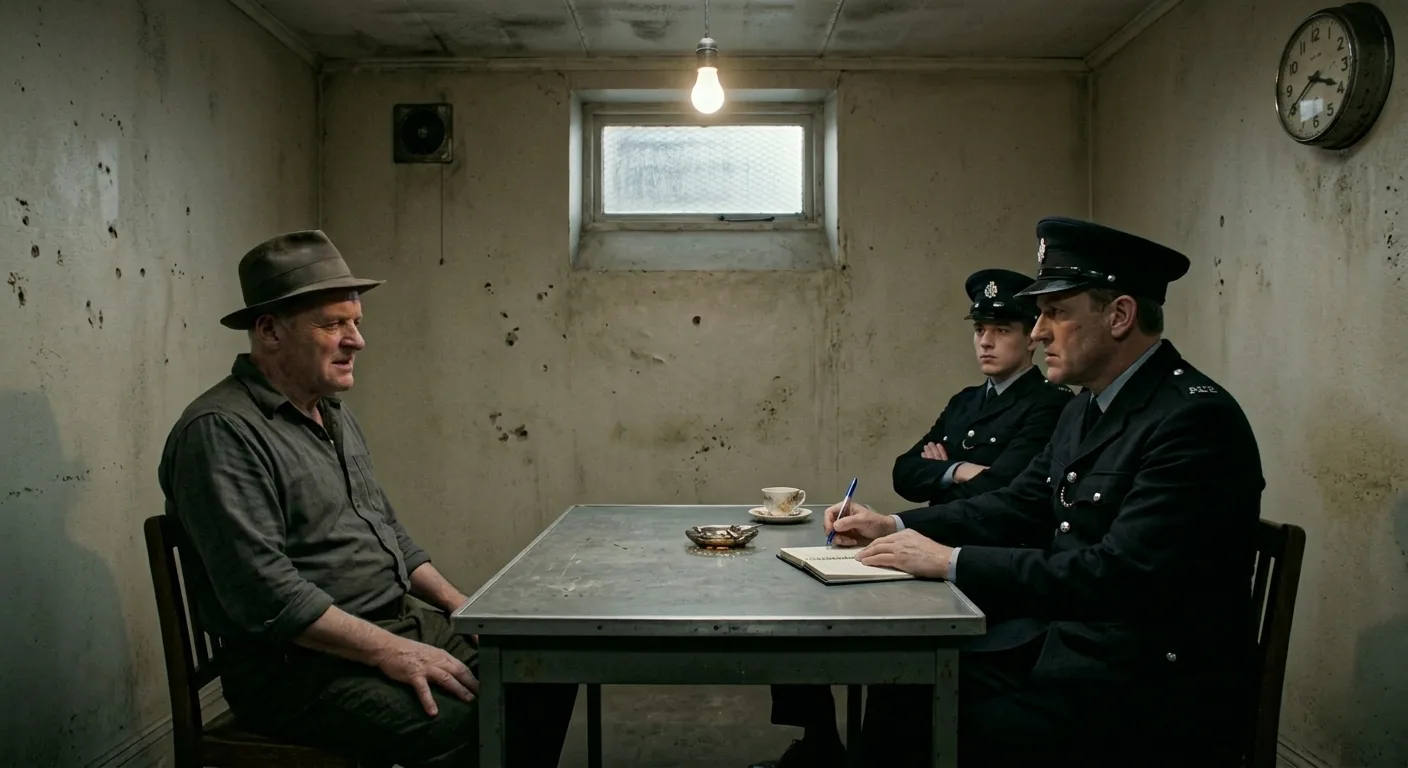
A police officer arrived shortly after. After questioning the ambulance staff, he turned to Racid.
“Was the old man your father?”
“No, but he was like a dad to me. I lived here with him.”
“Mr Racid, I’m very sorry for your loss,” the officer said. “However, because of the nature of death and your relationship with Mr Ackroyd, we will have to conduct an autopsy and go through the necessary investigation. It’s all perfectly normal. If you’ll accompany me to the station…”
“Certainly, Officer,” replied Racid calmly.
At the station, Racid was interviewed in a polite, clinical manner. Since he had nowhere else to stay, he was allowed to sleep in a cell. He slept soundly.
The next morning, the Inspector stood before him.
“I’m glad to see that you have slept soundly, Mr Racid. The preliminary report from the autopsy concurs with earlier investigations. You are free to go.”
“Thank you, Inspector.”
As he walked past the Inspector, Racid spotted a leftover biscuit on a plate. “Waste not, want not!” he uttered.
The Recluse
Racid took charge of the property. Years passed and no one came to claim the land. The farm took on the aspect of a scrap yard, surrounded by large fences and a pack of hounds.
Racid lived alone. He continued to work at the factory for a time, but his anxiety about his possessions became unbearable. He eventually packed in his job and remained at the farm, gathering scrap and claiming benefits. He barely left the property during the day and never at night, becoming a complete recluse.
Reader Comments
Leave a Comment
We would love to hear your thoughts on this chapter.
About Karl Swainston
Karl Swainston is a writer and storyteller whose work is forged from a life lived across the North of England and far beyond. Growing up on a Leeds council estate in the 1960s, Karl's journey was anything but linear. By the age of thirty, he had already lived a dozen lives: from the rigors of grammar school to a degree in Latin, a stint as a fishmonger, a period of discovery living in Marseille, and a return to the hustle of London. Whether working as a postman, a builder, or competing as a county-level chess player, he was, above all, an avid reader—constantly documenting the world around him. This restless spirit continued into his professional life. Karl later taught in Bradford, where he ran a specialist unit for 244 of the most excluded students from across the region—young people whom even the local Pupil Referral Units could not accommodate. Working alongside his old friend Malcolm, Karl spent his days navigating the volatility of Bradford's most aggressive and dysfunctional teenagers. Throughout his life, Karl has been an avid runner and has always shared his home with a rotating cast of beloved dogs and cats—companions who have been constant witnesses to his work. As a writer, Karl's range is as expansive as his history. He works across a wide breadth of genres, including fiction and short stories, autobiography and memoir, biography, non-fiction, and metaphysical writing, as well as providing sharp commentary, opinion, analysis, and essays. Whether writing about his years managing the Harrogate Arms or offering insights from his current adopted home in South East India, where he lives in a simple village with his dog, Bambi, Karl's voice reflects the full, untidy, and deeply human breadth of life. He continues to draw on the rich, decades-long tapestry of his experiences to tell stories that matter, proving that no matter where you live, the human story remains the same.
Author Page