Murder & the Devil
II - The Discovery
← Karl Swainston / Murder & the Devil
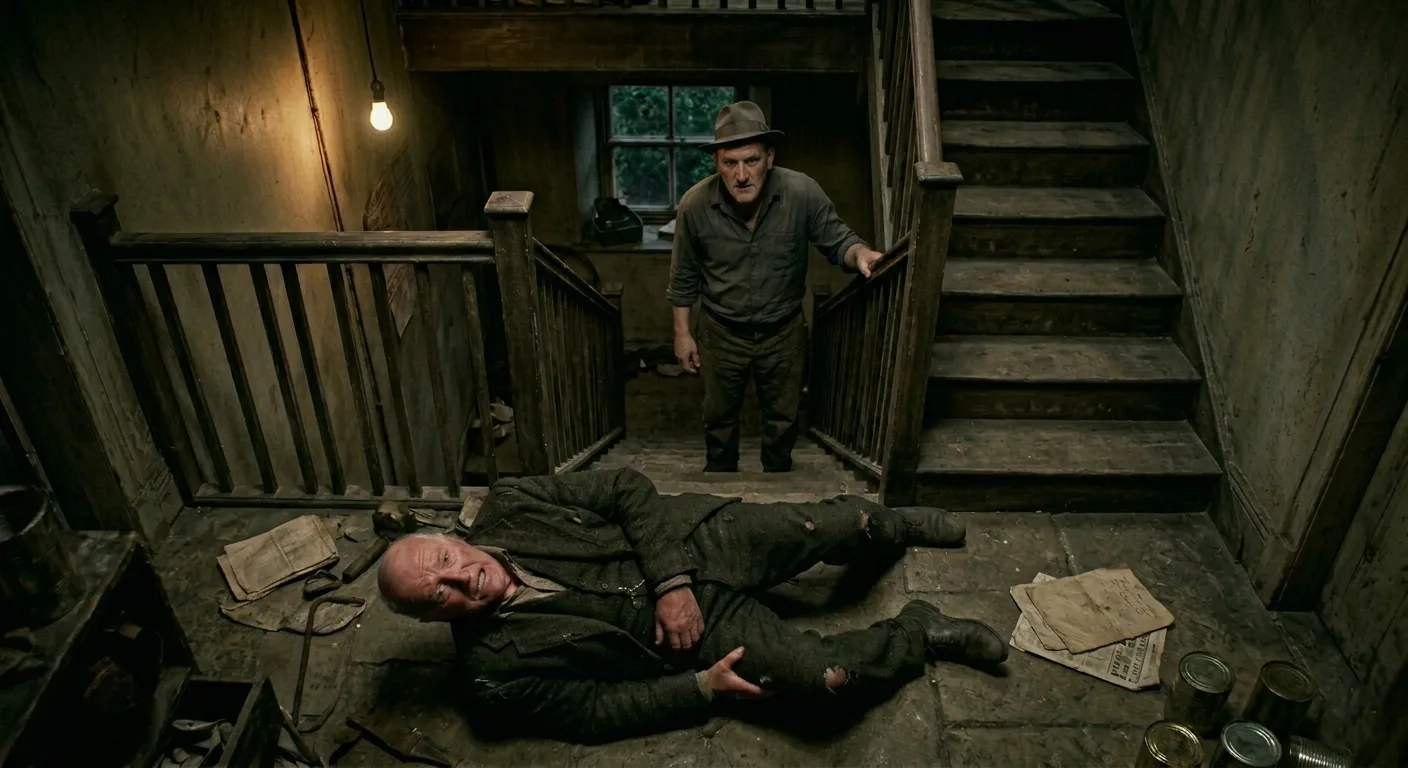
It was a beautiful summer’s afternoon when Racid finished fixing an old wheelbarrow to sell at the factory. He felt the heat unbearable in his choking bed-sit and decided to take a fresh stroll through Middleton Woods.
On the way along a somewhat deserted lane leading to the woods, Racid heard a groan coming from a semi-derelict farm across a short field. He ignored it at first, but upon hearing it a second time, he went to investigate.
When he neared the perimeter fence, he saw a large, hunched piece of cloth on the ground. Another groan rose from the strange pile on the grass. Not knowing what to do, since the fence barred access to the figure, Racid stared at the lump.
At last, a pink, bald head lifted itself from the clothes and looked toward him.
“Help me,” it called.
Racid realized the man on the floor was old and in need of help. Rather than springing into action, however, Racid concentrated his mind on what could be gained from the man’s accident.
“I wonder if he’s got any money on him,” thought Racid.
“Help me get into the house. Please. The dogs are tied up in the back yard, and you can let yourself through the front gates. Help me, please,” the old man pleaded.
Racid didn’t answer but walked casually down to the front gates. He entered, but rather than hurrying up the field to the old man, he walked toward the house. He knocked, but there was no answer; he then banged hard with his fist. Again, there was no reply.
He tried the door handle, but it was locked. Racid ventured around the property, trying to find access while carefully avoiding the back yard with the dogs, but to no avail. Realizing he could not get inside without breaking in, Racid walked back to the old man on the ground.
“You’ve been some time. Couldn’t you get through the gates?” muttered the old man.
“I didn’t know how to do it,” Racid replied calmly.
“I feel a bit better, and I don’t think I’ve broken any bones. Help me up.”
Racid put his right arm out to help the old fellow up, but with his left arm, he began searching the man’s pockets for anything valuable. He found nothing but scraps of old paper.
“I’ll take you to your house.”
“Cheers,” said the old man.
Racid helped him back to the farmhouse, where the old man unlocked the door and they entered. Racid’s eyes widened as his gaze latched onto a veritable treasure house. All sorts of junk littered the property. As Racid regularly bought and sold old goods, he quickly determined the house was easy pickings.
The two entered the kitchen and sat at the table.
Racid began, “It was good to help you. I don’t know what you’d have done if I hadn’t.”
“You’ve done well, lad; you’ve done well.”
“What’s your name?” Racid questioned.
“Mr Ackroyd, and this is my farm.”
Reader Comments
Leave a Comment
We would love to hear your thoughts on this chapter.

About Karl Swainston
Karl Swainston is a writer and storyteller whose work is forged from a life lived across the North of England and far beyond. Growing up on a Leeds council estate in the 1960s, Karl's journey was anything but linear. By the age of thirty, he had already lived a dozen lives: from the rigors of grammar school to a degree in Latin, a stint as a fishmonger, a period of discovery living in Marseille, and a return to the hustle of London. Whether working as a postman, a builder, or competing as a county-level chess player, he was, above all, an avid reader—constantly documenting the world around him. This restless spirit continued into his professional life. Karl later taught in Bradford, where he ran a specialist unit for 244 of the most excluded students from across the region—young people whom even the local Pupil Referral Units could not accommodate. Working alongside his old friend Malcolm, Karl spent his days navigating the volatility of Bradford's most aggressive and dysfunctional teenagers. Throughout his life, Karl has been an avid runner and has always shared his home with a rotating cast of beloved dogs and cats—companions who have been constant witnesses to his work. As a writer, Karl's range is as expansive as his history. He works across a wide breadth of genres, including fiction and short stories, autobiography and memoir, biography, non-fiction, and metaphysical writing, as well as providing sharp commentary, opinion, analysis, and essays. Whether writing about his years managing the Harrogate Arms or offering insights from his current adopted home in South East India, where he lives in a simple village with his dog, Bambi, Karl's voice reflects the full, untidy, and deeply human breadth of life. He continues to draw on the rich, decades-long tapestry of his experiences to tell stories that matter, proving that no matter where you live, the human story remains the same.
Author Page