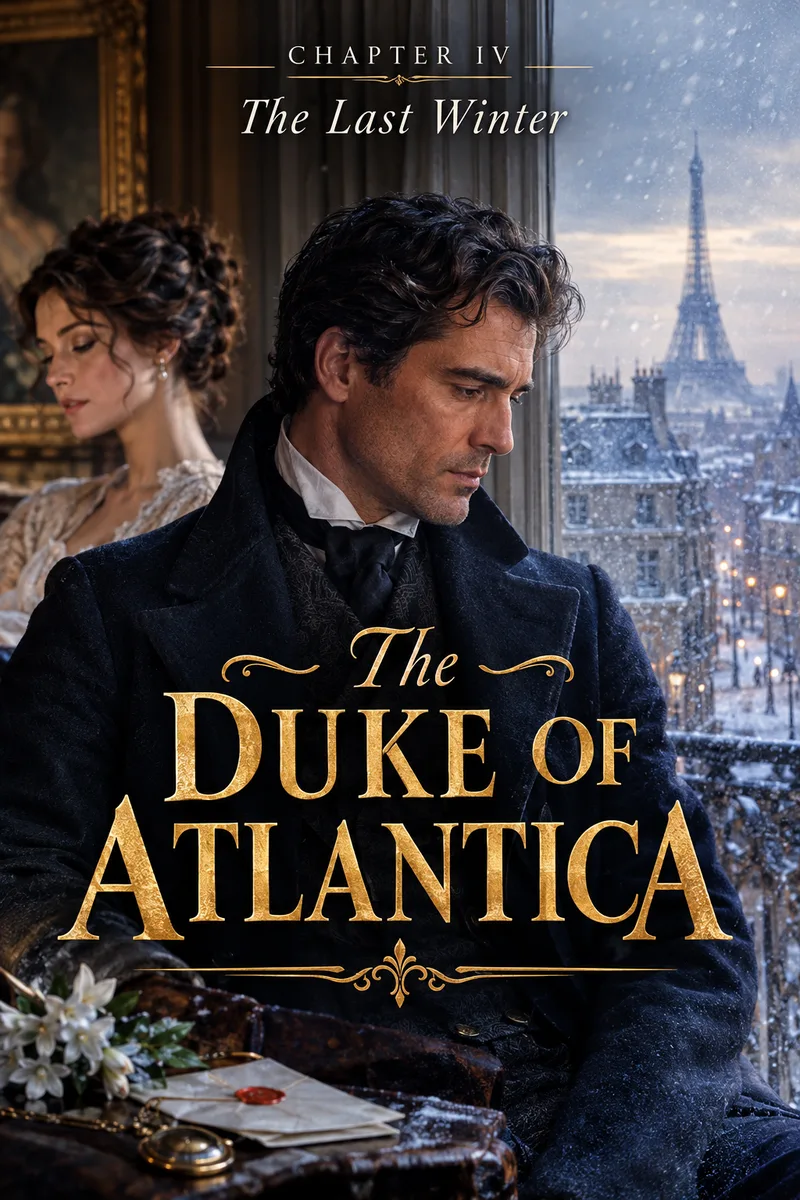
The Duke of Atlantica
Chapter IV — The Last Winter
← Jackie Hilloughby / The Duke of Atlantica
The Duke of Atlantica survived.
This is not the same thing as saying that he recovered.
Society eventually discovered new scandals.
London always does.
The rumours surrounding Edward faded. Lady Helena returned to England after two years abroad, though she and Edward never again became husband and wife in anything but name. They occupied separate wings of Atlantica House and conducted their lives with the solemn courtesy of diplomats from hostile nations.
Edward remained Duke.
He attended Parliament.
He managed his estates.
He received ambassadors and entertained foreign princes.
He became, to the outside world, precisely the man he had once pretended to be.
But something had changed.
He no longer mistook obedience for virtue.
Nor did he mistake rebellion for freedom.
Years passed.
One December morning, a letter arrived from Paris.
Lily was ill.
Edward read the letter twice.
He immediately ordered his carriage.
His secretary protested that the weather was dangerous.
Edward replied simply:
“I have spent too much of my life allowing other people to tell me where I may go.”
He travelled to Paris.
He found Lily in a small apartment overlooking a narrow street.
She was older.
So was he.
For several moments they merely looked at one another.
Then she smiled.
“You came.”
“I should have come sooner.”
“No.”
“Why not?”
“Because then we might have ruined what remained.”
He sat beside her.
They spoke for hours.
They remembered London, the theatre, the rain, the garden and the ridiculous certainty of youth.
At last Edward said:
“I loved you.”
Lily looked at him.
“You still do.”
“Yes.”
She smiled.
“And now you know what it means.”
He took her hand.
“I know what it cost.”
Outside, snow began to fall.
For the first time, Edward felt no desire to possess her.
He did not ask her to return to England.
He did not ask her to become Duchess.
He did not ask for another chance.
He simply sat beside her.
And in that silence, something like peace entered the room.
Lily died three days later.
Edward remained in Paris for a week.
When he finally returned to England, the world received him with its customary indifference. London had forgotten the scandal. The newspapers were concerned with politics, the markets and a new actress whose beauty was already becoming the subject of fashionable conversation.
Edward returned to Atlantica House.
He walked through the portrait gallery alone.
There hung the dead Rovers: dukes, duchesses, generals and statesmen, each painted with the solemn confidence of people who had believed themselves permanent.
Edward stopped before the portrait of the fifth Duke.
For years he had thought those painted eyes were judging him.
Now he understood that they were merely eyes.
He laughed.
It was the first genuine laugh that portrait gallery had heard in generations.
Lady Helena found him there.
“You are leaving,” she said.
“Yes.”
“Where?”
“I don't know.”
She looked at him.
For a moment they were no longer husband and wife, duke and duchess, but simply two human beings who had lost something and survived it.
“Will you return?”
“Perhaps.”
She nodded.
“I hope you find what you are looking for.”
Edward looked towards the windows.
Outside, the winter fields stretched beneath a pale sky.
“I think,” he said slowly, “that I finally have.”
And so the Duke of Atlantica departed from the house which had given him everything except happiness.
The tragedy of Edward Rover was not that he had loved Lily.
Nor was it that he had betrayed his marriage.
The tragedy was that he had believed himself powerful enough to escape the consequences of either.
His downfall had begun with the pride of a man who thought a title could command fate.
His recognition came when he discovered that love could not be possessed.
And his catharsis, if such a word may be permitted to describe the quiet end of a very English tragedy, came not through triumph but surrender.
For in the end Edward understood what the philosophers, priests and poets had been attempting to tell mankind since the beginning of memory: that no man, however exalted his birth, stands outside the laws that govern ordinary hearts.
The Duke of Atlantica had possessed estates, servants, titles and power.
But the one thing he had wanted most could neither be bought nor commanded.
He could only love it.
And then let it go.

About Jackie Hilloughby
Jackie Hilloughby lives in the Worcestershire countryside with her husband and two children. She has been writing for over fifteen years and has a particular love of Victorian fiction, its drawing rooms, its secrets, and the quiet tragedies that unfold behind closed doors. Her work explores the tension between duty and desire, the weight of inheritance, and the cost of a life lived according to other people's expectations. The Duke of Atlantica was her first novella for Tales From A Harrogate Caravan; The Duke of Rutland is her second.
Author Page
Reader Comments
Leave a Comment or a Book Review
We would love to hear your thoughts on this chapter, or even a complete book review.