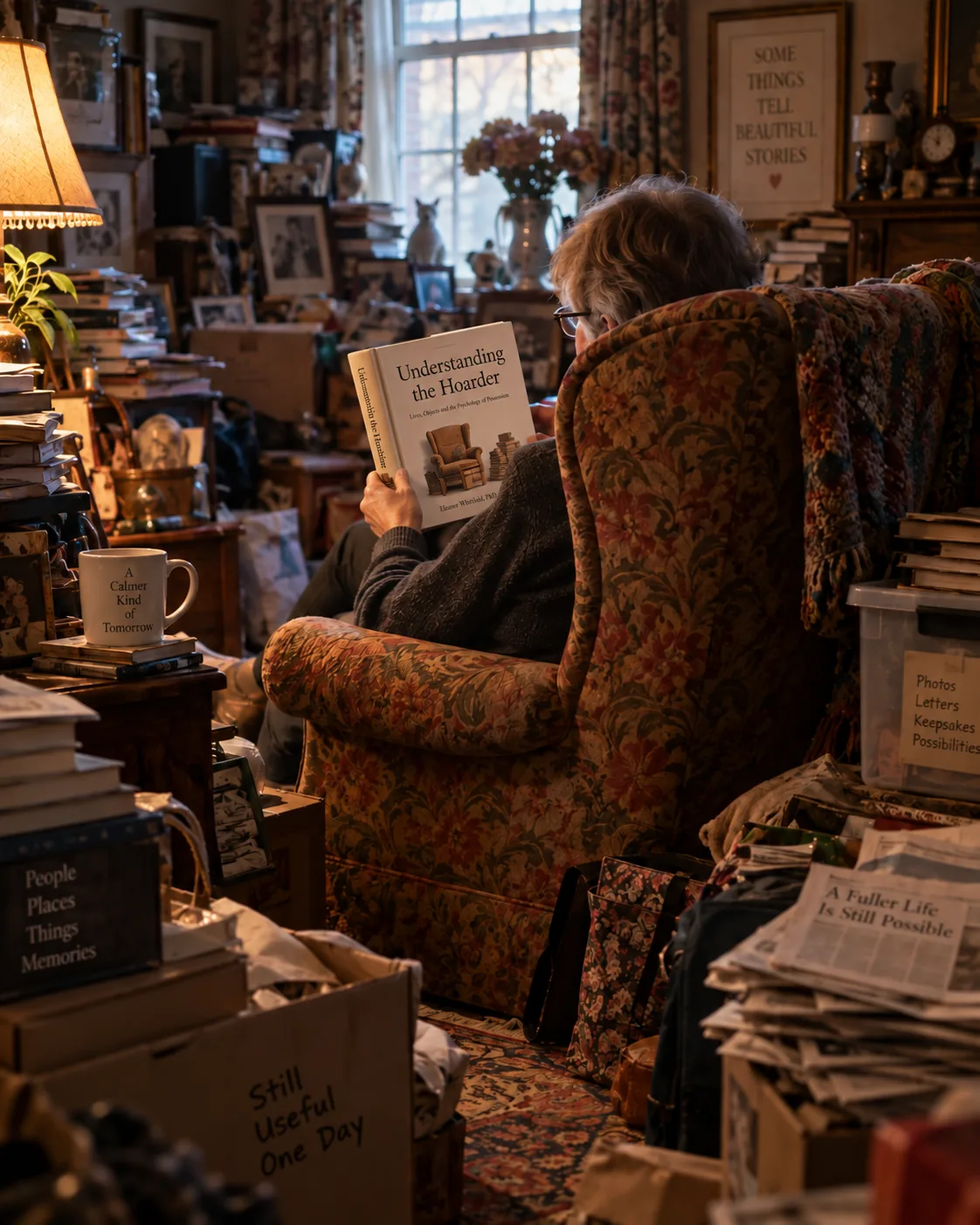
Understanding the Hoarder
Chapter 4 — Identity, Loss, and the Emotional Anchors of Belongings
← Harry Georgiou / Understanding the Hoarder
When we begin to understand hoarding, we quickly notice something powerful: it is rarely about possessions. It is about identity.
Yes, objects fill the rooms, clutter the surfaces, block doorways, and make ordinary daily living difficult. But what fills the house is not just stuff. It is a collection of stories, emotional stories, sometimes unresolved, sometimes painful, sometimes comforting, sometimes deeply protective.
Every item in a hoarded home once had a purpose, practical, emotional, or symbolic. But while most people let go of objects when they stop being useful, someone affected by hoarding often keeps them long after, because the meaning remains, long after the usefulness fades.
Objects can do emotional jobs. Even when no longer useful, they may still represent who I was, who I want to be again, someone I have lost, evidence of when my life made sense, or something I never finished but still hope to one day.
In these homes, belongings don't just sit on shelves. They speak. They remind. They comfort. And sometimes, they protect.
When Belongings Start Holding Identity
For many people who hoard, their belongings start to become extensions of themselves.
The piles are not random. They are often organised in emotional zones: a pile that represents a past hobby or skill, before health declined; a box of clothes from a time they felt confident, or loved; craft supplies from a time they were hopeful and creative; papers and letters that connect them to people, families, assessments, experiences, even if they haven't opened them in years.
To an outsider, these objects look like unused items taking up space. To the person living there, they can feel like proof that they once mattered, or might matter again.
So when somebody comes in and says, Why don't you just get rid of it, they don't hear logic. They hear loss.
They may hear: throw away your past, let go of who you used to be, forget that person, that memory, that time.
And sometimes, they hear the question they fear most: If I get rid of these things, what is left of me.
In those moments, the hoarding becomes clearer. It is less about possessions, and more about preservation.
When Control Has Been Lost Elsewhere
Another important truth: hoarding often develops when a person loses control in other areas of life.
This can happen through bereavement, divorce or family breakdown, trauma or emotional shock, sudden change in health or ability, redundancy, retirement, or unemployment, forced relocation or eviction, mental health decline, or a slow erosion of independence or relevance.
When these happen, something deeper gets lost, often quietly, invisibly, without words. Control. Dignity. Purpose. Relevance. Place in the world.
And whenever life strips those things away, possessions often step in to replace them.
When a person feels they have lost control of relationships, health, mobility, income, direction, or purpose, their belongings become the one area where they still feel in charge.
Objects become reliable. They don't argue. They don't disagree. They don't leave. They don't tell someone they are failing.
And so, possessions become something else: a place to put identity, a way to feel capable, a space where their decisions still matter.
When a person feels emotionally or socially invisible, belongings help them feel present, even if only to themselves.
When Time Stops Moving
One of the most powerful emotional anchors in hoarding is something rarely talked about: hoarding sometimes freezes time.
When someone hasn't fully processed grief, loss, separation, or emotional upheaval, belongings often act as emotional time capsules.
They help people hold onto a time they didn't want to leave, or a person they weren't ready to lose, or a version of themselves they wish they still were.
We tend to think of clutter as old stuff. But to the person holding onto it, these items are not old. They are alive with meaning. They are from when life still made sense. They connect now to then, and give comfort to what no longer exists in the present.
Why Removing Possessions Can Feel Like Removing Identity
This is why forced clearance, no matter how well intended, can feel emotionally like an attack, even if physically it makes sense.
It may look like people throwing away objects, but to the person living there, it can feel like people throwing them away.
That is why the most important part of hoarding support is not clearing space, but protecting identity.
People are more willing to let go of belongings when they first feel safe in themselves.
When dignity is protected, belongings don't need to do that job.
When a person regains control, items don't need to act as control.
When identity is acknowledged, possessions lose emotional power.
When someone feels heard, understood, and respected, they begin to let go voluntarily, safely, willingly, and permanently.
The Turning Point
Progress doesn't come when someone says, Right, we're clearing this now.
It comes when the person quietly begins thinking: I think I might be ready to start making decisions. I don't want to lose the past, but I do want to make room for the present. Maybe I don't need all of these things anymore. I want my home back. I want my life back.
That moment is not forced. It is earned.
And it is earned through respect, emotional safety, gentle conversation, trust, patience, and dignity.
And above all, allowing the person to stay in control of the decisions about their own belongings.
Because the goal is never to empty a house. The goal is to help someone feel whole again, so that they no longer need possessions to play that role.
A House Full of Belongings is Often a House Full of Stories
Every cup, coat, magazine, plug, bag, and envelope has a story. Sometimes the story is known. Sometimes it's forgotten, buried, or half-remembered. But it is rarely meaningless.
And here is the most important truth: once a person feels that their story is heard, they can let go of the object without feeling they have lost themselves.
That is the moment when real change begins. Not when belongings are removed, but when identity no longer needs to be protected by them.
That is when a house slowly begins to become a home again.
Reader Comments
Leave a Comment
We would love to hear your thoughts on this chapter.
About Harry Georgiou
Harry Georgiou is the owner of Swifty Clearances, a waste clearance business. He writes about responsible waste disposal, fly-tipping prevention, and the practical steps households and businesses can take to avoid inadvertently funding illegal waste operations.
Author Page