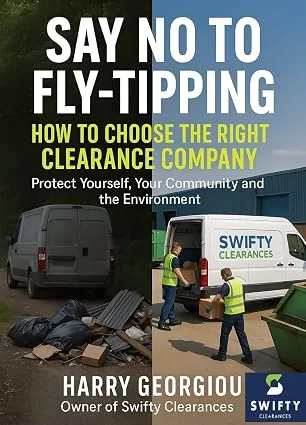
Say No to Fly-Tipping
Chapter 16 — Appendix — How to Check a Company
← Harry Georgiou / Say No to Fly-Tipping
Ask the waste carrier directly for its registration details.
If the operator hesitates or refuses to provide them, stop and investigate before handing over your waste.
Use the appropriate environmental regulator's online service to check the operator.
In England, that is the Environment Agency. In Wales, Natural Resources Wales. In Scotland, SEPA.
Check that the business details correspond with the company you are dealing with.
Ask for the name of the transfer station or disposal facility used by the company.
If you remain uncertain, contact the facility and ask whether the company uses its services.
Once you are satisfied, record the date, the company name, the registration number, the transfer station, and any other relevant notes.
Keep copies or screenshots of important documents.
Receive the appropriate Waste Transfer Note and keep it with your records.
Pay traceably where possible and retain your receipt.
If you want an additional precaution, place two or three letters inside the waste stating your address, the company name, its registration number, the collection date, and confirmation that you checked the company's credentials.
If something looks wrong, stop.
Do not hand over your waste if you have serious concerns about the operator.
Report suspected illegal waste activity to the appropriate authority.
Reader Comments
Leave a Comment
We would love to hear your thoughts on this chapter.
About Harry Georgiou
Harry Georgiou is the owner of Swifty Clearances, a waste clearance business. He writes about responsible waste disposal, fly-tipping prevention, and the practical steps households and businesses can take to avoid inadvertently funding illegal waste operations.
Author Page