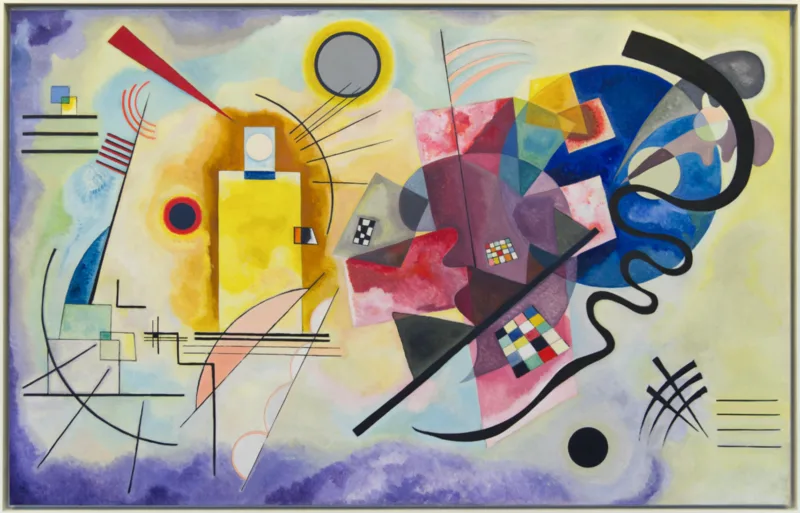
Art & Cultural Commentary Wassily Kandinsky — Yellow-Red-Blue (1925) An exploration of geometry, colour, and the spiritual forces that shaped one of the Bauhaus's most important paintings.
Painted in 1925 during Wassily Kandinsky's tenure at the influential Bauhaus school, Yellow-Red-Blue stands as a landmark masterpiece of geometric abstraction. During this period, Kandinsky increasingly replaced the spontaneous, expressionistic explosions of his earlier work with a more disciplined visual language of precise shapes, intersecting lines, and carefully balanced colour. Yet beneath this apparent mathematical order lies a profound exploration of the psychological and spiritual forces that govern human perception, transforming a seemingly simple arrangement of geometric forms into a complex vision of universal existence.
Key Visual and Structural Elements
-
The Architecture of Colour: Against a pale, luminous background, Kandinsky orchestrates a dynamic confrontation between expansive yellow forms, concentrated red shapes, and the commanding presence of a deep-blue circle. These primary colours establish opposing visual forces, creating an intricate balance between brightness, density, and spatial depth.
-
The Dominance of the Circle: The enormous blue circle on the right acts as a powerful compositional anchor. In Kandinsky's artistic philosophy, the circle represented a fundamental geometric form associated with inwardness, spiritual depth, and cosmic unity. Its dark interior appears to draw the surrounding shapes into its gravitational field, suggesting a mysterious centre around which the remaining elements revolve.
-
Geometric Rhythms and Movement: Angular structures, intersecting lines, and sweeping curves create a visual rhythm that recalls the relationships between musical notes and harmonic progression. Sharp geometric divisions establish a sense of rational control, while irregular forms and curved trajectories introduce an opposing energy that prevents the composition from becoming static.
Historical, Philosophical, and Structural Significance
Kandinsky's artistic development during the Bauhaus period reflected his enduring conviction that abstract forms could communicate profound psychological and spiritual experiences. Influenced by the relationship between colour, music, and human consciousness, he sought to establish a visual language capable of transcending the limitations of literal representation. His geometry was therefore not simply decorative or mathematical; it was an attempt to uncover an underlying order connecting artistic expression with the deeper structures of existence.
The historical upheavals surrounding the painting's creation provided a striking backdrop to this search for order. In the aftermath of the First World War and the Russian Revolution, Europe confronted the collapse of established political structures, rapid technological transformation, and profound uncertainty about the future of civilisation. Within this fractured environment, the rational principles of the Bauhaus offered a means of reconstructing the relationship between art, technology, and society. The painting's precise geometric arrangements may consequently be interpreted as an attempt to establish harmony within a world whose traditional certainties had been irrevocably disturbed.
Within this carefully constructed framework, the opposing colours suggest a deeper division between competing forces of consciousness. The expansive yellow forms project outward energy and illumination, while the immense blue circle introduces a darker, more introspective dimension. Between them, the red shapes occupy a zone of tension, suggesting a confrontation between outward activity and inward contemplation. These associations remain interpretive rather than definitive statements of Kandinsky's intentions, yet they reveal the painting's potential as a symbolic representation of humanity's struggle to reconcile opposing dimensions of existence.
The multitude of intersecting lines and fragmented shapes further suggests a universe governed by simultaneous division and interconnection. Each boundary separates one element from another, yet every intersection establishes a new relationship within the composition. Viewed metaphorically, this intricate network resembles the structure of human civilisation itself, in which individuals, institutions, and competing systems of belief continually collide while remaining inseparable from the larger whole.
Reflecting the rational ambitions of the Bauhaus alongside Kandinsky's enduring spiritual concerns, Yellow-Red-Blue demonstrates his belief that abstract art could directly influence the human soul. Rather than reproducing the visible world, the painting constructs an independent visual universe where geometry, colour, and movement become instruments of philosophical exploration. Its carefully balanced forms suggest that order and uncertainty, reason and intuition, and the material and spiritual dimensions of existence are not necessarily opposing realities, but interconnected forces within a larger and ultimately mysterious harmony.

Reader Comments
Leave a Comment or a Book Review
We would love to hear your thoughts on this chapter, or even a complete book review.