Introduction
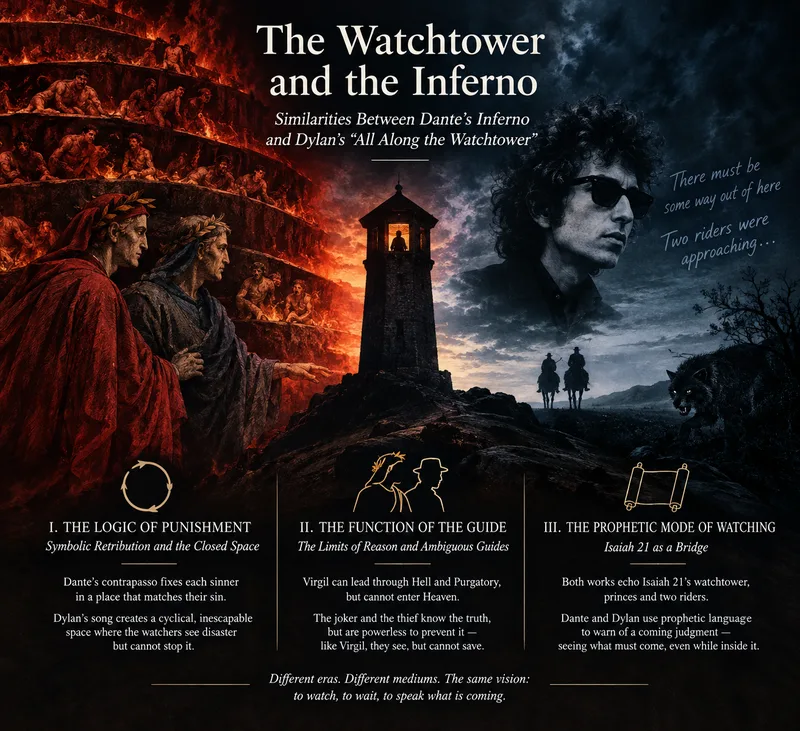
Bob Dylan's 1967 song "All Along the Watchtower" and Dante Alighieri's fourteenth-century Inferno appear to belong to entirely different eras and mediums, yet they share a deep structural poetics of watching and waiting. Both construct a closed, moralized space in which individuals are placed in a position where they must "see" the truth but cannot escape it. This essay will analyze the correspondences between the two works across three dimensions: the logic of punishment, the function of the guide, and the prophetic mode of watching. Ultimately, it will argue that Dylan's song can be read as a modern, compressed version of the structural logic of Inferno.
I. The Logic of Punishment: Symbolic Retribution and the Closed Space
The core structural principle of Dante's Inferno is contrapasso, a poetic justice in which each sinner's punishment symbolically corresponds to their sin in life. As the research summarizes: "each punishment in Inferno is a contrapasso, a symbolic poetic justice." The diviners must walk backwards because they tried to see the future; the treacherous are frozen in ice because they treated others with cold-bloodedness. Hell is not merely a place of punishment but a self-enclosed system in which sinners "are categorized by sin and placed in an environment with no upward or downward mobility, left there for eternal punishment."
Dylan's "All Along the Watchtower" likewise constructs a closed, moralized space, though it is far more abstract than Dante's Hell. The song presents a cyclical structure: the dialogue between "There must be some way out of here" and "Two riders were approaching" returns repeatedly to its starting point, creating a sense of inescapable urgency. As one scholar precisely notes: "the song's circular structure keeps returning us to the same moment, to the fact that there is no 'way out of here.'" The wildcat growling outside, the wind beginning to howl, these images do not constitute physical punishment but a diffuse, inescapable atmosphere of judgment. The "watchtower" itself is a contrapasso-like space: it is a position of watching, but what the watchers ("princes") see is only the approach of disaster, which they cannot intervene against, just as the souls in Dante's Hell are forever fixed in the position defined by their sin.
II. The Function of the Guide: The Limits of Reason and Ambiguous Guides
In Dante's journey, Virgil plays multiple roles: the pinnacle of classical poetry, the symbol of human reason, and the embodiment of political wisdom. But Virgil's role as guide has a fundamental limitation: he can lead Dante through Hell and Purgatory, but he is "not permitted to enter Heaven" because, as a pagan who lived before Christ, he cannot achieve salvation. This limitation makes Virgil a tragic, liminal guide, he possesses enough knowledge to lead others through darkness but not enough grace to save himself. As Dante scholarship summarizes: "Virgil is elevated as the symbol of reason and serves as guide in the pilgrimage through Hell and Purgatory."
The "joker" and the "thief" in Dylan's song perform a similarly ambiguous guiding function. Their dialogue ("There must be some way out of here" / "Let us not talk falsely now") constitutes the framing voice of the song, offering listeners a path into this closed world. Like Virgil, their knowledge is limited and partial: they know what the "princes" do not, they know that "women came and went / Barefoot servants, too", but their awareness ultimately cannot change the fact that "two riders were approaching." Moreover, scholars have noted Dylan's creative state during the John Wesley Harding period, when he "read extensively from the Bible after his motorcycle accident," which brings the song's "joker" and "thief" closer to the marginal witnesses of prophetic texts, they see the truth but cannot prevent disaster. This forms a structural correspondence with Virgil's situation: the capacity to see does not equal the capacity to save.
III. The Prophetic Mode of Watching: Isaiah 21 as a Bridge
The most direct and powerful connection between the two works is Isaiah 21. This passage, a prophecy of Babylon's fall, appears in Dylan's lyrics in almost verbatim form: "Watch in the watchtower, eat, drink: arise ye princes, and prepare the shield." The passage's "watchtower," "princes," and "two riders" are all incorporated by Dylan into his song. Scholars have confirmed: "one of Dylan's most famous lyrics, 'All Along the Watchtower,' was inspired by Isaiah: the watchtower, the princes, the two riders, the growling wildcat and the howling wind."
But the reason this allusion is crucial for understanding Dylan's relationship to Dante is that Dante himself engages in a similar "prophetic citation." Dante weaves the prophetic language of the Bible into his political critique of Florence, the Papacy, and the Empire. The writing of Hell is itself a prophetic warning: if you continue thus, this is what awaits you. What Dylan found in Isaiah is precisely a "watchman" role, one who is commanded to "declare what he seeth." A quoted analysis in the research captures this well: "At the moment when the watchman must blow the trumpet and fails to blow it, his blood will be required at the watchman's hand." Dylan's song is precisely such a watchman's voice: it announces the approach of disaster while already being inside the disaster; it sees, but already too late.
Conclusion
Reading Dylan's "All Along the Watchtower" alongside Dante's Inferno reveals a shared poetic structure: both place the watcher within a watched, moralized space and confront them with a judgment they cannot escape. Dante's Hell is an elaborately stratified system of punishment, each sinner fixed in the position their sin prescribes; Dylan's watchtower is a compressed, cyclical site of watching, where the "princes" continue their daily routines while the "two riders" have already appeared on the horizon. The tragedy of Virgil as a limited guide, possessing the ability to see darkness but unable to enter light, finds a distant echo in Dylan's "joker" and "thief," who likewise know the truth but are equally powerless to stop the wind from howling. Ultimately, both depend on a prophetic mode of watching: Isaiah 21's watchtower is not merely a geographical image but a moral position, forced to see, forced to wait, forced to announce what is coming within an inescapable cycle.
Works Cited
Dante Alighieri. The Inferno. Translated by Robert Hollander and Jean Hollander.
Analysis of Isaiah 21 in "All Along the Watchtower."
Correspondence between Isaiah 21 and Dylan's lyrics.
The circular structure of Dylan's song and the theme of no exit.
Virgil as the symbol of reason and the limits of the guide.
Contrapasso and the closed structure of Hell.
Reader Comments
Leave a Comment or a Book Review
We would love to hear your thoughts on this chapter, or even a complete book review.