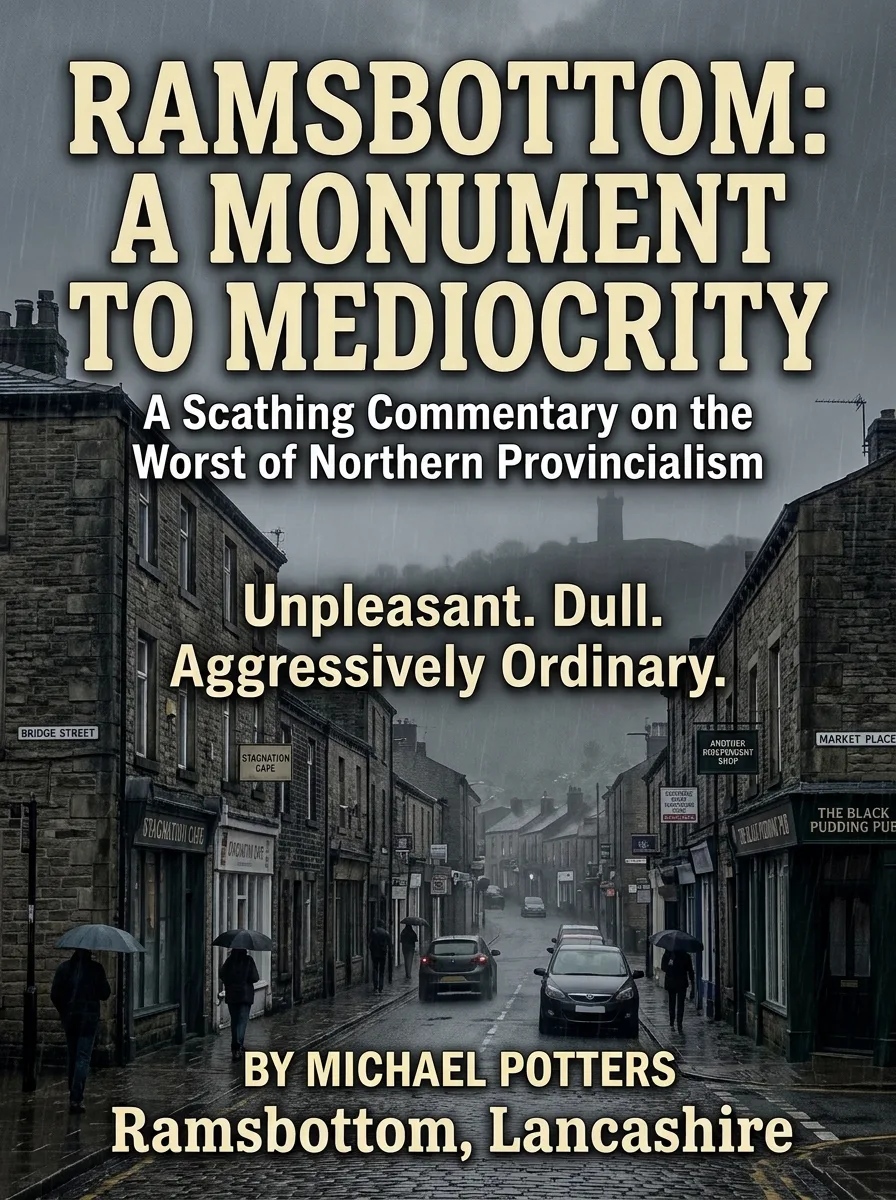
There are unpleasant places, there are dull places, and then there is Ramsbottom: a town that has taken the worst aspects of industrial decline, northern provincialism, and architectural disappointment, and pressed them into one thoroughly uninspiring, grey paste.
Ramsbottom is not merely underwhelming. It is aggressively, almost militantly, ordinary. It possesses the distinct, suffocating air of a settlement that peaked somewhere around 1880 and has spent every subsequent decade wallowing in a state of terminal, rain-soaked inertia.
The town centre is a masterclass in misplaced nostalgia and unearned arrogance. Its Victorian stone buildings do not inspire historical admiration; they resemble a row of damp, dilapidated headstones desperately clinging to whatever dignity they have left. Bridge Street and Market Place carry the grim atmosphere of an open-air waiting room where human excitement goes to suffer a slow, agonizing death. A sparse scattering of overpriced independent shops and pretentious coffee establishments cannot disguise the underlying rot of economic stagnation. Calling it a "vibrant market town" requires a level of delusional imagination that borders on clinical psychosis.
The East Lancashire Railway is touted as Ramsbottom’s crowning jewel, a fact that speaks volumes about the sheer, soul-crushing void of its competition. Its primary achievement is forcing visitors to pay for the privilege of nineteenth-century transport delays without even the historical excuse of a booming cotton industry. A steam locomotive may be a triumph of Victorian engineering, but watching one slowly belch soot into an already dreary sky is hardly a compelling reason to ruin an entire afternoon. It is nostalgia on rails: a plodding, noisy museum piece travelling at a speed that gives passengers ample time to fully absorb the surrounding disappointment.
Perched atop Holcombe Hill, Peel Tower stands like a monument that has suddenly realized where it was erected and is paralyzed by regret. Historically significant though it may claim to be, its primary architectural contribution is a stark stone finger pointed at the heavens, a desperate, permanent attempt by the masonry itself to escape the town below. The views from the top are admittedly better than looking at Ramsbottom, though being marginally preferable to a view of Ramsbottom is a standard so low it scrapes the bedrock.
Then there is Nuttall Park, which offers the exhilarating opportunity to walk alongside the River Irwell, provided one can muster enthusiasm for a stretch of grass so aggressively unremarkable it makes golf courses look dynamic. It is a park. It has grass. It has mud. It features the exact same pedestrian amenities found in every forgotten suburb in Britain, none of which warrant burning fuel to witness.
And, of course, one cannot overlook the World Black Pudding Throwing Championship, an event that leaves one questioning whether Ramsbottom is a real place or a psychological experiment that spiraled out of control. Somewhere in its history, the populace collectively decided that hurlers chucking regional offal at baked batter was the peak of cultural ambition. The town embraced this absurd spectacle with the manic eagerness of a community that realized it lacked the brainpower or infrastructure for literally anything else.
Even the natural landscape deserves a formal apology. The West Pennine Moors are genuinely scenic, and the surrounding hills offer beautiful walking routes. Tragically, Ramsbottom sits smack in the middle as a dreary administrative tollbooth, forcing countryside enthusiasts to wade through its gridlocked streets before reaching anything worth seeing.
The transport links only compound the misery. The heritage railway is useless for actual human commuting, leaving residents at the mercy of atrocious road connections and infrequent buses. Ramsbottom exists in a geographical dead zone: inconveniently tethered to Greater Manchester, yet isolated enough to feel like a remote island the moment you actually need to get anywhere.
Yet, its reputation as a "desirable property hotspot" persists, a triumph of marketing over reality. Apparently, three artisan bakeries, a sea of damp stone terraces, and proximity to a muddy hill are all it takes to convince middle-class urbanites they’ve stumbled into a northern paradise. One can only assume local estate agents are trained in advanced optical illusion, carefully cropping out the ubiquitous drizzle, the crushing boredom, and the lingering smell of defeat.
That, ultimately, is Ramsbottom’s singular, towering achievement: it has managed to trade a collection of aggressive mediocrities for an extraordinary sense of self-importance. It is a town boasting a train that travels backwards in time, a tower that goes nowhere, a park that offers nothing, and a local sport that sounds like a medieval torture method.
Ramsbottom is not a hidden gem. It is not an undiscovered treasure. It is a wet, over-hyped speedbump in the Irwell Valley, definitive proof that having a history is not the same thing as having a reason to exist.

Reader Comments
Leave a Comment or a Book Review
We would love to hear your thoughts on this chapter, or even a complete book review.