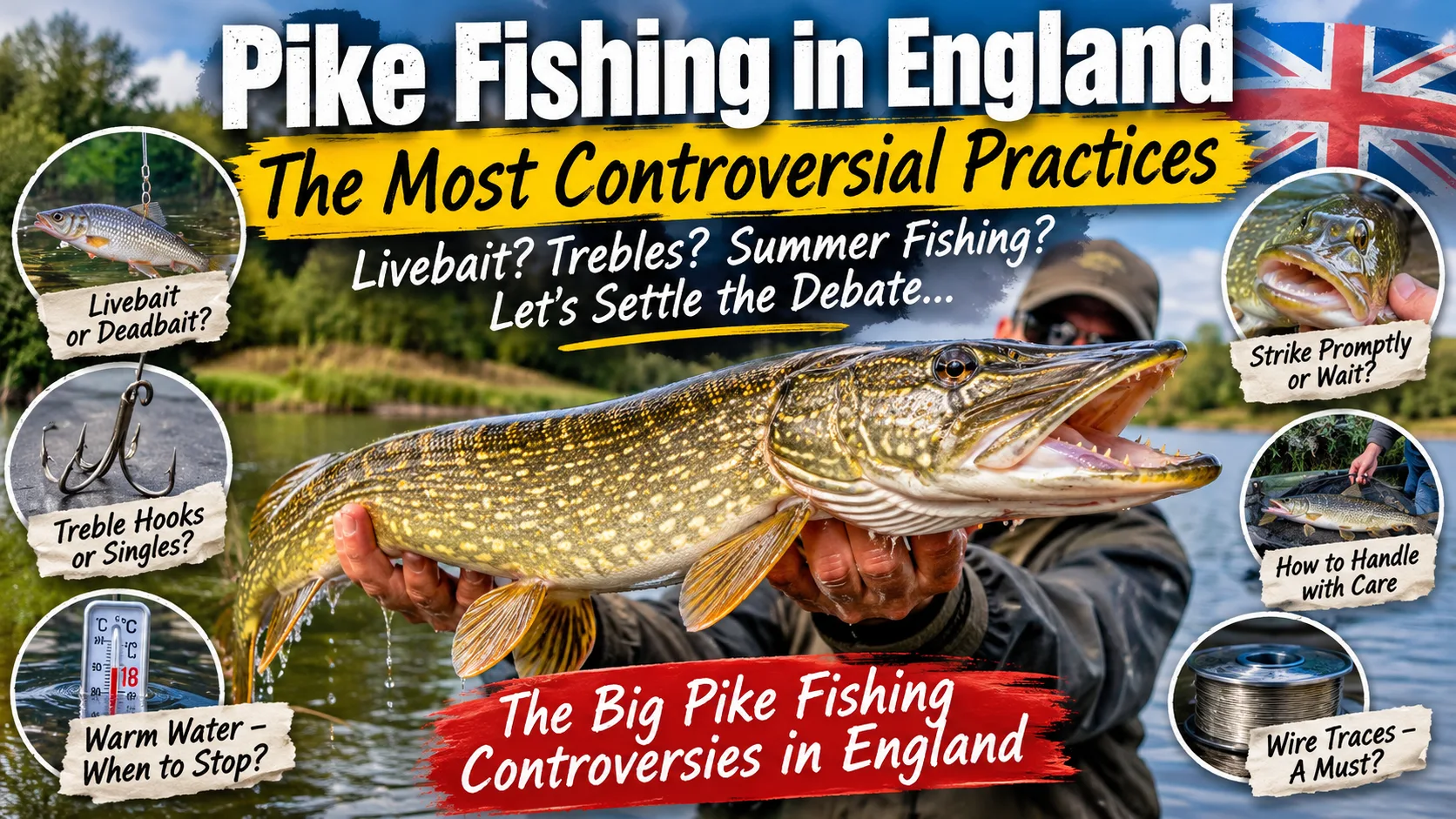
Pike fishing in England has several practices that are particularly controversial, both among anglers themselves and between different schools of fishing. Some disagreements are about fish welfare, some about sporting ethics, and others about whether traditional methods should still be acceptable in modern pike fishing.
The most hotly contested issues tend to centre on livebaiting, bait presentation, hook arrangements, fish handling, unhooking, fishing in warm weather and the use of certain tackle.
Here are the main battlegrounds.
1. Livebaiting versus deadbaiting
One of the biggest controversies
This is probably one of the oldest and most emotionally charged arguments in British pike fishing.
Livebaiting involves hooking a live fish and using it to attract a predatory pike.
Arguments against it:
- Deliberately hooking and restraining a live fish causes avoidable injury and stress.
- Some anglers consider it an unnecessarily cruel way of fishing.
- There are concerns about transferring parasites and disease between fisheries.
- It can create conflict with other anglers, particularly on mixed coarse fisheries.
Arguments in favour:
- Pike naturally prey on live fish.
- Some experienced anglers consider it a traditional and legitimate method.
- Supporters argue that, when properly conducted, it can result in effective hooking and relatively quick unhooking.
The important legal distinction: Livebaiting is not universally prohibited throughout England. However, there are restrictions on where livebait can be obtained and used, and individual fisheries can prohibit it. The Environment Agency's rules require livebait to be kept and used in the water from which it was caught, subject to applicable local byelaws.
Deadbaiting has its own controversy, particularly concerning how long an angler waits before striking.
2. Delayed striking and deep-hooking
Major fish welfare issue
This is an especially important debate.
When fishing with deadbaits, some anglers historically allowed a pike to move away with the bait before striking. The theory was that the fish needed time to turn and swallow it.
The problem is that delaying the strike can result in:
- Deep-hooked pike.
- Hooks lodged in the throat or gullet.
- Serious internal injuries.
- Fish dying after release.
Modern pike welfare advice generally favours sensitive bite indication and striking promptly when a take is registered.
The Canal & River Trust specifically highlights the danger of delayed striking and explains why lure fishing can reduce the likelihood of deep-hooking.
The debate is essentially between traditional bait-fishing practices and modern fish-welfare expectations.
3. Treble hooks versus single and barbless hooks
Another significant disagreement concerns hook arrangements.
Traditional pike traces often use two treble hooks, particularly for deadbaiting.
The arguments against trebles include:
- More potential penetration points.
- Increased risk of multiple hook-ups.
- Greater difficulty removing hooks when a fish is deeply hooked.
- Potentially more damage during unhooking.
Others argue that appropriately sized trebles, correctly positioned and used with prompt striking, provide reliable hooking and can be removed safely.
There is also disagreement about barbed versus barbless hooks.
Some fisheries insist on barbless or crushed-barb hooks. Others permit barbed hooks, arguing that they can reduce the chance of hooks coming loose during a fight.
There isn't one universally accepted arrangement across English fisheries.
4. Fishing for pike in warm weather
Perhaps the most serious modern welfare debate
This is an increasingly important subject.
Pike are particularly vulnerable to stress when water temperatures rise and dissolved oxygen levels fall.
The Pike Anglers' Club of Great Britain recommends not fishing for pike when water temperatures reach 18°C or above.
The Canal & River Trust takes a more contextual approach, explaining that different waters have different oxygen levels and environmental conditions. It also highlights the risks of exhaustion and delayed recovery.
The arguments include:
- Should pike fishing stop completely above 18°C?
- Is 20–21°C an acceptable threshold on well-oxygenated waters?
- Should anglers use lures only during summer?
- Should fisheries introduce mandatory seasonal restrictions?
- Is it responsible to target large specimen pike in hot weather?
The Angling Trust also advises considering stopping fishing for large pike when river temperatures exceed 21°C.
My view is that this is a debate where fish welfare should take priority over catching opportunities. A fish surviving release does not necessarily mean it has suffered no lasting damage.
5. Holding, weighing and photographing pike
There is considerable disagreement about how pike should be handled.
The main contentious practices are:
- Holding large pike vertically by the jaw.
- Using lip-gripper devices.
- Lifting fish by the gill plates.
- Holding pike without supporting their bodies.
- Photographing fish for extended periods.
- Retaining fish in tubes or slings unnecessarily.
Experienced pike anglers generally advocate supporting the fish horizontally, minimising time out of the water and using suitable weighing equipment.
There is also a disagreement about whether fish should be photographed at all, particularly when anglers spend considerable time arranging photographs of large specimens.
A particularly important point: pike should never be lifted by their gill arches.
6. Wire traces and inadequate tackle
This is an issue where there is considerably less room for reasonable disagreement.
Pike have extremely sharp teeth. Fishing without an appropriate wire trace, or using tackle that is insufficiently strong, can result in a pike breaking the line and swimming away with hooks and trailing line.
The contentious issues include:
- Using fluorocarbon instead of wire.
- Using traces with inadequate breaking strains.
- Fishing with excessively light mainline.
- Using unsuitable rods that prolong the fight.
- Using rigs that leave a pike tethered to leads or other tackle.
The Canal & River Trust recommends a minimum 15lb breaking-strain mainline and describes wire traces as essential.
7. Livebait transportation and fish movements
This is another significant issue, involving both ethics and biosecurity.
Some anglers catch small fish in one water and transport them to another to use as livebait.
This can introduce:
- Fish diseases.
- Parasites.
- Invasive species.
- Unwanted fish populations.
The rules on moving live fish are important. You should not assume that permission to use livebait means permission to transport it between fisheries.
The Environment Agency's national byelaws contain specific provisions about livebait.
8. Seasonal restrictions and year-round pike fishing
There is a long-running argument about when pike should be targeted.
Many clubs impose a traditional pike season, commonly running from October through to March.
Others allow pike fishing throughout the year, subject to fish welfare considerations.
There is an important legal distinction here:
- Rivers in England have a coarse fishing close season from 15 March to 15 June inclusive.
- Most enclosed stillwaters and canals can be fished for coarse fish throughout the year.
- Individual fisheries can impose additional restrictions.
Consequently, there is no single nationwide October-to-March pike season.
9. Pike culling and removing large fish
This is a particularly divisive subject on commercial and club waters.
Some fisheries have historically removed pike because they believe predators reduce stocks of smaller coarse fish.
Arguments for removal:
- Protecting vulnerable silver fish stocks.
- Maintaining a particular balance of species.
- Protecting fishery income and match-fishing interests.
Arguments against:
- Pike are a natural part of a healthy aquatic ecosystem.
- Removing large pike can disrupt the natural predator-prey balance.
- Large pike are valuable specimen fish.
- Predator removal is not necessarily an effective way to improve fish populations.
There is also disagreement about whether large pike should be retained for specimen records or returned immediately.
10. Pike fishing versus other anglers' interests
This is less about tackle and more about the culture of British angling.
Pike anglers sometimes encounter hostility from:
- Match anglers who believe pike eat too many silver fish.
- Carp anglers who dislike predator fishing in their swims.
- Pleasure anglers who object to livebaiting.
- Fisheries that consider pike a nuisance rather than a valuable sporting species.
There are also arguments about fishing close to other anglers, using large baits, occupying popular swims and fishing during periods when other species are spawning.
My ranking: the ten biggest controversies
| Rank | Controversy | Main issue |
|---|---|---|
| 1 | Livebaiting | Ethics and animal welfare |
| 2 | Warm-water piking | Fish survival and stress |
| 3 | Delayed striking | Deep-hooking and mortality |
| 4 | Treble hooks | Injury and unhooking |
| 5 | Fish handling | Physical damage |
| 6 | Pike culling | Conservation and ecology |
| 7 | Barbed versus barbless | Hook retention and injury |
| 8 | Inadequate tackle | Lost fish and trailing hooks |
| 9 | Seasonal restrictions | Welfare versus fishing opportunities |
| 10 | Livebait transportation | Biosecurity and legality |
Some particularly useful English pike fishing resources
These are worth reading because they represent different perspectives on the subject:
- Pike Anglers' Club of Great Britain – specialist pike fishing advice, fish handling and warm-water guidance. PACGB website.
- Canal & River Trust – an interesting perspective on livebaiting, deadbaiting and summer pike fishing. Fishing guidance.
- Environment Agency – the actual freshwater fishing legislation and byelaws. Official fishing rules.
- Angling Trust – broader fish welfare and responsible angling guidance. Angling Trust website.
One interesting question
I think there is a much bigger discussion underneath all this: how much of traditional English pike fishing is genuinely acceptable in modern catch-and-release angling?
For example, should livebaiting be banned nationally? Should there be an 18°C maximum water temperature? Should all pike anglers be required to use barbless hooks? Should fisheries prohibit deadbaiting during warmer months?
These are questions on which even experienced pike anglers can have very strong and conflicting opinions.

Reader Comments
Leave a Comment or a Book Review
We would love to hear your thoughts on this chapter, or even a complete book review.