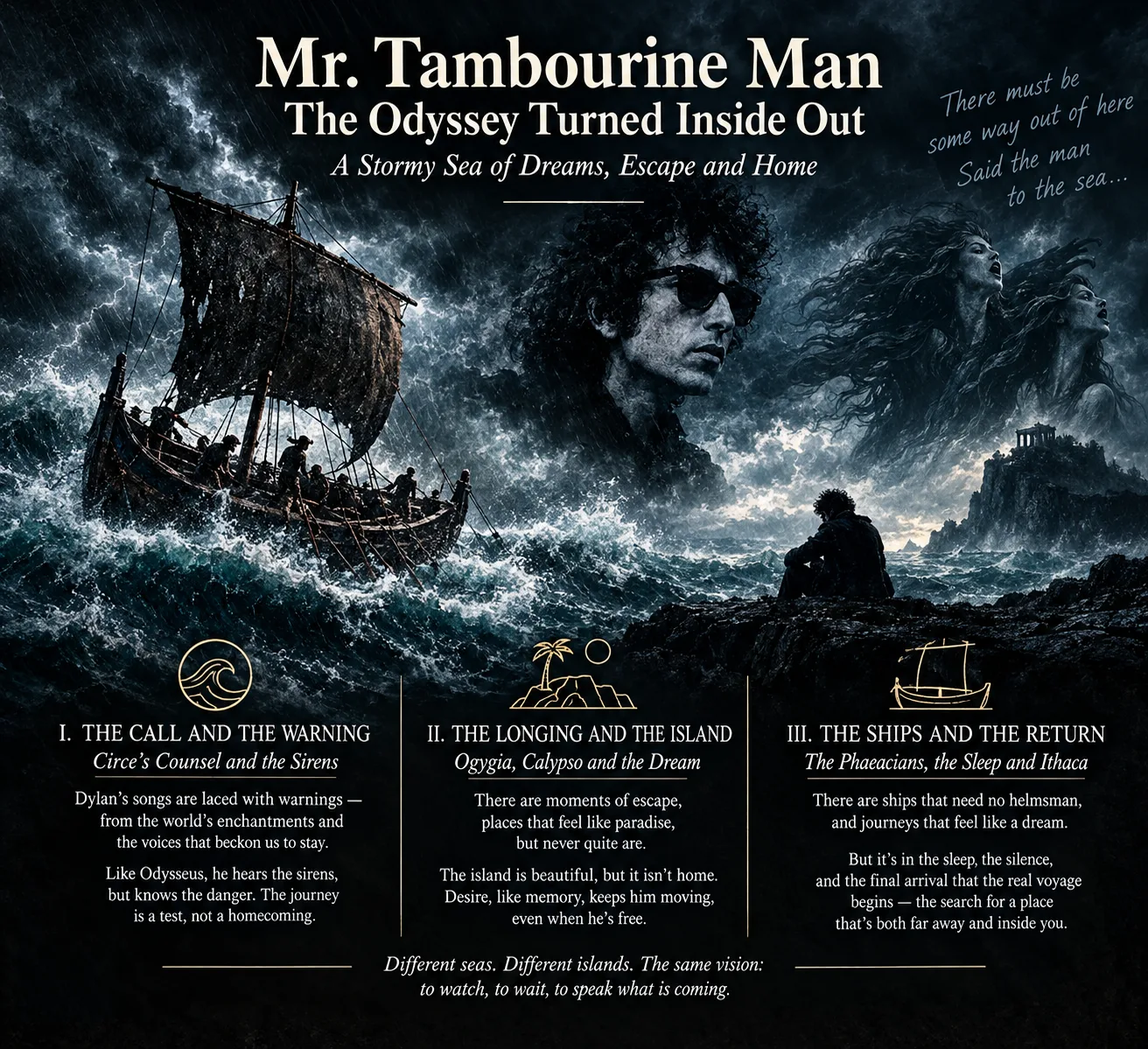
Homer's Odyssey is a poem about getting home. Dylan's "Mr. Tambourine Man" is a song about having nowhere to go. Set side by side they look like opposites, but they are better read as one story told from either end. The Odyssey asks what it costs to resist being carried away. The song asks what it would be to give in.
Some limits should be stated at the outset. This is a comparison of shared themes, not of influence. Dylan has said he read the Odyssey as a schoolboy, and in his Nobel lecture he named it among the books that shaped him.[1] But he never framed this song as a response to Homer, and the argument here does not depend on his having had the poem in mind in 1964.
The song that must be resisted
The strongest case begins with the Sirens. In Book 12, Circe warns Odysseus that their song will draw men to their deaths.[2] His answer is to plug his crew's ears with wax and have himself tied to the mast. What matters is that he does not decline to listen. He wants the experience, but on terms that keep him bound to the voyage home.
Dylan's narrator reverses the arrangement. He is awake and aimless, and he asks the musician to play and promises to follow. Where Odysseus builds restraints, the narrator asks to be taken. The song opens in the one condition Odysseus never occupies, which is having no destination at all.
The Lotus-Eaters sharpen the contrast. In Book 9, the men who eat the lotus lose all wish to return, and Odysseus has to drag them weeping back to the ships.[3] Homer treats this forgetting as a loss of self. The final movement of Dylan's song wants it as a mercy: to sink memory and fate beneath the waves and to put off today until tomorrow. What the Odyssey calls a temptation, the song calls relief.
The enchantress and the nymph
The song's request for a spell has a Homeric ancestor in Circe, who transforms Odysseus' men and then keeps him on her island for a year. The narrator's numbed hands and toes, and his sense of a body stripped of feeling, are closer to Calypso's Ogygia, where Odysseus lives in comfort and stasis for seven years, weeping on the shore.[4] Both places are pleasant, and both are traps, because nothing there can happen.
The difference is that Homer sets longing against the enchantment. Odysseus keeps wanting Ithaca, and that wanting is what eventually frees him. The narrator has no such counterweight. The spell is the only thing he wants.
The singer
The tambourine man has a place in Homer too, in the bards. In Book 8, at the Phaeacian court, Demodocus sings of the Trojan War, and Odysseus, still unrecognised, hides his face and weeps.[5] A song can reach a man more directly than any speech, and the poem takes that seriously. But Homer's bards stay at the edge of the action. They do not carry anyone anywhere.
Dylan's musician does. The song's "magic ship" has a counterpart in the Phaeacian vessels, which need no helmsman and carry Odysseus home while he sleeps.[6] The contrast is almost mechanical: Odysseus is delivered because he is asleep, and the narrator asks to be delivered because he cannot sleep.
A caution is needed here. The musician may not be a mythic figure at all. Dylan credited the guitarist Bruce Langhorne as the inspiration in a box-set liner note, though Langhorne said Dylan might deny it if asked.[7] The bard in the song may be an ordinary session player who has been transfigured.
Dissolving and keeping the self
There is a quieter parallel in the matter of identity. When Odysseus tells the Cyclops his name is "Nobody," he gives it up deliberately and tactically, in order to survive and return as himself.[8] The narrator's wish to fade into his own parade is the same act without the return. The self is not a disguise to be put on and taken off, but a burden to be put down.
Where the comparison strains
This is not an exact fit, and it would be dishonest to pretend otherwise. The Odyssey is an epic of twenty-four books with a hero, a crew, a family and a recognisable moral order of hospitality, loyalty and cunning. The song has none of that. Its narrator has no companions, no antagonist and no obstacle.
It would also be too neat to say the song rejects Homer's values. Its closing image, a figure dancing beneath the sky beside the sea, is more rapt than nihilistic, and a reader may reasonably find it closer to the joy of the bards than to the numbness of the lotus. Nor is the escape plainly chemical. Dylan has denied that the song is about drugs,[9] so the "trip" is better read as imaginative than as intoxicated.
The Sirens parallel is also less secure than it looks. Homer's Sirens promise knowledge and kill, while Dylan's musician promises only release. The resemblance is in the structure of the encounter, not in the moral status of the music.
Finally, the scholarship that documents Dylan's use of Homer does not reach this song. Richard F. Thomas has shown how Dylan lifts passages from the Odyssey, and the Aeneid and Ovid as well, but the best-documented examples come from his late work.[10] On Tempest, Dylan takes lines and images from Homer's epic and cloaks himself in the hero, and a version of "Early Roman Kings" follows Book 9 nearly word for word.[11] Nothing comparable is on record for 1964.
Form: the line and the loop
The most useful difference may lie in shape. The Odyssey is linear in its geography, a voyage from Troy to Ithaca, though its telling is not: it begins late, and Odysseus narrates his earlier wanderings in a long flashback at the Phaeacian court. It also moves by repetition, with formulae and ring structures returning on themselves. But everything is tilted toward arrival, and the final books exist to bring a man into his own house.
Dylan's song moves differently. Each verse ends by returning to the same plea, so that every journey, however far it travels, is brought back to the same request. The song never says whether the musician plays or whether the narrator follows. It circles the moment of departure without completing it. In Homer, the form drives toward Ithaca. In Dylan, it holds the narrator at the threshold of the ship.
So the two works make their themes felt through structure as well as imagery. One is a poem that cannot stop moving toward home. The other is a song that cannot quite leave.
Conclusion
Read together, the Odyssey and "Mr. Tambourine Man" are two answers to a single question: what should a person do when music offers to carry them away? Odysseus ties himself to the mast and goes home. Dylan's narrator unties himself and goes under. Homer gives us a hero who proves his worth by refusing the spell. Dylan gives us a figure who asks for the spell as an act of freedom, and in doing so makes visible what the Odyssey spends twenty-four books keeping out of sight: the real appeal of never arriving.
Dylan closed his Nobel lecture by returning to Homer's invocation of the Muse, "Sing in me, oh Muse, and through me tell the story."[12] The line is a request to be carried by a song, and it is not far from the plea at the heart of this one.
Notes
- Dylan said in his Nobel lecture that he read Moby-Dick, All Quiet on the Western Front and the Odyssey in grammar school. He also said the Odyssey's themes have worked their way into the ballads of many songwriters. Bob Dylan, Nobel Lecture, recorded 4 June 2017.
- Homer, Odyssey 12.39-54* (Circe's warning) and 12.154-200* (the Sirens' passage).
- Homer, Odyssey 9.82-104. Fitzgerald's translation is cited at 9:84 and 9:96-97 for the lotus passage.
- Homer, Odyssey 5.151-58* and 7.259-60*.
- Homer, Odyssey 8.62 (first song), 8.499 (the Trojan Horse) and 8.521 (Odysseus' reaction), per the Royal Holloway outline.
- Homer, Odyssey 8.555-63* and 13.79-92*.
- Dylan credited Langhorne in the liner notes of a later box set, though Langhorne said in an interview that Dylan would likely deny it.
- Homer, Odyssey 9.364-67* ("Nobody") and 9.502-5* (the name revealed).
- Dylan has denied that the song is about drugs. He began writing it in February 1964, finished it in April, and re-recorded it on January 15, 1965. It was released on Bringing It All Back Home on March 22, 1965.
- Richard F. Thomas, Why Bob Dylan Matters (Dey Street, rev. ed. 2019). A review notes that Thomas explains Dylan's appropriations from Homer's Odyssey, Virgil's Aeneid and Ovid. Check chapter and page numbers against your copy.
- On Tempest, Dylan channels Odysseus, soaking up lines and images from Homer's epic. A version of "Early Roman Kings" follows Book 9 of the Odyssey nearly word for word. See "Harvard classicist Richard Thomas on Bob Dylan," Harvard Magazine, 2017.
- Dylan, Nobel Lecture, closing line, quoting Homer in Fitzgerald's translation with an added "oh."
Asterisked line numbers were not retrieved from a source in this session; check them against your edition.
Works cited
- Dylan, Bob. Nobel Lecture, 4 June 2017.
- Homer. The Odyssey. Trans. Robert Fitzgerald (1961), or A. T. Murray (Loeb; free at Theoi.com).
- Thomas, Richard F. Why Bob Dylan Matters. Dey Street Books, rev. ed. 2019.
- "Harvard classicist Richard Thomas on Bob Dylan." Harvard Magazine, 2017.
- "Mr. Tambourine Man." Wikipedia; Classic Song of the Day.
Reader Comments
Leave a Comment or a Book Review
We would love to hear your thoughts on this chapter, or even a complete book review.