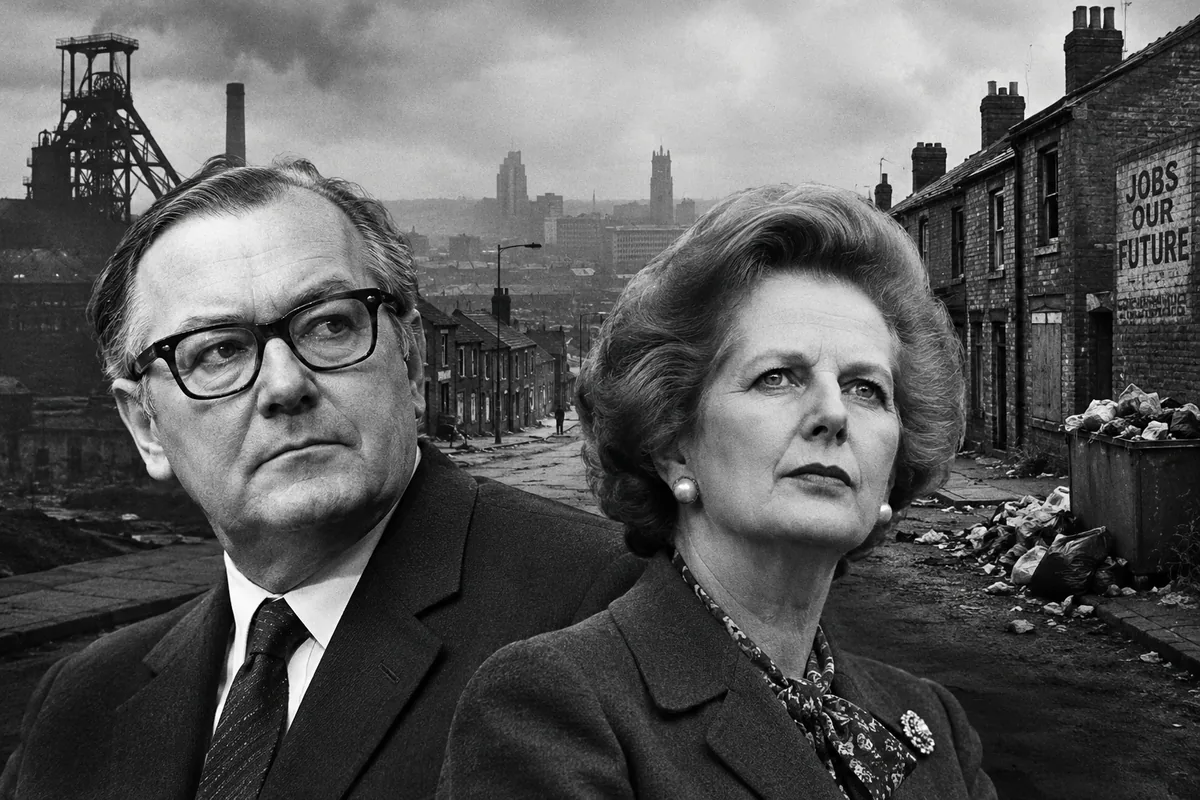
There was a time when British politics was populated by politicians who, whatever their faults, appeared to understand that governing a country was a heavy, physical business. James Callaghan and Margaret Thatcher were not saints, nor should either figure be transformed into some mythical model of political perfection. Their governments made mistakes, suffered humiliating failures and wrestled with structural economic problems that they frequently failed to solve. But they inhabited a political world in which a Prime Minister was expected to manage the material mechanisms of the state—its factories, its coal reserves, its interest rates, its foreign currency reserves and its balance of payments. They were politicians who had to govern through systemic crises rather than merely comment upon them.
The contrast with the political culture of today is striking. Callaghan and Thatcher faced a Britain undergoing an existential reckoning: double-digit inflation, the breakdown of the post-war consensus, militant industrial disputes, the threat of national insolvency, the Cold War and the fundamental question of whether Britain could remain an industrial power. The challenges were not theoretical. They involved uncollected rubbish, dark factories, shuttered coal mines, financial bailouts and the very question of whether the British state was still governable.
James Callaghan entered Downing Street in 1976 after the sudden resignation of Harold Wilson, inheriting a Labour government with a vanishing majority and an economy under severe pressure. Inflation was soaring, sterling was falling, and foreign currency reserves were being burned through simply to keep the pound afloat. Callaghan’s government tried to stabilize the economy while preserving social cohesion, but the pressure soon became overwhelming.
On 29 September 1976, Chancellor Denis Healey was forced to turn back from Heathrow Airport to negotiate an unprecedented $3.9 billion bailout from the International Monetary Fund. The decision was accompanied by public spending cuts, strict monetary targets and the explicit abandonment of post-war commitments to spend out of recession.
This was not a minor embarrassment. For a Labour movement built on state-directed social democracy, it was a profound ideological defeat. Callaghan’s subsequent address to his party conference explaining why governments could no longer buy their way out of economic trouble became one of the defining political moments of the era. The fact that a Prime Minister had to tell his own party that its foundational economic assumptions were no longer viable gives some indication of the seriousness of the political environment.
And the crisis did not exist in isolation. The government was forced to survive on a day-to-day basis in Parliament through the Lib-Lab pact, while inflation eroded wages and industrial unrest worsened. By the winter of 1978–79, the dam broke completely. The "Winter of Discontent" saw strikes across transport, haulage, healthcare and municipal services, leaving uncollected rubbish piling high in public squares. The government’s authority collapsed not because of a bad media interview, but because the basic machinery of civil society had ceased to function.
Yet Callaghan’s government was attempting something much more challenging than merely surviving industrial disputes. Callaghan was trying to manage an orderly transition away from post-war corporatism without tearing the social fabric apart. He understood the power of the trade union movement from the inside and sought to preserve public order in a nation that was visibly running out of money.
And then came Margaret Thatcher.
Thatcher became Prime Minister in 1979 after defeating Callaghan at the general election. She inherited many of the problems Callaghan had struggled with, but her administration was determined to pursue a radical change of direction. It set out to reduce state intervention, break union power, embrace monetarism and force a transition toward a market economy. The political and social consequences were fierce. Manufacturing output plunged, and unemployment rose sharply.
In 1981, official unemployment passed two million and then swept toward three million—a politically explosive development in a country where successive post-war governments had treated full employment as a central duty. Cities saw widespread urban rioting, and senior figures within her own Cabinet pressed for a change of course. Thatcher refused, famously declaring that "the lady’s not for turning."
Then came the miners.
The 1984–85 miners’ strike was one of the defining industrial confrontations of the twentieth century. The government and the National Union of Mineworkers entered a year-long trial of strength, and Thatcher’s government approached the dispute with cold, operational strategy: stockpiling coal at power stations for months, organizing police logistics and altering energy supply chains.
Imagine the political pressure involved in that conflict. Picket lines erupted across coalfields. Energy supplies hung in the balance. Communities were deeply divided. The government was not running a media campaign; it was engaged in an operational battle over who controlled energy production in Britain.
Thatcher won the confrontation, paving the way for widespread privatization, financial deregulation and the restructuring of the British economy.
This is where the modern political comparison becomes particularly revealing.
Neither Callaghan nor Thatcher could simply escape difficult problems through a communications strategy. When sterling was under attack, Callaghan had to defend the currency or call in the IMF. When inflation surged, Healey had to cut spending. When coal supplies were threatened, Thatcher had to keep the power stations running. When unemployment reached record levels, ministers had to stand in Parliament and defend their policies. When the nation was paralyzed by strikes, the government had to negotiate or confront them directly.
There were no easy answers. There were no immaculate solutions waiting to be announced at a press conference. Every decision carried consequences.
This is what makes the modern obsession with political presentation so depressing. Modern politicians operate in an age of unprecedented communications technology, yet the political conversation can seem remarkably shallow. A complicated economic problem is reduced to a slogan. A structural problem in public services becomes a press release. A long-term question about Britain's industrial capacity becomes an argument about which politician delivered the better soundbite.
The old politicians were hardly immune to spin. Callaghan was a skilled broadcaster. Thatcher relied on image consultants and advisors to refine her public delivery. Both understood television, newspapers and the importance of presentation. But there remained a difference between using political communication and making communication the substance of politics.
Callaghan had to negotiate with actual trade union leaders who could shut down fuel supplies. Thatcher had to build actual coal stockpiles to keep the country lit.
That is a rather different political environment from the modern obsession with social-media cycles, carefully managed photo opportunities and endless rows over the wording of press releases.
And this is not an argument that Callaghan and Thatcher were secretly brilliant. They weren't. Callaghan’s economic record remains heavily criticized, ending in industrial paralysis and public collapse. Thatcher’s record is equally open to criticism: her policies devastated industrial towns, deepened regional inequalities and left scars that persist today. Her premiership eventually ended in political uproar over the poll tax.
But that is precisely the point.
They were politicians who could fail at governing because governing was what they were attempting to do.
The modern political class often gives the impression of having reversed the priorities. The objective is frequently to survive the next news cycle, dominate the next interview, avoid the next scandal and produce the next announcement. Politics becomes an exercise in permanent campaigning. Government becomes something that happens somewhere behind the scenes while politicians concentrate on explaining why everything is somebody else's fault.
The difference is not simply one of intelligence or personal character. It is institutional and cultural. The political environment has changed. Television transformed politics in the twentieth century; social media has transformed it again. Politicians now operate in an environment where outrage travels instantly, where every statement can be clipped into seconds, and where maintaining attention can become almost as important as developing policy.
The result is a peculiar form of political inflation: more statements, more announcements, more slogans, more promises and more communication, while the public becomes increasingly sceptical about whether any of it actually changes anything.
Callaghan and Thatcher operated in a Britain that was wrestling with the loss of its industrial dominance, the collapse of its post-war economic model and deep social division. They faced a country wrestling with the loss of its old certainties. Their governments did not solve all those problems. In some cases, they arguably made matters worse. But they confronted the problems directly.
That distinction matters.
The traditional politician was not necessarily better because he or she was older, tougher or more eloquent. They were different because political office still carried an expectation of responsibility. If the economy collapsed, the government had to answer for it. If the rubbish went uncollected, the government had to explain it. If the unions went on strike, the government had to negotiate or fight them. If the country ran out of foreign reserves, the Prime Minister had to face Parliament and defend the consequences.
There was nowhere to hide.
That may be the quality missing most conspicuously from contemporary politics: not perfection, but seriousness.
Callaghan and Thatcher could be wrong. They could be dogmatic. They could be politically calculating. They could make disastrous decisions. But they were operating in an environment in which the machinery of government, Parliament, industrial relations, international finance and Britain's place in the world demanded sustained attention.
The modern political class inherited a country with different problems and far more sophisticated technology, but too often seems to have inherited none of the patience required to solve them. The problems have become more complicated while the political language used to describe them has become thinner.
And so the spectacle continues: another announcement, another slogan, another carefully staged photograph, another promise that the next initiative will finally fix the problem that the previous initiative was supposed to fix.
The politicians of the Callaghan and Thatcher generation did not possess some magical quality unavailable to their successors. They made enormous mistakes. Their governments suffered humiliating failures. Their economic records provide plenty of ammunition for their critics.
But when sterling was collapsing, when miners were striking, when rubbish was piling up, when inflation was destroying savings and when post-war consensus was breaking down, British politics was dealing with consequences rather than merely managing perceptions.
That is the uncomfortable comparison.
Perhaps the real demise of the traditional politician is not that Britain stopped producing people like Callaghan and Thatcher. Perhaps it is that politics stopped demanding politicians who were prepared to spend years wrestling with difficult problems for which there was no convenient slogan, no viral clip and no easy victory.
The old politicians could fail magnificently.
The modern ones too often seem determined merely to look successful.
Reader Comments
Leave a Comment or a Book Review
We would love to hear your thoughts on this chapter, or even a complete book review.