Pythagoras and the Squares on the Floor by Andy Brotherton
3 minute read
At a Glance
- • Focus: In his academy at Croton, Pythagoras counts the squares of a newly laid tile floor and finds that the two smaller squares on a right-angled triangle always add up to the largest.
- • By: Andy Brotherton, short story, 2026
- • Title: Pythagoras and the Squares on the Floor
- • Form: short story
- • Published by: Tales From A Harrogate Caravan
Back in the day, down in the old port city of Croton—right in the heel of Italy, like—Pythagoras ran a proper academy. It was a bit of a cross between a temple and a workshop, mind. Folks used to turn up from all over to learn about numbers, music, and the uncanny way maths seemed to make sense of the world around them.
One warm afternoon, Pythagoras was taking a walk along the colonnade towards the far side of the courtyard. The sun was cracking the flags, and the whole place was dead quiet, bar the odd set of footsteps and voices drifting out from the classrooms.
A lad had just finished laying some new mosaic tiles outside the geometry room. Nothing over the top—just black and white tiles set out in big squares.
But Pythagoras stopped and had a right good look.
There was just something about the pattern that caught his eye. You know how it is when you’re staring at something ordinary and all of a sudden you start wondering if there’s more to it? Well, that was him, right there.
He stood for a second, counting the tiles under his breath. Then he goes, "Hoy us a bit of chalk and a stick, will ye?"
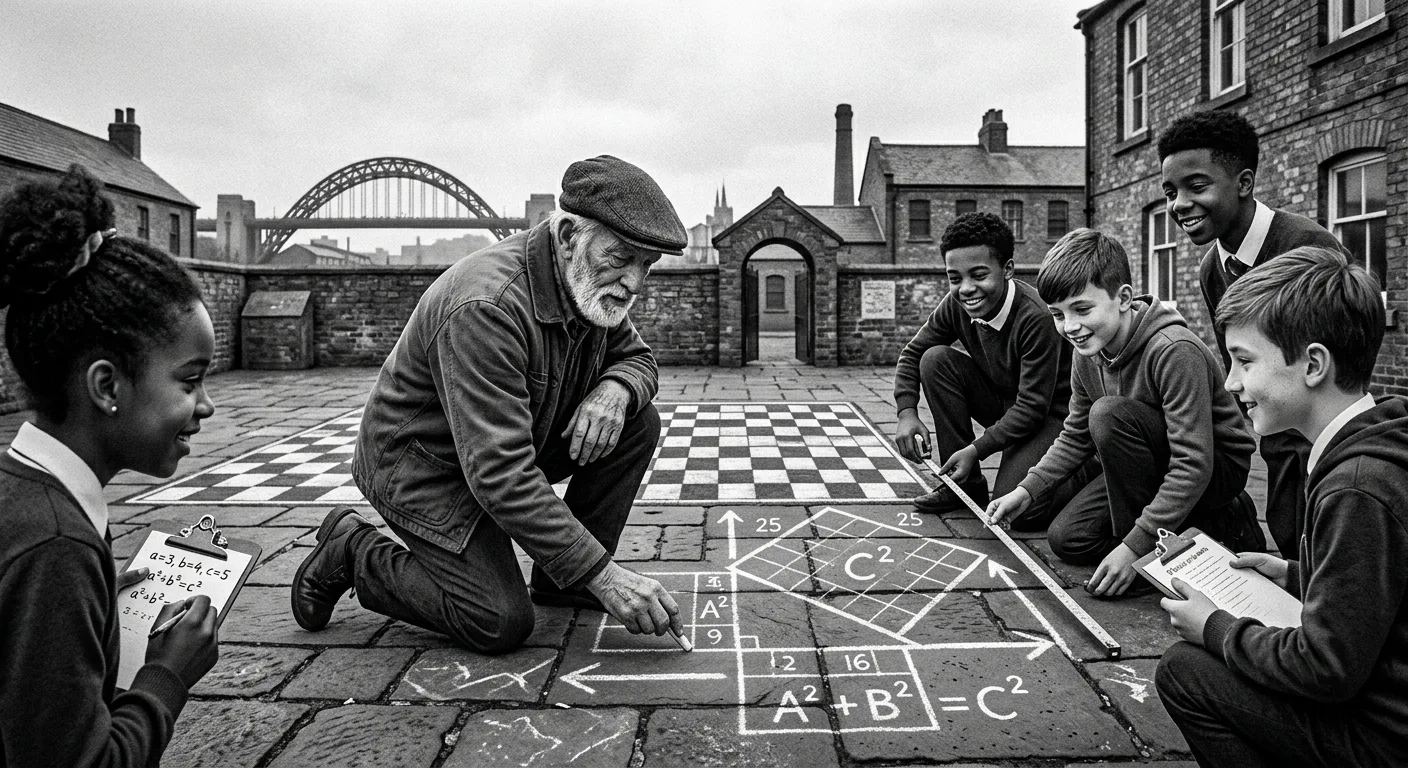
On the smooth floor, he marked out a right-angled triangle using three, four, and five tiles for its sides. Then he drew a square right along the outside of each side of the triangle.
The square on the three-tile side had nine tiles in it.
The square on the four-tile side had sixteen.
And when he added them two together, he got twenty-five.
Which was bang on the exact number of tiles in the square built on the longest side.
Now, that got him thinking.
So he had another go with different lengths. And then another.
Same result every single time.
Didn't matter how many times he tried it, the numbers just kept adding up. The area of the square on the longest side was always spot on equal to the two smaller squares added together.
He was onto something massive here, like.
Later that evening, he got all his students together in a huddle and explained what he’d cracked.
" right, listen here," he says. "The square on the longest side of a right-angled triangle is equal to the sum of the squares on the other two sides."
Now, the students weren't just going to take his word for it, mind. They wanted to see it with their own eyes. So they got stuck in with ropes, pegs, and measurements out in the dirt. They stretched strings right across the courtyard and tried all sorts of different triangles.
And every single time, it held up.
What makes this tale so belter is that it wasn't some grand flash of genius out of nowhere. It was just a bloke noticing something that had probably been sitting right under everyone’s feet all along.
Pythagoras had simply stopped, taken a proper look, and asked a question.
And isn't that how the best ideas always start? Not with anything flash or clever, but just someone looking at an everyday thing and going, "How does that work, then?"
Those little black and white tiles on the floor ended up revealing one of the most famous bits of maths in human history.
And more than two thousand years down the line, we're still teaching it to bairns in school today.
Not bad for a handful of tiles on a courtyard floor, is it?
Reader Comments
Leave a Comment or a Book Review
We would love to hear your thoughts on this chapter, or even a complete book review.

About Andy Brotherton
Andy Brotherton writes short stories. Pythagoras and the Squares on the Floor, a retelling of how a few floor tiles led to one of the most famous bits of maths in history, is the first story by Andy Brotherton published on the platform.
Author PageFiled under: Short Story · Science & Mathematics · Historical Fiction
Read Other Works

Alzheimers in Atacama
Two ancient Incan lovers have spent centuries enduring endless, agonizing reincarnations through major historical events. Now trapped in a modern care home, severe Alzheimer's has made Thomas and Mary forget who they truly are. Only two young Greek caretakers choose...
16 minute read

Bike Handle
By Trini Windsor-Dale-Montgommery
A tale told by a woman who lived in Hexthorpe, Doncaster, in the 1950s, about the notorious local girl everybody knew as Bike Handle.
8 minute read
The Duke of Atlantica
A Victorian tragedy in four chapters. A duke, an actress, and a title that cannot command fate.
14 minute read