We Are All Vampires
VIII — The Vampire is Never Wrong - Brian’s Story
← Karl Swainston / We Are All Vampires
255 regularly held little chess tournaments for all the cranks on the Leeds Chess scene, and it would be unfair not to mention the perfect marriage of Brian and Peter.
Brian and Peter were inseparable; wherever one of the characters went, the other was sure to be there too. They were not in a relationship; they were perfect friends. You might have called it a perfect friendship, as I never once saw the two characters fall out.
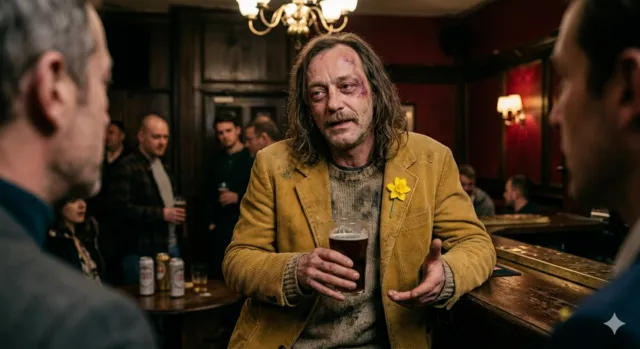
Brian was a beauty of council estate creation: middle-aged and weighing in at just over 20 stone, unshaven, matted hair, and a face looking like it had just emerged from a second-hand tyre yard: round, pock-marked, and bloated on account of all the alcohol and smoking it had undergone during a chess career at 136 level.
He had a unique way of not talking, but not shouting either, but somehow his mouth, if you could call the yellow thing one, was always making sounds like an industrial machine: Yorkshire-made, of course.
Peter, his ‘wife’, was the living contrast to Brian.
Peter was diminutive, thin and ill-looking, and the only manifest resemblance he had to Brian was when they sat together at a table, smoking as you could in the old days.
The collective exhalations from the two would create a toxic cloud of purple, which would have instantaneously turned any Victorian Industrialist into the first Victorian Environmentalist.
Unlike his husband’s bloated features, Peter’s countenance was gaunt and cadaverous.
A moustache, already dead and yellow with the smoke, hung over his top lip, and his eyes perpetually drooped as if to say, ‘Is it bedtime yet?’
Peter never looked awake; he was always in some semi-stupor state and barely let out the merest shuffle of life.
This trait undoubtedly resulted from working gruelling shifts in the factory where he sprayed ovens with toxic paints.
He regularly complained of spending an hour washing the cancerous stuff off his body in his bath.
Peter never did ‘wash all the cancerous stuff off’, though; in the end, it killed the poor sod.
However, Brian, the husband, lived, and during one eventful day at 255, we knew how angry and full of rage a middle-aged council man can be when someone lifts (steals) his cigarettes.
It was summer, and we’d been playing a series of five-minute chess competitions. It was nearing the end, and people were beginning to make their excuses and leave.
A few die-hards remained when the dogs leapt up and began to bark because of a knock on the door.
Brian was puffing away on the sofa, with Peter doing the same on the other side.
‘Someone at door, Karl!’ Brian boomed.
‘See who it is, Brian. I’ve only a couple of minutes on me clock.’
Brian heaved himself out of the sofa with a fog of smoke swirling around him and lumbered his frame to the door.
A minute later, he appeared again, saying, ‘It’s t’ Jehovah’s Witnesses. Have a to let ’em in?’
‘Do what you want,’ I answered without realising what I said and without looking up, frantically slamming the pieces down and slapping the clock in time trouble.
When I’d lost, there was Brian on the sofa with these two black-suited, young gentlemen of the faith of Jehovah, looking very frightened as the triple-headed hounds of Hell were showing their sharp, white teeth at them.
Brian and Peter flanked and smoked at them from either side.
‘What have you brought these in for, Brian?’ I asked, looking at them and wondering what to do.
‘Thought you might wanna ask ’em about God,’ he said, waving his hands.
Paul, a steadfast atheist, began to question the poor fellows, and what followed was a barrage of questions from Paul, the Doctor and Brian, with the occasional muttering of ‘Yea’ from Peter.
I listened.
I didn’t get involved, and eventually, the questions died out.
The Jehovahs, realising their cause and intention of converting these two was futile and seeing their opportunity to escape, duly made excuses and rose.
Brian and Peter were on opposite ends of the sofa.
‘It’s been nice chatting with you,’ one of the well-dressed young men said before leaving.
Brian was looking for his cigarettes.
‘We hope you can think about religion and give it some of your time.’
Brian was now frantic in the search for his cigarettes.
‘We’ll be getting off then,’ was the final word the Jehovahs uttered before leaving.
‘The bastards have nicked me fucking cigs,’ bawled Brian. ‘Don’t let the fuckers out.’
The dogs had all jumped to their feet; the humans were looking at Brian, and the Jehovahs were looking at each other.
‘You, yes, you near the door. Where’s me fucking cigs?’
‘I’m sorry, but I don’t smoke and haven’t seen your cigarettes.’
‘You lying bastard,’ and Brian went for him, nearly falling over Peter’s feet, who was still smoking at the end of the sofa.
‘Whoa, Brian. What yer doing? They won’t have your cigs,’ we all added.
‘I know these bastards, and I’m telling you they’d nick owt, and they’ve nicked me fucking cigs.’ And he lurched again for one of the Jehovahs.
Quick thinking was needed before some outrage upon the poor Jehovahs was done by Brian, who by this time had become enraged.
I grabbed hold of Brian, and Paul gave support, and I think it was Stuart who got the poor lads out of 255 and away from Brian and his lost cigs.
Peter, Brian’s wife, was still sitting smoking on the settee, saying to his husband, ‘They must have nicked ’em, Brian. Gotter a been them,’ and he blew out another plume of smoke as if to conclude the matter.
A year later, when all the old settees would be fed to the Bonfire Night pyre on Bonfire Night, 255’s flea-bitten mess was added to the pile.
It was customary to tear open the bottom and sides of the settee to see if any lost money had fallen there, and, lo and behold! - there, before our eyes, was Brian’s long-lost packet of cigarettes.
As the ‘rage-full and totally innocent’ Brian showed, successful vampires are not always charming vampires; they can be arrogant vampires.
The vampire’s world is only black and white; there are no variations of colour. There is what can be taken and what cannot be taken. They possess a unique thought process: to gain energy from others.
However, the vampire can be the complete chameleon when adapting its actions to gain self-rewards. They are adaptable creatures who bend and twist their actions to suit the battle arena.
Arrogance - definition: unpleasantly proud and behaving as if you are more important than, or know more than, other people.
Arrogance needs to be put into some context before we can elucidate upon the arrogance of the vampire.
Arrogance is created in the eye of the beholder, and we must be wary of that. One apocryphal story will show.
Jose Raul Capablanca, a chess genius and then Champion of the World, was criticised for being ‘arrogant’ because he constantly referred to himself as ‘Chess Champion of the World.’
His reply to the assertion of ‘arrogance’ was, ‘But I am the Chess Champion of the World, and there is no one better at the present time?’
Some may see his comment as being ‘unpleasantly proud’, but most of us can agree that Capablanca merely states, without unpleasantness, that he is ‘Chess Champion of the World.’
He doesn’t behave as if he were more important than others: the fact is he is. There was no one better chess player at that time.
Muhammad Ali also demonstrated such fact, although, perhaps, in a more boastful way, that he was the ‘Boxing Champion of the World.’
The arrogance of the vampire is not of the kind demonstrated by a World Chess or Boxing Champion; the vampire’s arrogance is superficial to those able to see through it.
Unfortunately, many more vulnerable people cannot, and they see arrogance as a demonstration of strength. They succumb to this ‘power’ and give in to the vampire. This can be in a relationship, the workplace, or friendship. The victim relinquishes power over the arrogant vampire.
The arrogant vampire is an excellent trickster. They will side-step strong individuals with discerning characters and faculties and focus their energy-sucking attention upon those who cannot resist believing their demonstrations of prowess will be good for a relationship, a company, or an organisation.
These victims are the ones the arrogant vampire will target and succeed with.
In the workplace, arrogance is a surefire way to identify the vampire. However, it takes work to deal with them, as these arrogant vampires will stick together both for defence and their vampiric attacks. This makes them formidable in business and in the workplace.
Vampires are generally inclined to work alone or be strong and independent.
However, in the workplace, vampires do not always possess enough power to work their vampiric nature; they need the support of other vampires.
Arrogant vampires will work together for mutual benefit. And the vampires’ arrogance will often become bloated.
Reader Comments
Leave a Comment
We would love to hear your thoughts on this chapter.

About Karl Swainston
Karl Swainston is a writer and storyteller whose work is forged from a life lived across the North of England and far beyond. Growing up on a Leeds council estate in the 1960s, Karl's journey was anything but linear. By the age of thirty, he had already lived a dozen lives: from the rigors of grammar school to a degree in Latin, a stint as a fishmonger, a period of discovery living in Marseille, and a return to the hustle of London. Whether working as a postman, a builder, or competing as a county-level chess player, he was, above all, an avid reader—constantly documenting the world around him. This restless spirit continued into his professional life. Karl later taught in Bradford, where he ran a specialist unit for 244 of the most excluded students from across the region—young people whom even the local Pupil Referral Units could not accommodate. Working alongside his old friend Malcolm, Karl spent his days navigating the volatility of Bradford's most aggressive and dysfunctional teenagers. Throughout his life, Karl has been an avid runner and has always shared his home with a rotating cast of beloved dogs and cats—companions who have been constant witnesses to his work. As a writer, Karl's range is as expansive as his history. He works across a wide breadth of genres, including fiction and short stories, autobiography and memoir, biography, non-fiction, and metaphysical writing, as well as providing sharp commentary, opinion, analysis, and essays. Whether writing about his years managing the Harrogate Arms or offering insights from his current adopted home in South East India, where he lives in a simple village with his dog, Bambi, Karl's voice reflects the full, untidy, and deeply human breadth of life. He continues to draw on the rich, decades-long tapestry of his experiences to tell stories that matter, proving that no matter where you live, the human story remains the same.
Author Page