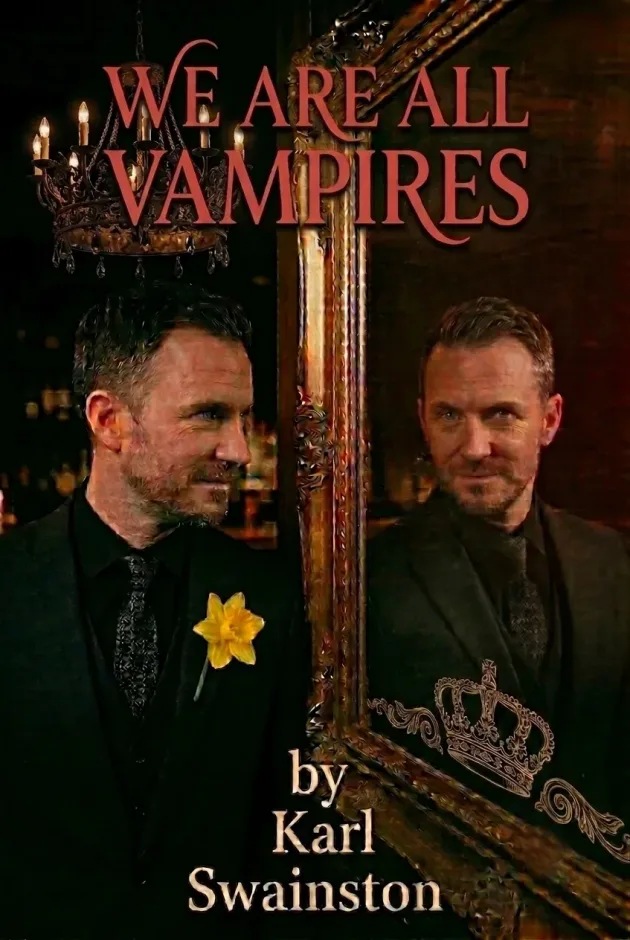
We Are All Vampires
I — An Introduction to the Narcissist
← Karl Swainston / We Are All Vampires
The word vampyre first appeared in Europe during the 1700s, quickly becoming widespread. Driven by superstition and the ravages of ill health, our ancestors believed in a ghoulish form of vampirism: nocturnal creatures draining the blood from hapless victims. Thankfully, modern generations perceive a more sophisticated version. Today’s vampire is a contemporary creature, sucking out the energy—the life force—of another human being.
We have all likely been guilty of this form of vampirism.
As you read through the demonstrable traits of the vampire, you may find that you are already living with one, working with one, or at the very worst: you are one. In modern psychology, we often label these destructive behaviors as narcissism—a profound, clinical inability to see beyond oneself. A vampiric trait can range from taking advantage of someone’s generosity to downright destroying another person’s life for one’s own benefit. While it may be uncomfortable to acknowledge the vampire within each of us, luckily, the creature in most of us is pretty tame, rarely venturing beyond minor transgressions.
This piece sets out to look at some of the more extreme forms of vampirism. Hopefully, this will enable you to identify who in the great crowd of human life is more vampire than others, and how to avoid them in relationships and business. Worryingly for some, it may also reveal vampiric traits you readily recognize in yourself.
Take two extremes of good and evil.
At one end, you have the Buddha. At the other, Henry VIII.
The former is the epitome of spiritual enlightenment. The latter was a lustful, debauched, and tyrannical ruler who was wont to strike off the heads of his beloved wives. While there may be individuals more blessed or wicked than these two, for argument’s sake, let us assume both historical figures represent total opposites.
Now, take a good, long look at your own character. Between the Buddha and Henry VIII, where do you lie?
If you think you rest outside the bounds of the Buddha, you are truly angelic. If you believe you rest beyond King Henry’s bounds, you are already damned to a perpetual Hell. For the rest of us, we reside somewhere in between.
The more virtuous are nearer the Buddha; the more depraved are nearer King Henry. By necessity, we all have some of Henry within us, just as we all have some of the Buddha. We all possess the potential to demonstrate the traits and actions of both—whether through an act of charity or a white lie, we all carry the capacity for both.
The “bad” is the vampire in us.
We all possess the potential to project our characters and identities to usurp the energy of another. When we acknowledge this uncomfortable truth, we can identify these wrong actions—Henry’s actions. This allows us to choose the contrary: the good actions of the Buddha for a better life.
Prefer to listen? Watch the video reading below.
Reader Comments
Leave a Comment
We would love to hear your thoughts on this chapter.

About Karl Swainston
Karl Swainston is a writer and storyteller whose work is forged from a life lived across the North of England and far beyond. Growing up on a Leeds council estate in the 1960s, Karl's journey was anything but linear. By the age of thirty, he had already lived a dozen lives: from the rigors of grammar school to a degree in Latin, a stint as a fishmonger, a period of discovery living in Marseille, and a return to the hustle of London. Whether working as a postman, a builder, or competing as a county-level chess player, he was, above all, an avid reader—constantly documenting the world around him. This restless spirit continued into his professional life. Karl later taught in Bradford, where he ran a specialist unit for 244 of the most excluded students from across the region—young people whom even the local Pupil Referral Units could not accommodate. Working alongside his old friend Malcolm, Karl spent his days navigating the volatility of Bradford's most aggressive and dysfunctional teenagers. Throughout his life, Karl has been an avid runner and has always shared his home with a rotating cast of beloved dogs and cats—companions who have been constant witnesses to his work. As a writer, Karl's range is as expansive as his history. He works across a wide breadth of genres, including fiction and short stories, autobiography and memoir, biography, non-fiction, and metaphysical writing, as well as providing sharp commentary, opinion, analysis, and essays. Whether writing about his years managing the Harrogate Arms or offering insights from his current adopted home in South East India, where he lives in a simple village with his dog, Bambi, Karl's voice reflects the full, untidy, and deeply human breadth of life. He continues to draw on the rich, decades-long tapestry of his experiences to tell stories that matter, proving that no matter where you live, the human story remains the same.
Author Page