Tales From A Harrogate Caravan
Chapter 24 — The Town Hall Tavern and the Barrister
← Karl Swainston / Tales From A Harrogate Caravan
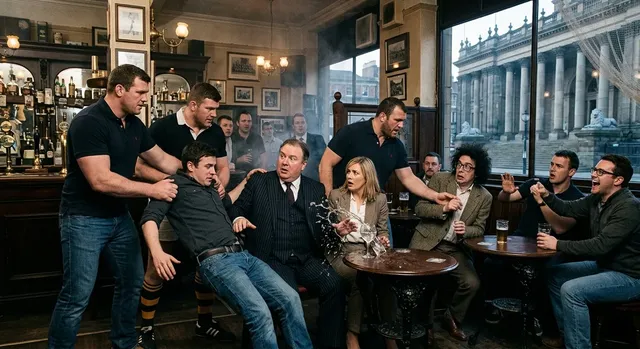
Chess continued apace and so did the Saturday night drinking sessions after a game. If it was quiet in the Victoria pub, we often headed to the Town Hall Tavern just around the corner, opposite the grand facade of Leeds Town Hall with its resting lions and columns of rising Greek architecture. They've draped the sculpture now in netting to stop the pigeons shitting all over it. The pub was the frequent haunt of professional Leeds Rugby players as well as barristers, lawyers, and other people of the law, as the courts were nearby.
The Doctor would sit in his tavern chair and take the piss out of anybody walking in. Most of the time he'd do it with subtlety, but when he was roused in mind and wit with alcohol, he would become louder, which drew attention to us.
‘Vellication of the face,' is how he described one poor bugger coming into the Town Hall Tavern. The man's right eye was swollen as he cast a hurting face towards us. No doubt he had called in for a pint on his way home from the Leeds General Infirmary. His face and head were all wrapped in swathes of bandage, and when he twitched the whole lot shuffled on his head.
The rugby players who drank there were all over six foot and packed with equal amounts of muscle. Too much of a match for the Doctor, but he had wit, and after a drink was wont to use it against the brawn. He'd become a little loud in his comments and a small group of packed muscle had noticed and began to realise what was happening, especially as Warren spluttered with laughter and others were laughing too at the Doctor's comments.
You can imagine a geeky, glasses-faced Brummie laughing out loud in a Leeds pub and glaring faces becoming inflamed, blood boiling, and you immediately get a sense of the danger all of us faced without actually knowing it.
We were stationed in a small room, just off the edge of the bar, but within earshot, and it was Paul – always acute to danger – who noticed the first signs when returning from the bar. 'Someone's going to get it, Karl. Tell him to shut up.'
It was pointless, however, as the Doctor was now in full swing and Warren laughing even louder brought the pack of muscle to the table.
I had a flashback to those vile London gangsters I once met. Broken noses, broken necks, crushed backs were expected in that moment of fight-or-flight syndrome. Flight was preferable, and as there was no question of fighting these brutes, escape was the only option, and especially so when Paul was told to shut his 'Geordie-fucking face up.' They were going straight for the Doctor, whose face, normally of a pallid colour because of the smoking and ill eating, became extremely white, and if it wasn't for his black bundle of wiry hair, you'd have thought him an albino at that moment.
I stood up – I don't know what for; I haven't got a clue – but a large, a very large hand, shoved me backwards, and this was one of those moments when Fortune comes to visit. I fell onto a barrister, who slipped his glass of gin, or whatever he was sipping, and it went all over the woman next to him.
The violence had begun and the brutes were trying to get to the Doctor. The barrister, in a clinical pin-striped suit, although overweight, jumped up with ease and stationed himself between compact muscle intending violence and the Doctor and us. I couldn't swear by it, but I think the Doctor was heading for the sanctuary of a three-legged Britannia table, which wouldn't have offered much safety, but desperation grasps at desperate acts.
'Gentlemen, I'm a barrister of our Queen's courts. So much as touch any of these people here, and I will personally take it upon myself to ensure you do the fullest level of time for gratuitous violence upon a bunch of hapless individuals.'
The Doctor decided not to complete the task of seeking sanctuary under the table, and he merely looked up.
'This man here,' continued the barrister, pointing to the Doctor, ‘has done nothing wrong but bring you into an affray, which, I may add, you will be prosecuted for if you pursue it to its bloody conclusion. Now, go sit down. I’ll have a word with him, and that's better than the violence you intend upon him. Landlord, buy these sturdy gentlemen a pint of your finest.’
The offer of free beer distracted the rugby players long enough for us to make our escape. ‘I'll have a word with these laughing hyenas outside and ensure they leave and bother you no more. I shall leave with them, and the matter will be ended.'
And so it was, the Doctor escaped death for sure, or at least a brutal beating. The barrister led the Doctor by the arm from the pub, whilst all we timid creatures followed, looking back, of course. We were lucky and the only person following us was the woman whom I accidentally soaked in gin.
The barrister was bristling with his reconciliation skills and how he controlled the Doctor and extricated him and us from the four engines of muscle inside the pub.
Accompanying the barrister was his secretary. No one really noticed her until, that is, we got to the Victoria pub and the barrister bought all the beer, and we all sat down in a corner of the pub.
The barrister controlled the whole of the discussion for the brief time he was there, and it was rare for the Doctor to be quiet and listening to him. The barrister related at length how he could control any unruly crowd and had done so on one such occasion in Her Majesty's Prison in Manchester. I don't know if the tale was true or not, but he was convincing, and you should always give the benefit of belief to Truth over Lies.
Throughout the whole oration from the barrister, his secretary, Irene, added amusing anecdotes to complete the show. They both complimented one another, and they were first class in showing what good company was like. I was sat next to Irene and in between the display of wit exercised between the Doctor and the barrister, I entertained another softer form of conversation.
Irene was a couple or so years older than me, and there was something striking and unfamiliar about her. She was neither good looking nor bad looking either; she had a head full of blond hair, and she had a consummate art of conversation, which kept you engaged. When she rose to go to the toilet, all the chess players' eyes were looking at the legs and arse of such a woman.
'Ask her out, Karl. Go on,' urged Paul.
There are some individuals who can pull the women or men, whichever the gender case may be, and they don't even have to try, but for the vast majority of loveless souls you have to entertain within your own expectations. My expectations had always had a smack of realist reasoning, and I knew what was achievable and what was not, and Irene was somehow above this, but I thought, 'What the hell, nothing can be lost.'
As the barrister and Irene were on the point of leaving, I asked, 'Do you want to go out tomorrow evening, Irene?' thinking the best I'd receive was, 'Thanks, Karl, for asking, but I've something else on.'
'Yes. I'd love to go out with you. Here's my number. Give me a ring tomorrow morning.'
Paul, who was an expert on women, commented, 'I told you, Karl, didn't I? Your round.'
I gladly bought Paul a Jack Daniel's and couldn't really believe my luck, as I'd never really scored above my station, and I couldn't wait until tomorrow and Saturday night.
Reader Comments
Leave a Comment
We would love to hear your thoughts on this chapter.

About Karl Swainston
Karl Swainston is a writer and storyteller whose work is forged from a life lived across the North of England and far beyond. Growing up on a Leeds council estate in the 1960s, Karl's journey was anything but linear. By the age of thirty, he had already lived a dozen lives: from the rigors of grammar school to a degree in Latin, a stint as a fishmonger, a period of discovery living in Marseille, and a return to the hustle of London. Whether working as a postman, a builder, or competing as a county-level chess player, he was, above all, an avid reader—constantly documenting the world around him. This restless spirit continued into his professional life. Karl later taught in Bradford, where he ran a specialist unit for 244 of the most excluded students from across the region—young people whom even the local Pupil Referral Units could not accommodate. Working alongside his old friend Malcolm, Karl spent his days navigating the volatility of Bradford's most aggressive and dysfunctional teenagers. Throughout his life, Karl has been an avid runner and has always shared his home with a rotating cast of beloved dogs and cats—companions who have been constant witnesses to his work. As a writer, Karl's range is as expansive as his history. He works across a wide breadth of genres, including fiction and short stories, autobiography and memoir, biography, non-fiction, and metaphysical writing, as well as providing sharp commentary, opinion, analysis, and essays. Whether writing about his years managing the Harrogate Arms or offering insights from his current adopted home in South East India, where he lives in a simple village with his dog, Bambi, Karl's voice reflects the full, untidy, and deeply human breadth of life. He continues to draw on the rich, decades-long tapestry of his experiences to tell stories that matter, proving that no matter where you live, the human story remains the same.
Author Page