Tales From A Harrogate Caravan
Chapter 17 — The Open University and Lil the Angel
← Karl Swainston / Tales From A Harrogate Caravan
It was around my twenty-eighth year that I decided to call time on London and the haphazard lifestyle I was leading between Leeds and the capital. I'd worked down in that big city for a good ten years, but the place had suddenly grown wearisome to me. In addition, work became erratic, and since I'd already enrolled upon an Open University degree, I decided to stay in Leeds and concentrate upon that discipline.
My admiration goes out to anyone undertaking and successfully completing an Open University degree. Stand five candidates in front of me petitioning for a job, and I'd be immediately biased towards the one with the Open University degree as opposed to the more traditional degrees.
The discipline, stamina, and dedication required to do a day's graft, come home, do the daily loathsome chores and then sit down and study alone for hours is truly commendable. You also have to remember that there wasn't really the internet then, and the only support you had were programmes on BBC2, which started at midnight and ran through the night. I can remember setting the VHS recorder and taping the relevant programmes in order to watch them the following day. The only other support was a monthly tutorial, where you'd meet in a pub and chat with other students. And that was it.
I only did a year – I'll shortly explain why – but these industrious people did up to six years: remarkable.
Today, I suspect it's much easier to undertake an Open University degree because of internet access and YouTube etc., where you can learn everything from the Renaissance to making a bomb. I don't quite understand why students spend upwards of £40,000 on a traditional university degree when they could spend a fraction of that, and still work, and still achieve graduate status through the Open University avenue. Some may say that the support is greater at university, but that's a load of bollocks. You're lucky if you get fifteen minutes support, and throw in the excruciating lectures, which seem interminable, and the value the student gets for their £40,000 is dire.
The biggest obstacle I had to overcome with home study was home and 255. Even in my late twenties, the house was forever full of people visiting. Barely a day passed without someone walking through the door. In the beginning, I felt like packing the whole study-lot in and moving back to London, but Lil, my next door neighbour who lived with her husband, Bruce, came to the rescue.
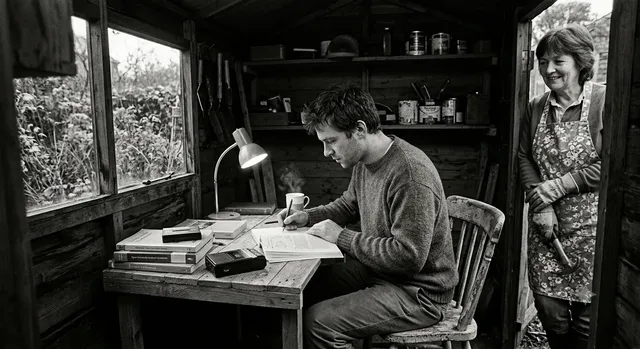
Lil was in her fifties, and she was an absolute angel; she couldn't do enough for you. The last time I saw the wonderful lady was when Bernie hired a van and took her and Bill to Scotland, where they retired. Anyway, I'd casually told Lil about the constant distractions while trying to study and write, and then I left her, thinking no more about the event. I arrived home later that day just as Lil was emerging from the back garden with a hammer, some wood and nails in her arms. Her face was flushed, and she appeared a little out of breath.
'Wait there, Karl. Don't move. I'll be back in a minute,' and off she trotted to her house next door.
No sooner did she return and lead me by the arm towards the back of 255. We walked past the back door and towards the garden shed.
'Have a look in,' she ordered.
I opened the door, and there, at the back of the shed, was a newly built desk, complete with a salvaged chair.
'Now, you've no reason to sit in there,' as she pointed to the house. 'You'll be able to do all your essays in here, and let's hear no more of you going back down London.'
Without that sweet woman, I'm sure I would have packed the studying game in and walked a different path, but Lil, angel that she was, knew which direction I needed to go, and like all true friends she facilitated the way.
The garden shed was a complete sanctuary, and the quiet interior was completely fitted to study. It's strange, but I cannot now write anything when it's quiet; I need that surrounding hubbub of noise. Silence is a complete distraction for me and isn't beneficial at all to any attempt at creativity.
Reader Comments
Leave a Comment
We would love to hear your thoughts on this chapter.
About Karl Swainston
Karl Swainston is a writer and storyteller whose work is forged from a life lived across the North of England and far beyond. Growing up on a Leeds council estate in the 1960s, Karl's journey was anything but linear. By the age of thirty, he had already lived a dozen lives: from the rigors of grammar school to a degree in Latin, a stint as a fishmonger, a period of discovery living in Marseille, and a return to the hustle of London. Whether working as a postman, a builder, or competing as a county-level chess player, he was, above all, an avid reader—constantly documenting the world around him. This restless spirit continued into his professional life. Karl later taught in Bradford, where he ran a specialist unit for 244 of the most excluded students from across the region—young people whom even the local Pupil Referral Units could not accommodate. Working alongside his old friend Malcolm, Karl spent his days navigating the volatility of Bradford's most aggressive and dysfunctional teenagers. Throughout his life, Karl has been an avid runner and has always shared his home with a rotating cast of beloved dogs and cats—companions who have been constant witnesses to his work. As a writer, Karl's range is as expansive as his history. He works across a wide breadth of genres, including fiction and short stories, autobiography and memoir, biography, non-fiction, and metaphysical writing, as well as providing sharp commentary, opinion, analysis, and essays. Whether writing about his years managing the Harrogate Arms or offering insights from his current adopted home in South East India, where he lives in a simple village with his dog, Bambi, Karl's voice reflects the full, untidy, and deeply human breadth of life. He continues to draw on the rich, decades-long tapestry of his experiences to tell stories that matter, proving that no matter where you live, the human story remains the same.
Author Page