Tales From A Harrogate Caravan
Chapter 30 — The Latin Interview
← Karl Swainston / Tales From A Harrogate Caravan
A couple of weeks after my application was submitted, I received a reply from Leeds University asking me to attend an interview there. However, jubilation suddenly subsided when I realised I didn't really have a clue about Latin, and I could only remember snatches of the dead language from school. The interview was in little over a week, and therefore, there wasn't much time to learn about Roman culture and language.
Nevertheless, I did try to read as much as I could, but it wasn't nearly enough, and the nearer the day of the interview came, the more nervous I became about pulling it off. I knew I was up against students with A Level Latin, and I had no qualifications except one year of Open University and nearly a year on an Access Course. It was too late to change, and on that Tuesday, I can remember feeling completely hopeless and thinking what a complete wanker I was to have chosen such a ridiculous option when I'd no education in the discipline.
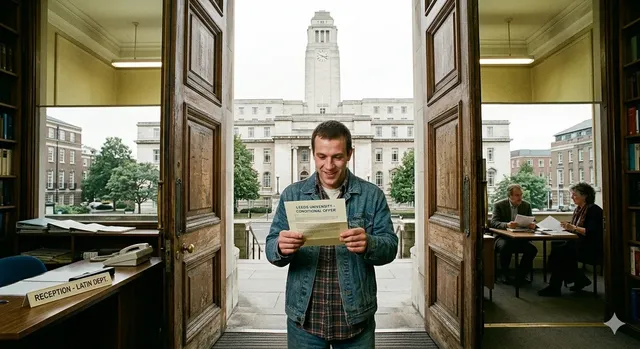
I informed the receptionist of my arrival and waited to be called through those aged doors of Parkinson's Building at the heart of Leeds University. By this time, I'd realised the dire nature of my situation, and I began to accept it, which made the shame of it all easier to bear.
'Mr Swainston? You can go in now.' I was the last candidate to be interviewed.
I walked without purpose to the door, knocked and made my way in. The place was musty with the smell of books, and in the middle were two aged intellects, who were preparing to rip to bits my lack of understanding. The best practice in situations such as these is to get the deed done as quickly as possible. When the first academic asked about my understanding of Latin and the relevant qualifications I held, I knew speed was of the essence, and that I should reply in short words, and not try to make something from nothing, as they say.
The two professors took no more than ten minutes to destroy what little confidence I had left, and when they couldn't think of much more to ask, they began to shuffle and look at one another, tacitly deciding there wasn't really much point in pursuing any more questions.
I'd performed dutifully to my expectations and completely fucked up, as they say, because I didn't have a clue about Latin and Roman culture, and had felt completely inept trying to reply.
'Any more questions?' I asked, just wanting to get out of there.
'No. I think you've answered all the questions.' He asked of his colleague: 'Do you have any more questions you'd like to ask Mr Swainston?'
'Yes. What do you read, Karl? Tell me something you've really enjoyed when reading. Have you read Shakespeare for instance?'
I was just about to rise from the chair and leave. I fell back into it.
The next hour, and it could have been more, because time simply fell away, we discussed the tragedy of King Lear, anagnorises, peripeteia, hamartia, tragic flaw, character, plot, Aristotle's Poetics, Horace's On the Art of Poetry, Greek tragedy, Hippolytus and Phaedra; and everything in the Renaissance from Marlowe to Shakespeare to the great Russian writers of the 19th Century: Pushkin, Gogol, Dostoevsky and Goncharov – and not forgetting English and American classics.
There wasn't a book, artist, or composer whose work I didn't drag into that interview.
'You have a remarkable and very varied experience of reading, Karl, and we'll let you know of our decision by post. Thank you for coming along.'
Two days later a letter dropped upon the worn and tattered lino of 955. It had written in blue letters on the back: Leeds University. I took the letter and a cup of coffee to the garden shed, and after a few moments of looking at it, finally opened it.
'Congratulations. Leeds University would like to offer you an unconditional place for a degree in Latin.'
I was ecstatic. Not only had I succeeded in gaining a place, but I'd done it without any conditions attached, and I could completely mess up the Access Course and still gain entry to that grand university.
I showed Brenda the letter, and she was delighted, but Robert simply shoved the letter away from the dining table he was eating at, and muttered, 'I've already heard. Well done, Karl.'
Prefer to listen? Watch the video reading below.
Reader Comments
Leave a Comment
We would love to hear your thoughts on this chapter.
About Karl Swainston
Karl Swainston is a writer and storyteller whose work is forged from a life lived across the North of England and far beyond. Growing up on a Leeds council estate in the 1960s, Karl's journey was anything but linear. By the age of thirty, he had already lived a dozen lives: from the rigors of grammar school to a degree in Latin, a stint as a fishmonger, a period of discovery living in Marseille, and a return to the hustle of London. Whether working as a postman, a builder, or competing as a county-level chess player, he was, above all, an avid reader—constantly documenting the world around him. This restless spirit continued into his professional life. Karl later taught in Bradford, where he ran a specialist unit for 244 of the most excluded students from across the region—young people whom even the local Pupil Referral Units could not accommodate. Working alongside his old friend Malcolm, Karl spent his days navigating the volatility of Bradford's most aggressive and dysfunctional teenagers. Throughout his life, Karl has been an avid runner and has always shared his home with a rotating cast of beloved dogs and cats—companions who have been constant witnesses to his work. As a writer, Karl's range is as expansive as his history. He works across a wide breadth of genres, including fiction and short stories, autobiography and memoir, biography, non-fiction, and metaphysical writing, as well as providing sharp commentary, opinion, analysis, and essays. Whether writing about his years managing the Harrogate Arms or offering insights from his current adopted home in South East India, where he lives in a simple village with his dog, Bambi, Karl's voice reflects the full, untidy, and deeply human breadth of life. He continues to draw on the rich, decades-long tapestry of his experiences to tell stories that matter, proving that no matter where you live, the human story remains the same.
Author Page