Tales From A Harrogate Caravan
Chapter 48 — The Kitten in the Car
← Karl Swainston / Tales From A Harrogate Caravan
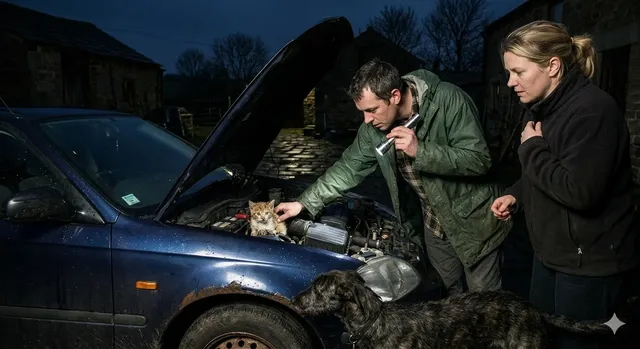
During a very cold night around 2007, Smokey, the dog, became extremely interested in an old car we used to have in the yard. He was whizzing around the front of it, and he knew something was inside. Anna came into the house and asked me to go out and take a look. It was dark, and you couldn’t really see much, so I went back into the house and retrieved a torch.
I opened the bonnet and peered in, whilst at the same time making sure Smokey didn’t jump up and grab whatever was in there. I couldn’t see anything, and when Anna came to join, she couldn’t either. Then we did. Something small moved down to the right-hand side of the battery, and when we took a closer look, there it was: a little bundle of dirty fur, trying desperately to hide.
I reached in and pulled out a very small kitten, which was terrified. It should have been white with streaks of ginger, but the muck and oil of the car had dirtied the feral feline. We took the poor little creature into the kitchen and bathed him, as it was a tom cat.
Clung fast on both his hind legs were two ticks. I’ve never seen a tick before, and if you haven’t, you don’t want to. They are nasty little monsters, which attach themselves to dogs and cats, and I suppose other animals, too. Once they’ve attached, they start to live off their host and continuously suck life out of them. The kitten had two on him.
You cannot simply pluck the insects from the flesh, which by the way are as big as a button, as they fasten tight to their host with fangs. I had to read up on the internet what to do, and it suggested going to the vet and buying this powder, which you apply, and it kills the vermin. Two days later the two insects fell off dead.
We named the cat Murtagh after the Irish jockey, who we used to follow. It was incredibly scared at first and used to hide in the kitchen beneath the cupboard, and we thought it was better to leave it, and let it find its own will to come out.
***
Eventually it did begin to appear, and each morning it would jump up and sit on Anna’s lap in the kitchen. Even though the kitten was no more than five or six weeks old, it knew which lap it wanted to sit on, and it was always Anna’s. Perhaps the little thing thought she was its mother.
I don’t know, but I knew the cat could discern who lived in the house. When the months passed, the kitten grew, but it never lost that feral streak, and whenever any visitors called round, the cat would always disappear into the nearby fields and never return again until the house was empty of strangers.
Shep, the Alsatian, never showed any interest in the cat and neither did the other cat, Alfie. Smokey’s trick with the cat was to run and grab it in the garden and cart it off to his kennel. He didn’t hurt it, and as soon as he dropped Murtagh down on the kennel floor, the cat would run off again, and the whole circus was repeated.
As the months passed, Murtagh would have none of it anymore, and he would attack the dog, but that didn’t stop Smokey from taunting it. One day, though, Smokey never appeared from his kennel, even when the cat was sat outside pawing his leg.
‘Smokey doesn’t seem himself today, Karl,’ Anna commented one morning before work.
‘He’ll be alright. It might be something he’s eaten,’ I replied, and we set off for work.
It was just into the afternoon when Sean, our neighbour, rang up the unit and told us that Smokey looked very ill. We made arrangements straight away and left immediately. When we arrived home, Smokey was on a blanket, which Sean had put down for him, and he did look grave. We carefully put him into the car and set off for the vets.
Prefer to listen? Watch the video reading below.
Reader Comments
Leave a Comment
We would love to hear your thoughts on this chapter.

About Karl Swainston
Karl Swainston is a writer and storyteller whose work is forged from a life lived across the North of England and far beyond. Growing up on a Leeds council estate in the 1960s, Karl's journey was anything but linear. By the age of thirty, he had already lived a dozen lives: from the rigors of grammar school to a degree in Latin, a stint as a fishmonger, a period of discovery living in Marseille, and a return to the hustle of London. Whether working as a postman, a builder, or competing as a county-level chess player, he was, above all, an avid reader—constantly documenting the world around him. This restless spirit continued into his professional life. Karl later taught in Bradford, where he ran a specialist unit for 244 of the most excluded students from across the region—young people whom even the local Pupil Referral Units could not accommodate. Working alongside his old friend Malcolm, Karl spent his days navigating the volatility of Bradford's most aggressive and dysfunctional teenagers. Throughout his life, Karl has been an avid runner and has always shared his home with a rotating cast of beloved dogs and cats—companions who have been constant witnesses to his work. As a writer, Karl's range is as expansive as his history. He works across a wide breadth of genres, including fiction and short stories, autobiography and memoir, biography, non-fiction, and metaphysical writing, as well as providing sharp commentary, opinion, analysis, and essays. Whether writing about his years managing the Harrogate Arms or offering insights from his current adopted home in South East India, where he lives in a simple village with his dog, Bambi, Karl's voice reflects the full, untidy, and deeply human breadth of life. He continues to draw on the rich, decades-long tapestry of his experiences to tell stories that matter, proving that no matter where you live, the human story remains the same.
Author Page