Tales From A Harrogate Caravan
Chapter 17 — The End of the Harrogate Arms
← Karl Swainston / Tales From A Harrogate Caravan
One morning, as I was just on the point of setting out to work, I noticed the kitchen was empty, and that people were already on their way down for breakfast. Isla wasn’t there. She was still in bed. After some persuasion, I encouraged her to come down and at least serve the customers their breakfast.
Isla had hit that point upon which something snaps, and she slumped down against the wall in tears and declared she couldn’t do it any longer. I had to go to work and bring in the money, and the only option left was to get Eileen, Isla’s friend, up, who had stayed the night, and get her to cook the breakfast and see to the customers. I set off for work.
At eleven, I phoned up to see how Isla was, and a slurred voice answered. ‘Heaaloo, this isss the HarrrOgate arms.’
It was eleven o’clock in the morning, and Eileen was pissed. I asked her to pass the phone to John, who’d come over to help out in the kitchen, and he confirmed the fact, ‘She’s pissed, Karl.’
I informed the college I had to leave, and I made my way back to Harrogate. When I arrived, Eileen was singing away, if that’s what you could call it, and practically falling over. The punters had all gone to write their reviews, and John was in the kitchen.
‘Eileen, you’re drunk.’
‘I’m not drrrunkk. What makes you saayy htat?’
‘John?’
‘She’s pissed, Karl,’ and he carried on cooking the potatoes.
I took Eileen upstairs, minus the gin bottle, and put her into bed. Next door, Isla was in bed, and I can remember standing outside those two rooms, and thinking inside lay two women, both dead to the world for different reasons.
The next day, and the few days following, Isla made a renewed effort with the Arms and even booked in a band, which no one turned up for, and that was the final straw.
‘I’ve had it, Karl, and can no longer work or live here. I’m off.’
And within the fortnight, Isla had found a job, and Rachel and she had moved out of the Harrogate Arms and into an expensive flat by the beautiful Stray.
Soon after, Thomas and his son moved out of the caravan and, in desperation, I persuaded John to come across and take up residence there. I’d decided to sell my last property, the bungalow, and it was fitting it should be empty to facilitate the sale, and so John arrived to live with me, Jack, the cat, and three dogs.
Only Richard, the last employee, had any appreciable experience of the hospitality and catering business, and with only John, me and Jack helping out, the business quickly folded. We all tried our hardest to please, but customers, even when a complaint was resolved with either their money back or a free drink or meal, still went home and wrote a horrid review. In the end I’d had enough, and when one old woman complained her tea was coffee, as it had been placed in a coffee pot instead of a tea pot, I went out, opened the lid, stuck in a fork, and lifted a tea bag out, saying, ‘Look, tea bag. It’s tea,’ and then dropping the bag back in the pot and walking off.
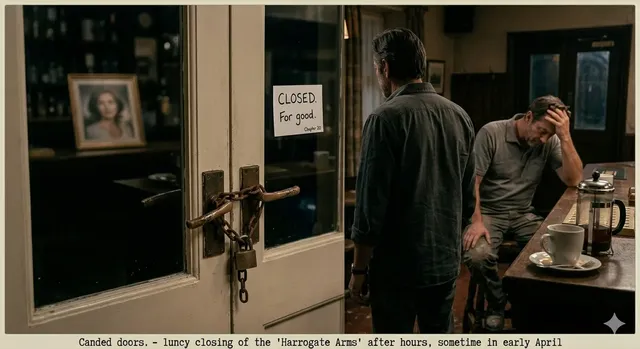
I thought we could have seen it out to the summer, attracted visitors again, and built up the business. Winter paid punishment to that idea, and even in April there was still snow on the ground, and the doors of the Harrogate Arms closed for the last time.
Prefer to listen? Watch the video reading below.
Reader Comments
Leave a Comment
We would love to hear your thoughts on this chapter.

About Karl Swainston
Karl Swainston is a writer and storyteller whose work is forged from a life lived across the North of England and far beyond. Growing up on a Leeds council estate in the 1960s, Karl's journey was anything but linear. By the age of thirty, he had already lived a dozen lives: from the rigors of grammar school to a degree in Latin, a stint as a fishmonger, a period of discovery living in Marseille, and a return to the hustle of London. Whether working as a postman, a builder, or competing as a county-level chess player, he was, above all, an avid reader—constantly documenting the world around him. This restless spirit continued into his professional life. Karl later taught in Bradford, where he ran a specialist unit for 244 of the most excluded students from across the region—young people whom even the local Pupil Referral Units could not accommodate. Working alongside his old friend Malcolm, Karl spent his days navigating the volatility of Bradford's most aggressive and dysfunctional teenagers. Throughout his life, Karl has been an avid runner and has always shared his home with a rotating cast of beloved dogs and cats—companions who have been constant witnesses to his work. As a writer, Karl's range is as expansive as his history. He works across a wide breadth of genres, including fiction and short stories, autobiography and memoir, biography, non-fiction, and metaphysical writing, as well as providing sharp commentary, opinion, analysis, and essays. Whether writing about his years managing the Harrogate Arms or offering insights from his current adopted home in South East India, where he lives in a simple village with his dog, Bambi, Karl's voice reflects the full, untidy, and deeply human breadth of life. He continues to draw on the rich, decades-long tapestry of his experiences to tell stories that matter, proving that no matter where you live, the human story remains the same.
Author Page