Tales From A Harrogate Caravan
Chapter 19 — The Accusation of Plagiarism
← Karl Swainston / Tales From A Harrogate Caravan
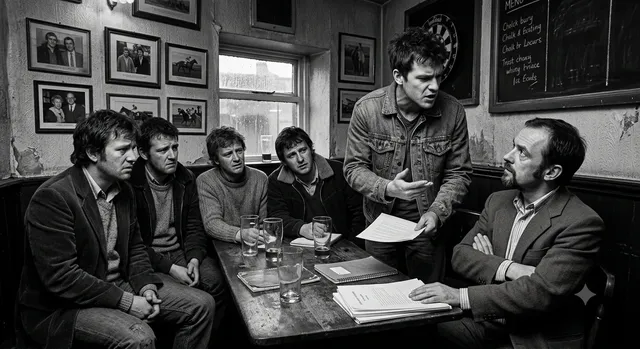
On the first Monday of every month a small group of students would meet with our tutor, who would direct us along the study path. He was a small man in his mid-fifties, skinny and had one of those goatee beards. He was so fluffed up with himself to the annoying point where he'd never let anyone finish a sentence before he interrupted them and began spouting further crap. I took immediate dislike to the fellow and fell to being quiet, as I knew my character, and I didn't trust it to keep my mouth shut.
I can remember sitting there in that pub watching this cretin with all his eager students around him, and him cooing his intelligence to them. Don't get me wrong: I wasn't envious of him, but disliked intensely his shameful exhibition of pride.
In that first year of study you had to produce essays on anything from paintings, music, literature and philosophy, and on this one occasion the annoying fellow had asked us all to comment upon a painting by one of the Pre-Raphaelites, of which I knew very well, as our Mick had made many studies of Dante Gabriel Rossetti, and the essay I wrote was one of the easiest I've ever written. I'd sent the essay off in the post a week earlier than the Monday meeting, and during that meeting he would provide verbal feedback to each one of us. When my turn came, he pulled me to one side and bit his lip before looking at me with these two beady, suspicious eyes.
'I haven't marked it, Karl, because you haven't written it. The language is too purple and there is much too much understanding of artistic techniques and styles for you to have written it.'
There have only been a few times in my life when I've resisted the greatest temptation to slam someone in the face, and, believe me, that bloke didn't know how lucky he was that evening. I don't know how I did it, but I did and chose another course of action, which was not as brutal, but embarrassing for me.
There were five or six other students in that small pub room, and after biting my tongue and sitting back down, I began.
'Mr Wilson has just accused me of plagiarism, which is fine, because that's what the man deems my essay to be. Now, if someone accuses you of something, you have the right of redress, which is what I'm doing now.'
A few embarrassed faces looked sideways at one another, and Mr Wilson attempted to intervene, but I was not to be denied.
'Here is my essay, and he says I've commented upon artistic techniques such as pointillism, camera obscura, etc., without knowing what these concepts are. Every single line in this essay I can justify, elaborate, embroider, determine and expound to defend myself against such a scurrilous accusation of plagiarism.'
More embarrassed faces glanced nervously at one another, before one of the students said, 'Karl, I think you should discuss this with Mr Wilson in private, as it has nothing to do with any of us.'
Each of the students then began to make their excuses and left. I'd already departed to the bar, determined like a child to be the last one to leave.
Mr Wilson before leaving came to the bar and said, 'I'd prefer it if you didn't attend any more of my meetings, and I'll correspond on your essays only with you in writing. Goodbye.'
I must have worn down a quarter of my teeth in grinding them those few seconds the fellow stood behind me delivering his dictate.
The only consolation I had was the knowledge that even if I had failed every one of my essays, I could still progress on by passing the end of year exam, which I did to the utmost rage of Mr Wilson.
However, not much mattered anyhow, as in the same year of studying at the Open University I also enrolled upon an access course for mature students wishing to gain access to university.
Prefer to listen? Watch the video reading below.
Reader Comments
Leave a Comment
We would love to hear your thoughts on this chapter.

About Karl Swainston
Karl Swainston is a writer and storyteller whose work is forged from a life lived across the North of England and far beyond. Growing up on a Leeds council estate in the 1960s, Karl's journey was anything but linear. By the age of thirty, he had already lived a dozen lives: from the rigors of grammar school to a degree in Latin, a stint as a fishmonger, a period of discovery living in Marseille, and a return to the hustle of London. Whether working as a postman, a builder, or competing as a county-level chess player, he was, above all, an avid reader—constantly documenting the world around him. This restless spirit continued into his professional life. Karl later taught in Bradford, where he ran a specialist unit for 244 of the most excluded students from across the region—young people whom even the local Pupil Referral Units could not accommodate. Working alongside his old friend Malcolm, Karl spent his days navigating the volatility of Bradford's most aggressive and dysfunctional teenagers. Throughout his life, Karl has been an avid runner and has always shared his home with a rotating cast of beloved dogs and cats—companions who have been constant witnesses to his work. As a writer, Karl's range is as expansive as his history. He works across a wide breadth of genres, including fiction and short stories, autobiography and memoir, biography, non-fiction, and metaphysical writing, as well as providing sharp commentary, opinion, analysis, and essays. Whether writing about his years managing the Harrogate Arms or offering insights from his current adopted home in South East India, where he lives in a simple village with his dog, Bambi, Karl's voice reflects the full, untidy, and deeply human breadth of life. He continues to draw on the rich, decades-long tapestry of his experiences to tell stories that matter, proving that no matter where you live, the human story remains the same.
Author Page