Tales From A Harrogate Caravan
Chapter 37 — Teaching in Dewsbury
← Karl Swainston / Tales From A Harrogate Caravan
Since my degree had been in Latin, the PGCE assigned me to Harrogate Grammar, which was great, but the travelling, since I didn't have a car, or the funds to get there and back for a year, was not practical. I just couldn't afford the travelling expenses, and I'd overheard another student from Harrogate complaining he'd been posted in Wakefield, which wasn't far for me, and I suggested swapping. We had to dance through a couple of hoops, but the deed was done, and I was posted in Dewsbury and he in Harrogate. I shall return to the town of Harrogate later in the story.
Dewsbury, a grim and lifeless town, a dull and sour town, that's all I remember of that godforsaken place. It possesses old mills, whose walls have become black over the years, and the people are always hunched and suspicious looking creatures.
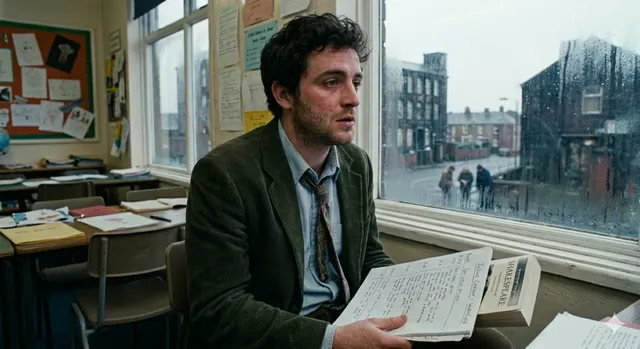
Broadacre Secondary was the school, and all the children of these suspicious looking creatures attended it. It was a large secondary modern, and the building was one of those chucked up in the sixties or early seventies just like Leek Street Flats, but a little more durable than them, but nevertheless, still as unattractive.
I was to teach English there, as they didn't have Latin on the syllabus and wouldn't have known what it was even if they did. It was at this time, while I was at Broadacre Secondary, that Jack was born and my father had died.
I had to teach Julius Caesar, and I enjoyed delivering the Bard to this bunch of impoverished kids. I changed the time from Rome to Dewsbury, and Brutus, Caesar, and Mark Antony to the names of some local drug dealers the kids had told me about, and we set about understanding the play. Kids are surprisingly astute in their understanding of politics when they make an effort, and the parliament of traitorous deeds is connected with their own world, and they loved the play, and I loved teaching it, too.
***
I've got flu. Schools are unnatural. Where else in God's western hemisphere do you cram thirty people in a small room for a day, a week, a year, pile on the heating to get the bugs, infections, and bacteria to the breeding point of contagion, and then expect the mortals in the classroom to sustain a level of healthy existence. Even in the most congested office, the climate is not as claustrophobic as a classroom.
The Department of Education crams our future generations into these unnatural environments, and when their time is done, and they've learnt the difference between a verb and pronoun, and can recognise a question of algebra, but haven't got a clue how to use it in real life, off they toddle into the world of work and a completely different and more natural environment, for which education has completely failed them.
I don't think I'm being negative, but a simple realist. I've studied on both sides of the desk and worked in both menial and management roles and am afforded some wisdom into the facts. Take the following example: Speaking and listening is, arguably, the greatest demonstration of understanding. It exhibits demonstrating, showing, knowing, telling, persuading, arguing, describing, instructing, ad infinitum.
Almost every aspect of life is suffused with this skill: Prime Minister's Question Time, BBC Question Time, the news, a dustman explaining why he won't remove a dead dog that a woman has left in her bin, a boss telling his fresh sixteen-year-old new employee to 'Fuck off, yer finished,' a husband listening to his wife complain of chest pains and offering a little relief in words. There isn't a day goes by when we don't have to rely on words and the skill of listening in order to make sense of the world and to be a meaningful part of that world.
You would expect, like the ancients, who raised rhetoric to an art, and worshipped and applauded that art, that Education would too – raise the art of speaking and listening to a core skill of student schooling. But no: speaking and listening doesn't get anywhere near the pedestal it deserves. Renowned educationalist idiots, the Goves and Wiltshaws, et al., don't even give it an allowance of ten percent. They bury the skill in with English, and they only apportion a very small percentage to the discipline. The monster share goes to writing and comprehension. A GCSE in Urdu or Spanish carries more clout than speaking and listening. FACT. And yet the monster share in life, real life, is not with writing and comprehension, but with speaking and listening.
Is it any wonder then that our kids leave school and arrive at their first job like muttering idiots, creeping around and not daring to speak? Speaking and listening should have its own syllabus and should be a core subject, out there on top of the rest and giving our next generation a skill they would be pleased to learn and proud to use, and unlike all the shite they were forced to learn, would never forget.
Rant over. Flu doesn't make you mad – I believe I've always been that in varying degrees – but it does make you irate at the injustices sprayed upon people who have no control over their inability to change events.
Prefer to listen? Watch the video reading below.
Reader Comments
Leave a Comment
We would love to hear your thoughts on this chapter.

About Karl Swainston
Karl Swainston is a writer and storyteller whose work is forged from a life lived across the North of England and far beyond. Growing up on a Leeds council estate in the 1960s, Karl's journey was anything but linear. By the age of thirty, he had already lived a dozen lives: from the rigors of grammar school to a degree in Latin, a stint as a fishmonger, a period of discovery living in Marseille, and a return to the hustle of London. Whether working as a postman, a builder, or competing as a county-level chess player, he was, above all, an avid reader—constantly documenting the world around him. This restless spirit continued into his professional life. Karl later taught in Bradford, where he ran a specialist unit for 244 of the most excluded students from across the region—young people whom even the local Pupil Referral Units could not accommodate. Working alongside his old friend Malcolm, Karl spent his days navigating the volatility of Bradford's most aggressive and dysfunctional teenagers. Throughout his life, Karl has been an avid runner and has always shared his home with a rotating cast of beloved dogs and cats—companions who have been constant witnesses to his work. As a writer, Karl's range is as expansive as his history. He works across a wide breadth of genres, including fiction and short stories, autobiography and memoir, biography, non-fiction, and metaphysical writing, as well as providing sharp commentary, opinion, analysis, and essays. Whether writing about his years managing the Harrogate Arms or offering insights from his current adopted home in South East India, where he lives in a simple village with his dog, Bambi, Karl's voice reflects the full, untidy, and deeply human breadth of life. He continues to draw on the rich, decades-long tapestry of his experiences to tell stories that matter, proving that no matter where you live, the human story remains the same.
Author Page