Tales From A Harrogate Caravan
Chapter 15 — Bernie and the Doctor's Character
← Karl Swainston / Tales From A Harrogate Caravan
People don't like mental defectives. They shuffle and feel uneasy. I did, too, when encountering Bernie for the first time. He had working class breeding and was articulate. He stood in a queue waiting for a coffee or tea, but John said he'd pushed in. An argument ensued, which almost came to blows, and that set the theme.
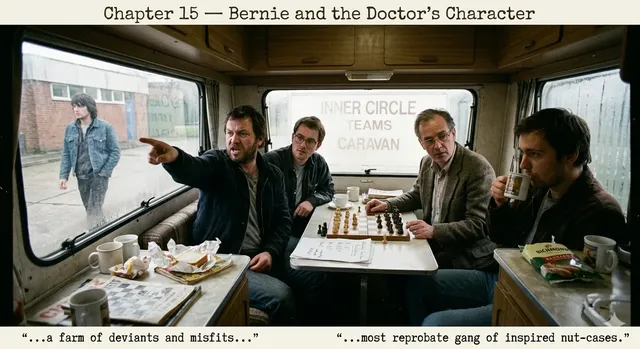
‘That's the fucker!’ John cried, noticing him saunter by our Inner Circle team's cheap caravan, which we’d parked up outside the sports centre where the event was being held. Four of us were sat around the removable dining table analysing and drinking tea.
‘Yea, that's him,’ Paul agreed.
The Doctor, looking bewildered, muttered, ‘What's his name? Don't bother, I won't remember, and I’ll probably never get to know him, so what difference does it make? You should have played Ne5 here and taken the outpost.’
The Doctor looked out of the caravan window again. ‘Wait a minute! That’s the bastard who swindled a draw against me after I refuted his Advance Caro-Kann!’
I hadn’t noticed Bernie before but, one way or another, he had upset everyone else in the caravan. I made a mental note to take a look at his play next time I was passing his board.
Best to plan ahead in these matters, I find.
Over only a couple of weeks, Bernie had muscled his way into the camp at Leeds Chess Club, or should I say a farm of deviants and misfits encompassing every possible description of decrepitude. Gone were the days of the doctors and lawyers, saying, ‘Thank you, Sir, for the game in which I was able, through my higher intellect, to defeat you. Would you care for a sherry? My cost, of course’ – and the victor would lead his defeated counterpart to a stiff drink.
The working class were more brutal and Bernie was working class. In the early eighties, most of the chess brigade was. They came out of nowhere. God forbid, these creatures had intelligence and the depression of Thatcher's years gave them nothing else to do but to play chess. The old brigade of doctors and lawyers became sweaty when beaten by these working class upstarts. Within a couple of years, the professionals had either left or died, and in their places were the most reprobate gang of inspired nut-cases.
Stricknin was one such character and he was a complete oddity. He wasn't aggressive, but there was definitely something disturbing about him. I can recall one night in West Leeds Chess Club, Stricknin telling a few of us about how the police were called to this house where one bloke had cut another bloke's balls off, and the blood was all over the walls and furniture of the room. Stricknin found it hilarious and had laughed beyond what was even remotely normal. Yes, Stricknin really did wander outside the boundaries of mental health. But the Doctor?
The Doctor was another deviant of mental health, but, you have to remember, at that time, we all had something wrong in the structure of our brains.
The Doctor had this remarkable ability to annoy almost any normal human being on the planet. He possessed an extraordinary wit and ability to spin words around with the most remarkable ease, so that whatever you said, you would look an idiot. His special delight was to 'put people down', as they say in Yorkshire, and maybe other parts of the country too, but I don't know. What I do know is that the Doctor made an enemy of almost every chess player he ever played.
I remember him waiting one night for me to turn up and aimlessly chatting to this small bloke stood at the side of him; a regular drinker at the Templar pub. The man wore glasses as thick as jam jar bottoms. The Doctor, noticing I'd approached the bar, declared to his acquaintance, 'Right, Mick, I'm off. Karl, meet Mick, although I call him Myopic Mick.'
I'm sure the small bloke would have banged out the Doctor's lights there and then were Mick the Myopic to have been bigger.
And that was how the Doctor was: insulting from the outset. Why did I get on with him you may be asking? I didn't, not really at the beginning, as he was extremely literate and I was a common oaf, and had no chance of competing with his quick irony. As I have hitherto stated, I used to enjoy the visits to his and his wife's abode in a posh house in Cross Gates, and as such, I tolerated the fellow. As I tolerated him, though, I began to learn something about the man. He wasn't malicious at all and really did love the 'teasing and tickling' of a character, as he used to say. When you accepted the banter, then you got to know the Doctor, and I did just that.
A year or two later, my dad had split up with his girlfriend and had come to stop at 255. He couldn't read and didn't have an education, as he was of Romany stock, and he took immediate dislike to the Doctor on account of not being able to even understand his irony, but knew he was 'taking the piss'.
'I'm gonna knock his fucking head off,' he would grind out beneath his teeth. Alf, my dad, would have surely done that: he was a boxer in a fairground at 15 years of age, and he used to call his fist the 'hammer', which the Doctor was surely going to get 'right on his button' (nose).
The Doctor had plenty of money in those days, having broken up with his wife and sold the house, and he would regularly call at 255 to see if I was going out for a drink. Mobile phones didn't exist in those days, and our landline had been cut off. On one occasion I was about to set off for London.
‘Coming out for a drink, Karl?’
'No, I'm off down London.'
'I'm not,' my dad added from the sofa he was laid upon watching some programme on the telly with boredom.
'All right, Alf, come on then, taxi outside won't wait.' And off they went down the path together. I couldn't believe it, and surely the Doctor was going to get it 'right on the button' that night with no one there to defend him. But I didn't care as London called.
I was gone three or four weeks or so before returning one Thursday night. Walking through the door of 255, my dad was just getting ready to go out.
'Where you off to?' I asked.
'The Doctor's picking me up, and we're off for a drink in town,' he said. 'Are you coming?'
Amazing! A few days later the Doctor and my dad were dancing together at our Mick's engagement, and how strange the Doctor never did get it 'right on the button' that night, but instead, here he was dancing with my dad, who loathed dancing as well.
I said earlier that 'we all had something wrong with the structure of our brains'.
Reader Comments
Leave a Comment
We would love to hear your thoughts on this chapter.
About Karl Swainston
Karl Swainston is a writer and storyteller whose work is forged from a life lived across the North of England and far beyond. Growing up on a Leeds council estate in the 1960s, Karl's journey was anything but linear. By the age of thirty, he had already lived a dozen lives: from the rigors of grammar school to a degree in Latin, a stint as a fishmonger, a period of discovery living in Marseille, and a return to the hustle of London. Whether working as a postman, a builder, or competing as a county-level chess player, he was, above all, an avid reader—constantly documenting the world around him. This restless spirit continued into his professional life. Karl later taught in Bradford, where he ran a specialist unit for 244 of the most excluded students from across the region—young people whom even the local Pupil Referral Units could not accommodate. Working alongside his old friend Malcolm, Karl spent his days navigating the volatility of Bradford's most aggressive and dysfunctional teenagers. Throughout his life, Karl has been an avid runner and has always shared his home with a rotating cast of beloved dogs and cats—companions who have been constant witnesses to his work. As a writer, Karl's range is as expansive as his history. He works across a wide breadth of genres, including fiction and short stories, autobiography and memoir, biography, non-fiction, and metaphysical writing, as well as providing sharp commentary, opinion, analysis, and essays. Whether writing about his years managing the Harrogate Arms or offering insights from his current adopted home in South East India, where he lives in a simple village with his dog, Bambi, Karl's voice reflects the full, untidy, and deeply human breadth of life. He continues to draw on the rich, decades-long tapestry of his experiences to tell stories that matter, proving that no matter where you live, the human story remains the same.
Author Page