Scardale
VIII — The Journey Home
Ronnie was being supported back to the bus. He could barely walk, yet he babbled on in drunken animation about something or other.
"Maarii," he stammered when he neared the bus.
Edna unashamedly sniggered aloud and said to Ethel, "I was wrong earlier, Ethel, about Ronnie copping off with a tart from Leeds, because he only has a battleaxe of a wife to copulate off with."
Both women fell to laughing, and others, too, added to the disgraceful cackle of shame.
"I thought you were going to keep an eye on him, Thomas?" Mary shouted when she spied him.
"I did try, Mary, but he wouldn't have it and carried on drinking."
"You can leave him here for all I care. I've had it with him, the bastard!" and Mary climbed onto the bus.
Ronnie was unceremoniously pushed and dragged onto the coach and taken to the back of the bus, where he was slung on the back seat.
He hadn't quite passed out and still felt—although drunkenly—he still had a "bit left in him."
He had earlier bought a bottle of spirits which he'd hidden in his pocket, and he began to sneak sips—or, more appropriately, slurps—from the bottle before it was discovered.
But by this time, the whole of the bottle had nearly been consumed, and Ronnie, the good-looking lad from Scardale, had long passed out and was completely dead to the world.
"He's been supping this," said Thomas when returning from the back of the bus to sit alongside Mary.
"I don't want to know. I'm sick to the back of him. Sick to the back teeth."
She gazed abstractly out of the window of the coach as it hurtled along home.
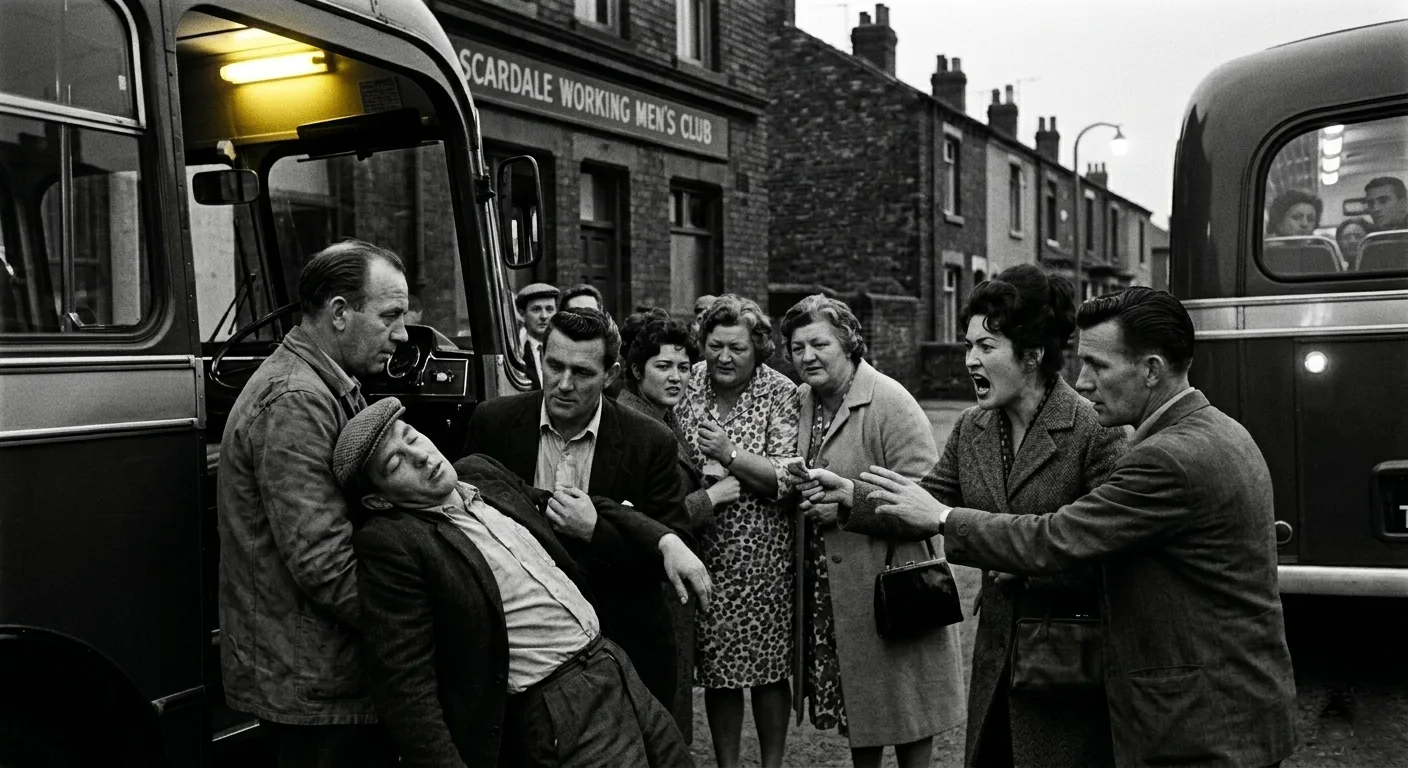
When the bus finally pulled into the car park of Scardale Working Men's Club and everybody had alighted and made their different ways through the coal village, the driver asked for some help in getting the unconscious Ronnie off the bus.
"Leave him there; don't anyone dare move him off the bus, as he isn't coming home with me!" Mary screamed.
"But I've to get back to Doncaster, and I won't be able to get him off the bus on my own," stated the driver.
Thomas was on the point of offering to help the driver, but was stopped by Mary before he could do so.
"Leave him, I said. Here," and she gave the driver her winnings from Bam-Bam's bingo and added, "Take that for your pains and drive the drunk to Doncaster."
"I'm not arguing, lady. I've a family waiting for me back home. Your husband can stay on the bus, but I'm not bringing him back in the morning."
"He's still got a pound," interjected Thomas. "I saw it when searching his pockets for more drink."
"Right, that's settled. Off you go, driver, and get rid of that thing on the back seat before I kill it!"
The driver climbed back in his bus, struck up the engine, and set off back to Doncaster with the drunk unconscious on the back seat.
"I'll walk you home, Mary," Thomas uttered, and gently placed his hand upon the back of her elbow to encourage her walk.
Thomas lived by himself next door to Mary and Ronnie, and therefore there was nothing unusual that night.
When they reached the adjoining gate to their cottages, Mary said, "Little Mark is staying with his gran tonight, as we didn't know what time we'd be back home. Can you come in for a while and have a chat with me, Thomas, as I don't want to be alone? I feel so desperately sad. I hate my life. Please, come in and have a cup of tea."
Mary opened the kitchen door, and Thomas stepped in.
The following morning, Thomas left by the same door and, through the adjoining gate, slipped up his own path and almost imperceptibly disappeared through his own kitchen door.
An hour earlier, a man, worse the worse for wear from drink, staggered off a coach in Doncaster. To a startled stranger, he asked where he was, and was alarmed to find himself miles from home.
With effort, he made his way to the bus station and waited an hour and a half for a bus to take him back home to Scardale.
On the journey back home, Ronnie swore never to have another drop of alcohol ever again.
He kept his promise for over ten years, and even when their second child, James, was born nine months after that trip to Scarborough, Ronnie didn't drink.
Prefer to listen? Watch the video reading below.
Reader Comments
Leave a Comment
We would love to hear your thoughts on this chapter.

About Karl Swainston
Karl Swainston is a writer and storyteller whose work is forged from a life lived across the North of England and far beyond. Growing up on a Leeds council estate in the 1960s, Karl's journey was anything but linear. By the age of thirty, he had already lived a dozen lives: from the rigors of grammar school to a degree in Latin, a stint as a fishmonger, a period of discovery living in Marseille, and a return to the hustle of London. Whether working as a postman, a builder, or competing as a county-level chess player, he was, above all, an avid reader—constantly documenting the world around him. This restless spirit continued into his professional life. Karl later taught in Bradford, where he ran a specialist unit for 244 of the most excluded students from across the region—young people whom even the local Pupil Referral Units could not accommodate. Working alongside his old friend Malcolm, Karl spent his days navigating the volatility of Bradford's most aggressive and dysfunctional teenagers. Throughout his life, Karl has been an avid runner and has always shared his home with a rotating cast of beloved dogs and cats—companions who have been constant witnesses to his work. As a writer, Karl's range is as expansive as his history. He works across a wide breadth of genres, including fiction and short stories, autobiography and memoir, biography, non-fiction, and metaphysical writing, as well as providing sharp commentary, opinion, analysis, and essays. Whether writing about his years managing the Harrogate Arms or offering insights from his current adopted home in South East India, where he lives in a simple village with his dog, Bambi, Karl's voice reflects the full, untidy, and deeply human breadth of life. He continues to draw on the rich, decades-long tapestry of his experiences to tell stories that matter, proving that no matter where you live, the human story remains the same.
Author Page