Resonance
VIII — Cognitive Dissonance and the Soul
Through backward rationalisation, we are able to do this.
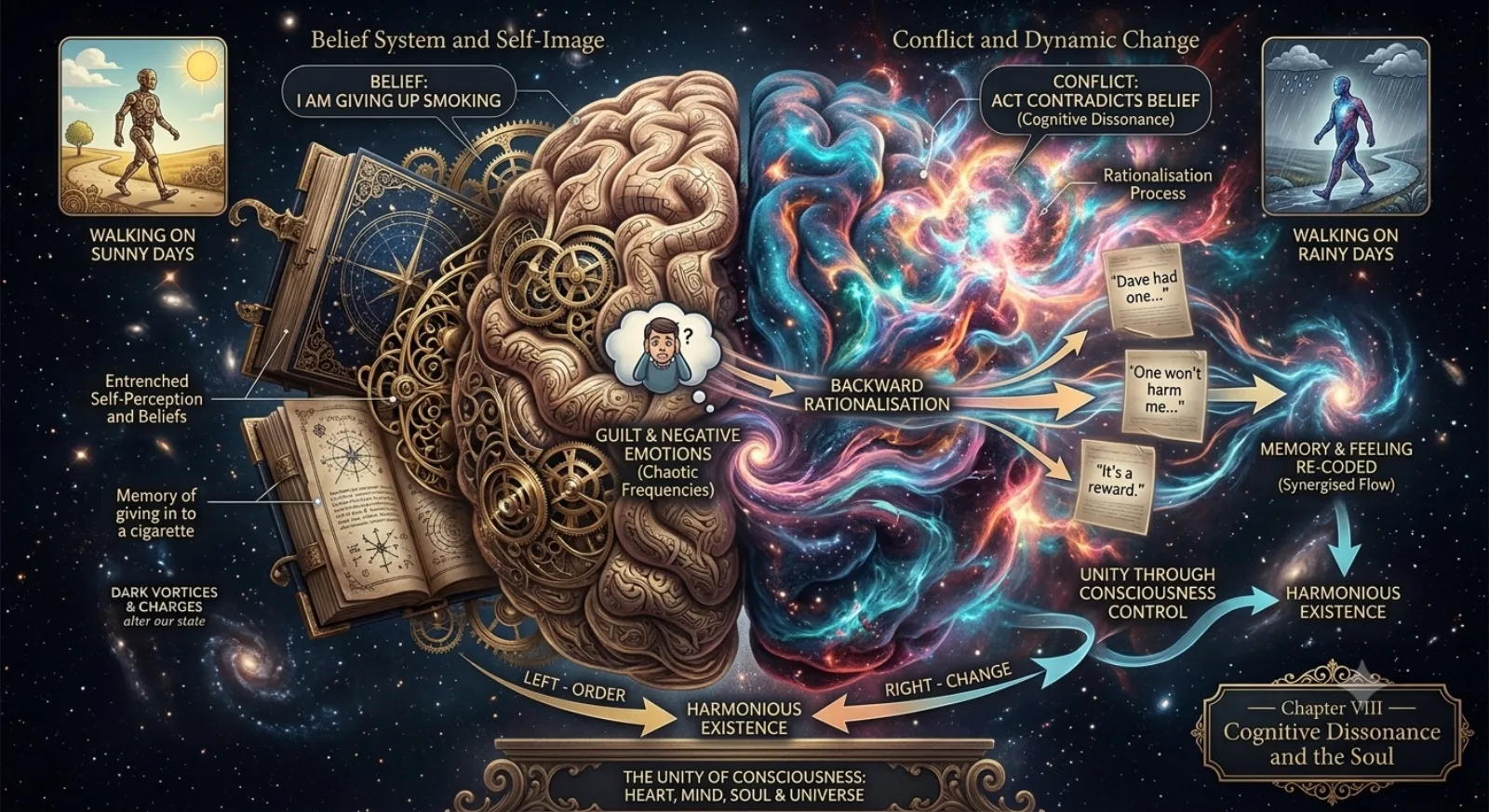
Backward rationalisation can work in two ways. We can look back in our memories and alter the feelings generated by them. Take for example a person trying desperately to give up on cigarettes, and they finally collapse and give in to one. After the event, to avoid feeling the guilt of irrational and unacceptable actions, they rationalise the situation, and they come up with various excuses to justify the action:
'I was under that much pressure at work; Dave's had a cig, so why can't I have one? One won't harm me, and I have done well today, so it's a reward.'
Each of these backward rationalisations alters the fact of the act and change the person's perception and memory of it. And now, rather than the person feeling an awful sense of guilt, and with that guilt a whole host of negative emotions, they have now justified the action and moved on, safe in the knowledge that the memory is now altered and understood in a much more beneficial way. They have changed the mirror neurons to see a totally different past, and when the memory suddenly appears at random, the mirror neurons don't associate the thought with anything bad, and the mind simply moves on to the next random thought.
Our consciousness does not reside in one particular abode of the head but is in all parts of our being, and the unity of consciousness is our whole self and not one particular strand of ourselves: it is our heart, mind, and soul, our feelings, our actions, our very existence in the eternal and infinite Universe. As we walk or wander through life, experience is constantly forging new dimensions in our consciousness, and as the saying goes, 'If we walk only on sunny days, we will forever see the sun in our life, and if we walk only on rainy days, so shall be the days in our mind.' We must endeavour to root out the latter and fill our experience with all that is good, and if it is bad, we act to resist the strain of stressful experience and to command and control the ill before it enters into the most profound parts of our consciousness.
Prefer to listen? Watch the video reading below.
Reader Comments
Leave a Comment
We would love to hear your thoughts on this chapter.
About Karl Swainston
Karl Swainston is a writer and storyteller whose work is forged from a life lived across the North of England and far beyond. Growing up on a Leeds council estate in the 1960s, Karl's journey was anything but linear. By the age of thirty, he had already lived a dozen lives: from the rigors of grammar school to a degree in Latin, a stint as a fishmonger, a period of discovery living in Marseille, and a return to the hustle of London. Whether working as a postman, a builder, or competing as a county-level chess player, he was, above all, an avid reader—constantly documenting the world around him. This restless spirit continued into his professional life. Karl later taught in Bradford, where he ran a specialist unit for 244 of the most excluded students from across the region—young people whom even the local Pupil Referral Units could not accommodate. Working alongside his old friend Malcolm, Karl spent his days navigating the volatility of Bradford's most aggressive and dysfunctional teenagers. Throughout his life, Karl has been an avid runner and has always shared his home with a rotating cast of beloved dogs and cats—companions who have been constant witnesses to his work. As a writer, Karl's range is as expansive as his history. He works across a wide breadth of genres, including fiction and short stories, autobiography and memoir, biography, non-fiction, and metaphysical writing, as well as providing sharp commentary, opinion, analysis, and essays. Whether writing about his years managing the Harrogate Arms or offering insights from his current adopted home in South East India, where he lives in a simple village with his dog, Bambi, Karl's voice reflects the full, untidy, and deeply human breadth of life. He continues to draw on the rich, decades-long tapestry of his experiences to tell stories that matter, proving that no matter where you live, the human story remains the same.
Author Page