Resonance
LXV — Resonant Wealth – Blocking Negative Energy
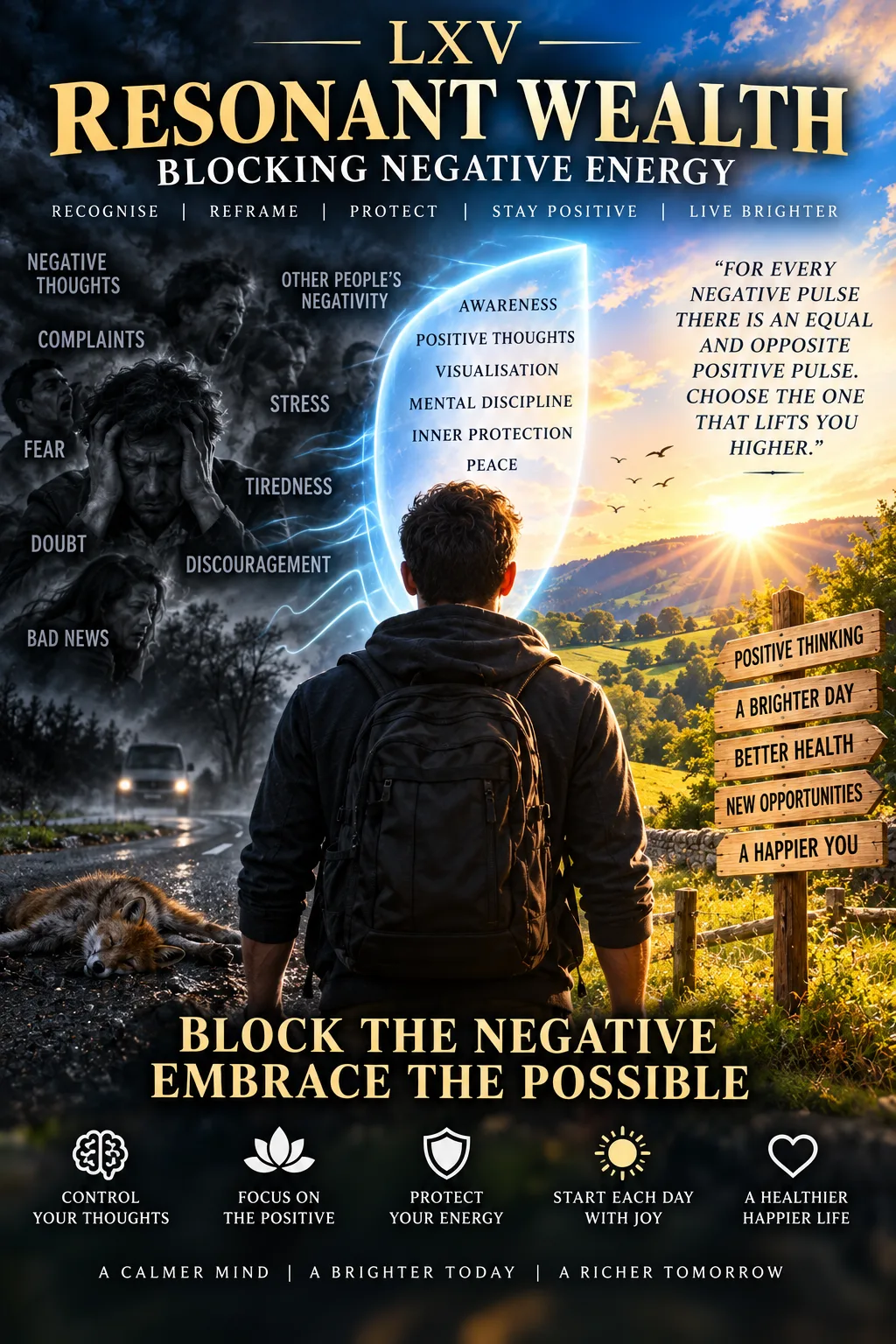
Once you are aware of these negative pulses of energy, you must determine a means quick of blocking the wavelengths from entering any further the outset of your hearing or seeing. One good way is to think that for every negative pulse of energy or action there's an equally opposite pulse of positive energy. By flooding the mind at that very instant when you feel negative, think upon its opposite, and although it may be difficult at first, after a while, and through determined practise, you will become a master of the remedy. I can remember a person saying they saw many dead animals on the way to work; animals that had perished trying to cross a busy road running through the countryside. They spoke of how, upon seeing each dead animal, whether it be a fox, a badger, a stoat, hare, or pigeon, they felt a sense of loss and sense of empathy for the deceased creatures. They mentioned how their thoughts began to drift into a fully charged negative field about life, about death, and about their own life of work. By the time they had reached work, they were already feeling down and lacking in the necessary spirit with which to entertain a hard day's labour. They were unaware that this was happening, and it was only when they were enlightened did they begin to change the pattern of how they saw death lying on the side of the road. They now viewed the spectacle as part of the infinite cycle of life and death, and of how truly abundant life is, teeming with its rich life. They immediately began to think of fields abundant with living creatures under a cobalt sky with a big, yellow sun. The practice of this simple vision arrested the unruly entrance of the negative attack further into the conscience, until, after a few seconds it had been obliterated altogether. Fortunately, we don't all have to travel along roads with such sights, but the practice is worth noting, as we can use the method to combat any unruly thought, image or action.
Lastly, when the mind is positive and charged with energy and creative pulses of light, it is much healthier and happier, and this in turn wards off a whole array of illnesses and diseases.
When you wake up in the morning, make sure you embrace the joyfulness and happiness in the day. It is of no use whatsoever to wake up with a tired, jaded frame of mind, which upon lifting the eye-lids from sleep sighs, 'Oh dear!' or 'Whooaargh.' It is of no use to complain that the night's slumber has been broken, or the dream pattern or anything else has constantly woken you, and you've had a terrible night's sleep. This fact cannot be changed when you wake; you can endeavour to seek a better night's sleep on the following night, but for the present moment nothing can be altered. The person who groans their way out of bed is already defeated by the living of the day. They are already giving themselves no chance to capture and seize any opportunities that the day may present to them. Their negative mental attitude begins the day with constricted and negative thoughts, which will only compound other negative and constricted thoughts throughout the duration of the day. They have already set fire to the box of matches in their pocket.
Prefer to listen? Watch the video reading below.
Reader Comments
Leave a Comment
We would love to hear your thoughts on this chapter.

About Karl Swainston
Karl Swainston is a writer and storyteller whose work is forged from a life lived across the North of England and far beyond. Growing up on a Leeds council estate in the 1960s, Karl's journey was anything but linear. By the age of thirty, he had already lived a dozen lives: from the rigors of grammar school to a degree in Latin, a stint as a fishmonger, a period of discovery living in Marseille, and a return to the hustle of London. Whether working as a postman, a builder, or competing as a county-level chess player, he was, above all, an avid reader—constantly documenting the world around him. This restless spirit continued into his professional life. Karl later taught in Bradford, where he ran a specialist unit for 244 of the most excluded students from across the region—young people whom even the local Pupil Referral Units could not accommodate. Working alongside his old friend Malcolm, Karl spent his days navigating the volatility of Bradford's most aggressive and dysfunctional teenagers. Throughout his life, Karl has been an avid runner and has always shared his home with a rotating cast of beloved dogs and cats—companions who have been constant witnesses to his work. As a writer, Karl's range is as expansive as his history. He works across a wide breadth of genres, including fiction and short stories, autobiography and memoir, biography, non-fiction, and metaphysical writing, as well as providing sharp commentary, opinion, analysis, and essays. Whether writing about his years managing the Harrogate Arms or offering insights from his current adopted home in South East India, where he lives in a simple village with his dog, Bambi, Karl's voice reflects the full, untidy, and deeply human breadth of life. He continues to draw on the rich, decades-long tapestry of his experiences to tell stories that matter, proving that no matter where you live, the human story remains the same.
Author Page