Resonance
XXVI — Norepinephrine and the Mind
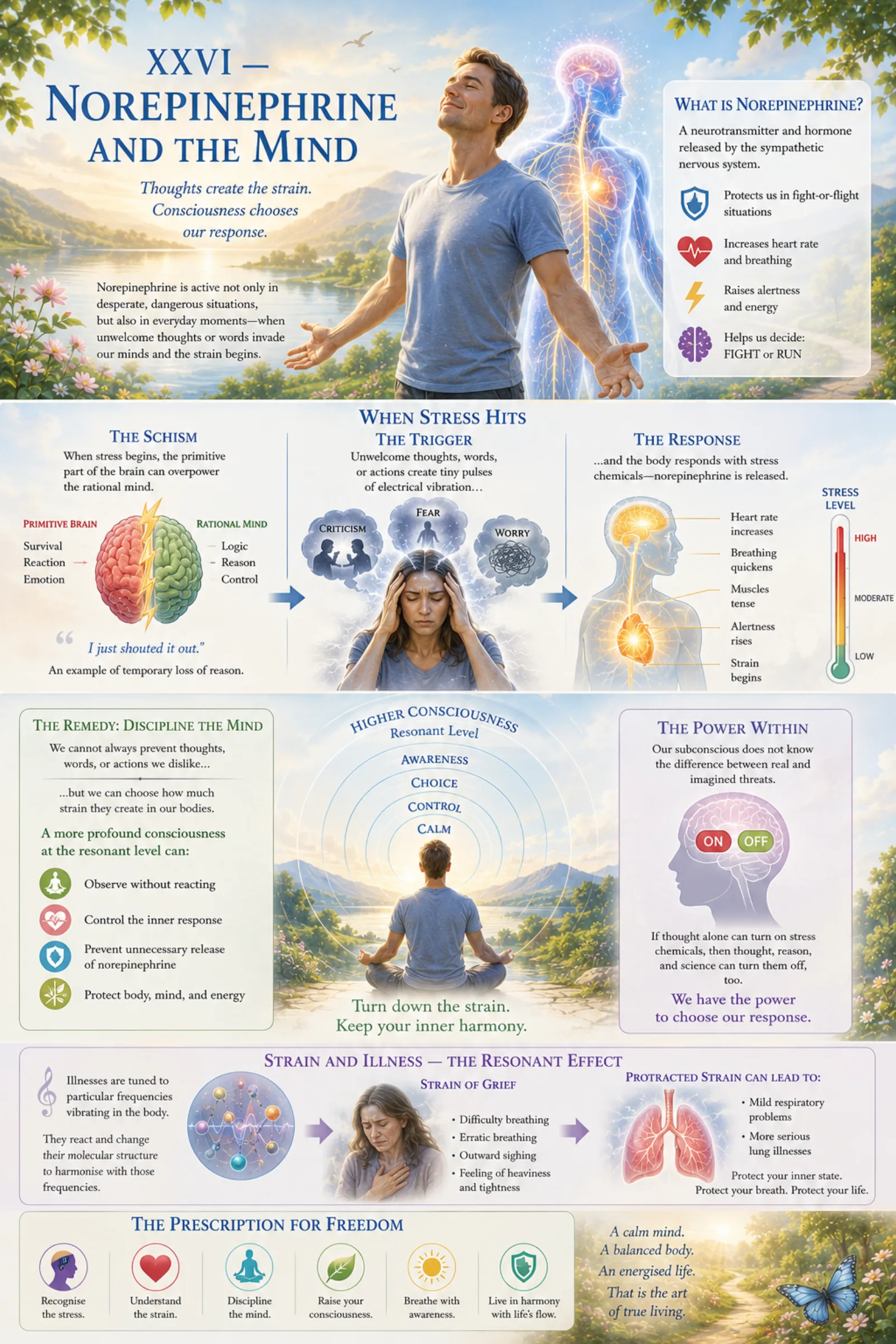
But it is not only in desperate and dangerous situations this tiny neurotransmitter is active. It is also active on lesser levels of attack, such as when unwelcome thoughts either from others or from ourselves come to call, and we can feel the strain from the stress beginning to raise our temperature or increase the beats of our heart. There is a schism, however, when this begins to occur, or is occurring, as the primitive part of the brain begins to dominate the rational, and an example of this temporary loss of reason is when a person declares, 'I just shouted it out,' when they felt threatened by something.
Norepinephrine can be our saviour in desperate moments, but at other times it can be a plague that brings to our beings the feelings of uneasiness about something. On a resonant level, it is the thoughts, the tiny pulses of electrical vibrations which abound in our minds that bring about this unsettling situation. As previously mentioned in Stress and Strain, the same remedy is for prescription here. We cannot always prevent unruly thoughts from being generated in our minds, or listening to, or being in the presence of words or actions, which we don't like, and feel uncomfortable with, but we do have the ability to check the strain on our bodies they bring about. Disciplining the mind, and by that we mean a more profound consciousness at the resonant level, controlling the very substance which allows the strain, and preventing it from happening will also prevent the unnecessary release of norepinephrine.
Our subconscious selves don't know the difference between what is real and what is not, and if they can turn on the stress chemicals by thought alone, then by reason and by science it must be, that we have the power to turn off those damaging stress chemicals by thought alone, too.
Illnesses are tuned to particular frequencies vibrating in the body. They react and change their molecular structure to harmonise with those frequencies. A person suffering the strain of grief often finds it difficult to breathe with the ease of action that they were once used to. Their breathing is often erratic, and every so often they outwardly sigh, which shows the strain of illness they feel within. If the strain of grief is protracted, then various forms of lung illnesses will follow from mild respiratory problems to much more debilitating ones.
Prefer to listen? Watch the video reading below.
Reader Comments
Leave a Comment
We would love to hear your thoughts on this chapter.

About Karl Swainston
Karl Swainston is a writer and storyteller whose work is forged from a life lived across the North of England and far beyond. Growing up on a Leeds council estate in the 1960s, Karl's journey was anything but linear. By the age of thirty, he had already lived a dozen lives: from the rigors of grammar school to a degree in Latin, a stint as a fishmonger, a period of discovery living in Marseille, and a return to the hustle of London. Whether working as a postman, a builder, or competing as a county-level chess player, he was, above all, an avid reader—constantly documenting the world around him. This restless spirit continued into his professional life. Karl later taught in Bradford, where he ran a specialist unit for 244 of the most excluded students from across the region—young people whom even the local Pupil Referral Units could not accommodate. Working alongside his old friend Malcolm, Karl spent his days navigating the volatility of Bradford's most aggressive and dysfunctional teenagers. Throughout his life, Karl has been an avid runner and has always shared his home with a rotating cast of beloved dogs and cats—companions who have been constant witnesses to his work. As a writer, Karl's range is as expansive as his history. He works across a wide breadth of genres, including fiction and short stories, autobiography and memoir, biography, non-fiction, and metaphysical writing, as well as providing sharp commentary, opinion, analysis, and essays. Whether writing about his years managing the Harrogate Arms or offering insights from his current adopted home in South East India, where he lives in a simple village with his dog, Bambi, Karl's voice reflects the full, untidy, and deeply human breadth of life. He continues to draw on the rich, decades-long tapestry of his experiences to tell stories that matter, proving that no matter where you live, the human story remains the same.
Author Page