Resonance
XVI — Resonant Entanglement
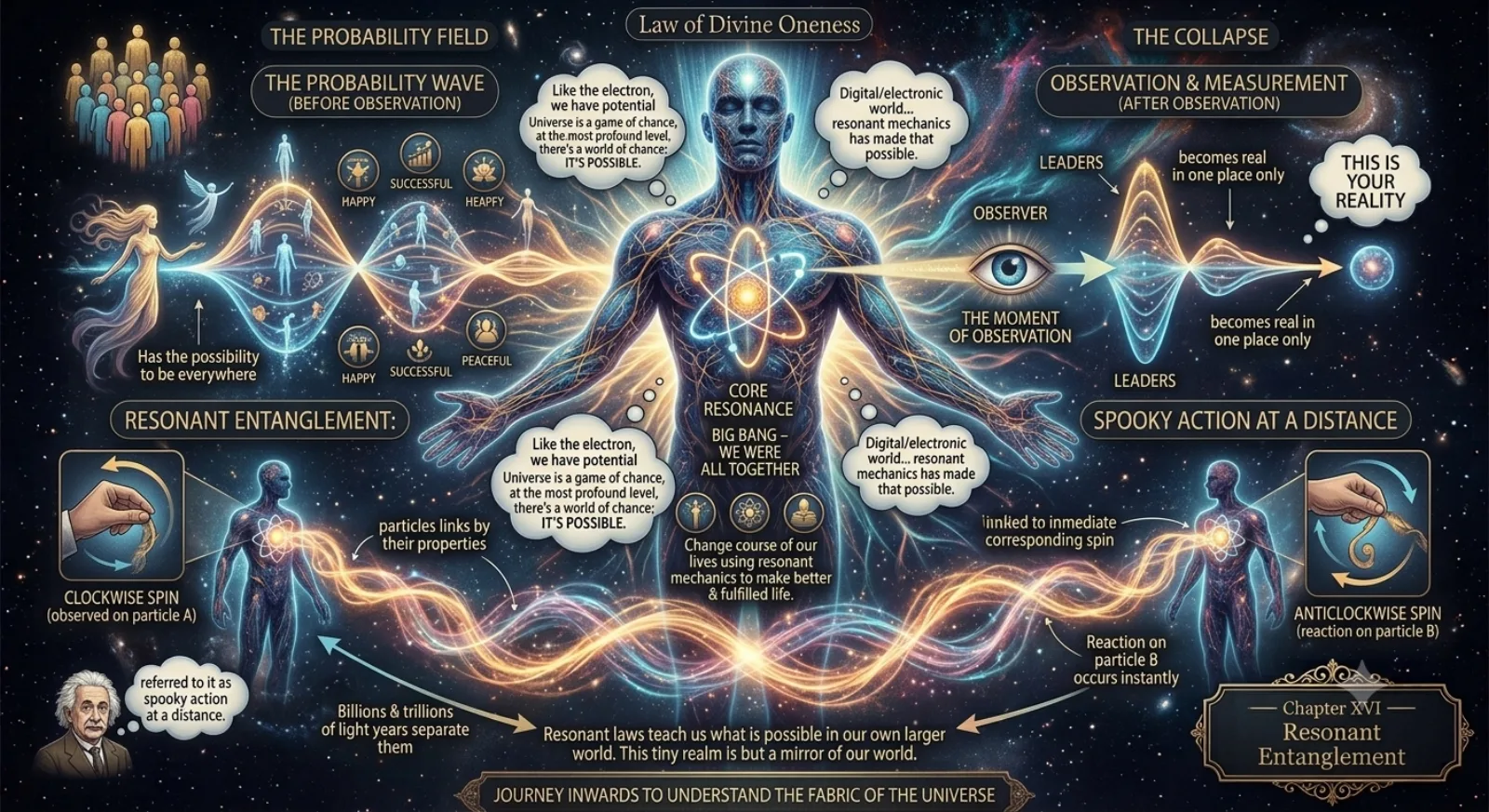
Although the electron is a particle when it first leaves the thrower's hand, as it were, it has many possibilities of where it can at any one given time. And this is the probability wave which hits the barrier behind. The electron can be anywhere until the moment it is observed, and when it is observed, it is either a wave or a particle. What this means is that before the electron is observed, it has the possibility to be everywhere, and only when it observed and measured does it become real in one place only.
Another fascinating feature resonant mechanics uncovered was that of resonant entanglement. Resonant entanglement is when two particles become linked by their properties, and even if the particles became separated by billions of miles, they can still remain inextricably linked, and one action from one of the particles will create a reaction on the other particle. An electron will spin almost indiscriminately before it is observed, but upon the moment of observation, it will spin either clockwise or anticlockwise. And when one electron spins in a clockwise direction, the other particle will spin an anticlockwise direction, even if they are billions of light apart. Einstein referred to it as 'spooky action at a distance.' And remember, at the moment of the so-called Big Bang we were all together; our atoms and subatomic particles were all together; our whole Universe was all together. Therefore, particles can still be connected even though billions and trillions of light years separate them.
But what does all of this mean for us? How can we change the course of our lives, using this information of resonant mechanics and make our lives better and more fulfilled?
What resonant mechanics has shown is that the Universe is made of billions upon billions of atoms and particles, ad infinitum, and we are part of that Universe. And like the electron, who has the probability of being in a place at any one given time, we also have the same potential to do the same. The Universe is a game of chance, and at the most profound and fundamental level of existence, within the existence and property of the resonant realm, there is a world of chance, or more importantly: it's possible. At the start of the 20th Century, today's digital/electronic world would have been unheard of, but resonant mechanics has made that possible.
In the so-called real world we see around us, objects and matter either remain fixed, like a tree or follow a certain path, as with a bird flying, which our minds can understand. And even if the path is haphazard, we can still comprehend the nature of its random flight. At the resonant level, however, the tiny atoms and particles appear not wanting to behave in this particular way. They often don't remain fixed in one position, like the tree, but can appear in many different fixed places at the same time. Also, their whole being can change one state to another is a billionth of a second; they can change from being a particle to behaving like a wavelength. The resonance have the ability to be almost anywhere at the same time. These infinitely small laws of resonant mechanics exist, and they can teach us not only about how matter behaves in their tiny world, but they can instruct us on what's possible in our own larger world. This tiny realm of the resonant is but a mirror of our world.
Prefer to listen? Watch the video reading below.
Reader Comments
Leave a Comment
We would love to hear your thoughts on this chapter.
About Karl Swainston
Karl Swainston is a writer and storyteller whose work is forged from a life lived across the North of England and far beyond. Growing up on a Leeds council estate in the 1960s, Karl's journey was anything but linear. By the age of thirty, he had already lived a dozen lives: from the rigors of grammar school to a degree in Latin, a stint as a fishmonger, a period of discovery living in Marseille, and a return to the hustle of London. Whether working as a postman, a builder, or competing as a county-level chess player, he was, above all, an avid reader—constantly documenting the world around him. This restless spirit continued into his professional life. Karl later taught in Bradford, where he ran a specialist unit for 244 of the most excluded students from across the region—young people whom even the local Pupil Referral Units could not accommodate. Working alongside his old friend Malcolm, Karl spent his days navigating the volatility of Bradford's most aggressive and dysfunctional teenagers. Throughout his life, Karl has been an avid runner and has always shared his home with a rotating cast of beloved dogs and cats—companions who have been constant witnesses to his work. As a writer, Karl's range is as expansive as his history. He works across a wide breadth of genres, including fiction and short stories, autobiography and memoir, biography, non-fiction, and metaphysical writing, as well as providing sharp commentary, opinion, analysis, and essays. Whether writing about his years managing the Harrogate Arms or offering insights from his current adopted home in South East India, where he lives in a simple village with his dog, Bambi, Karl's voice reflects the full, untidy, and deeply human breadth of life. He continues to draw on the rich, decades-long tapestry of his experiences to tell stories that matter, proving that no matter where you live, the human story remains the same.
Author Page