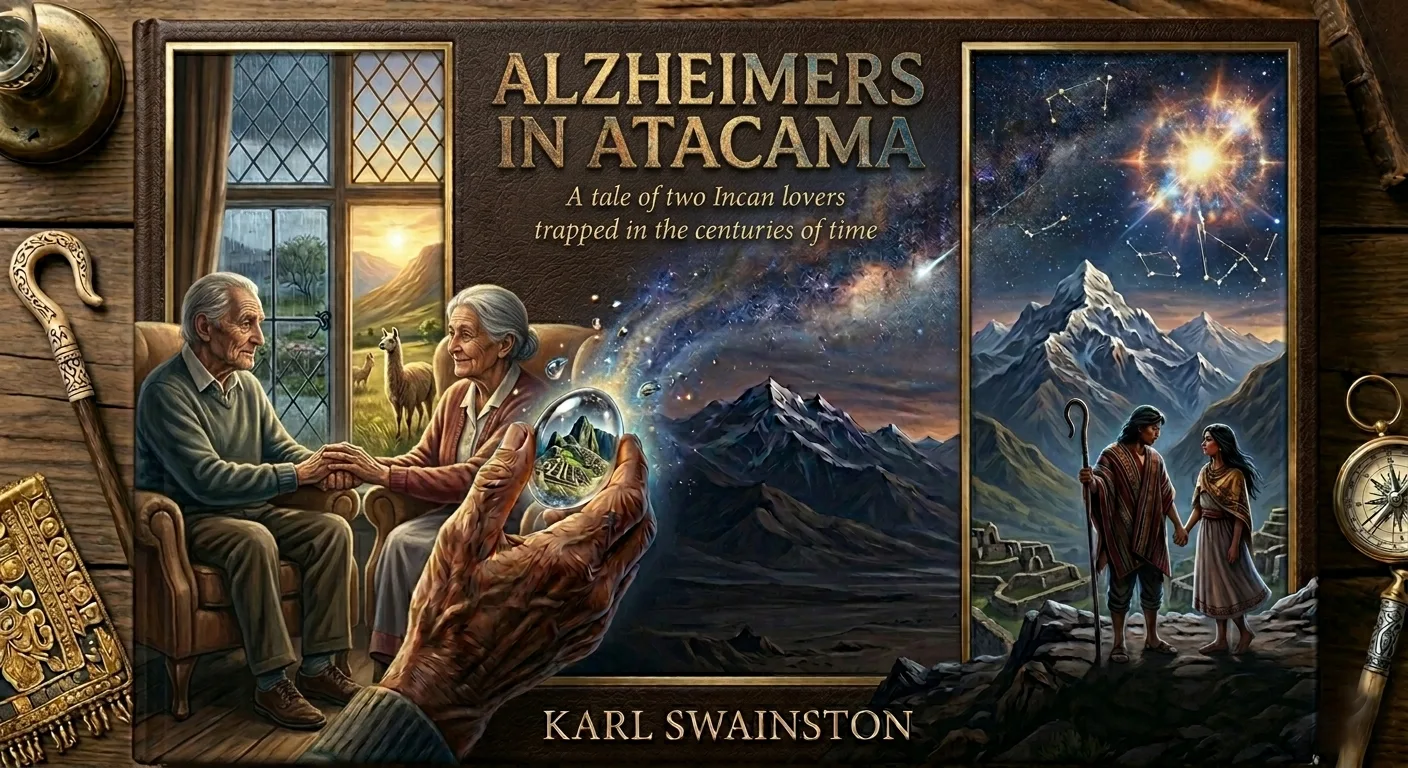
Alzheimers in Atacama
Prologue — The Voice of Atacama
The Voice of Atacama introduces the story of two ancient Incan lovers trapped in the centuries of time.
← Karl Swainston / Alzheimers in Atacama
THE VOICE OF ATACAMA:
Alzheimer’s in Atacama is a tale of two Incan lovers trapped in the centuries of time. The two are ignorant, though, of their reincarnations, and that the only way they can free themselves from this world and reach the distant stars of their ancestors is to find one another and become lovers; only then can they be taken back to the true infinity of their home in the stars.
Two aged characters, Thomas, 93, and Mary, 91, who don’t know one another, have been put into a care home because of their severe Alzheimer’s. Their English carers have given up on them, are rude and inattentive to the aged pair, and don’t listen to ‘two old codgers waffling on with dementia.’
Two young Greek migrants, Dion, 23, and Gaia, 21, who also don’t know one another, and who have both traveled from Greece to escape the economic plight there, secure employment at the care home. Both develop a bond with the aged pair and begin to listen to Thomas and Mary’s strange tales of centuries past.
The story begins with Gaia sitting with Thomas and hearing him tell of the ancient Incas, the early times of the civilization, Atacama, and El Niño, and of how a young warrior struggled with adversity to win the heart of an ill-fated Incan girl. Although Gaia knows that the tale she is hearing is but a symptom of Thomas’s Alzheimer’s, she is drawn irresistibly to the charm of it, so much so that it becomes real for her.
She tells Dion about the story, and he then relates how, the previous evening, Mary had told him a tale of how a young girl, in the last days before the Spanish destroyed the Incan Empire, was due to marry an Incan man, but she was captured by the Spanish and her man was killed. She, too, was then slain.
Interspersed between each of the aged pair’s tales, which move through the centuries of time, the reader is shown various scenes from the present: the struggles of the aged pair, the altercations with the ‘uncaring staff,’ and the developing love between the two young Greeks. The reader learns that both were abandoned as babies and orphaned, and that neither of them has ever had a lover in their lifetime.
As the tales move through to the present century, Thomas and Mary’s lives near their end, the love of the young Greeks becomes strong, and on one final night, when Thomas and Mary die, the young Greeks become lovers.
On the night the staff find the aged pair, Thomas and Mary, dead, the two young Greeks simply disappear from this world. In the night sky, the phenomenon of a supernova appears, and a young girl rushes out of her house. Seeing the spectacle, she says to her mother, ‘Look, mama, why is the star bursting?’
‘I don’t know, my child, but isn’t it beautiful.’
Reader Comments
Leave a Comment
We would love to hear your thoughts on this chapter.

About Karl Swainston
Karl Swainston is a writer and storyteller whose work is forged from a life lived across the North of England and far beyond. Growing up on a Leeds council estate in the 1960s, Karl's journey was anything but linear. By the age of thirty, he had already lived a dozen lives: from the rigors of grammar school to a degree in Latin, a stint as a fishmonger, a period of discovery living in Marseille, and a return to the hustle of London. Whether working as a postman, a builder, or competing as a county-level chess player, he was, above all, an avid reader—constantly documenting the world around him. This restless spirit continued into his professional life. Karl later taught in Bradford, where he ran a specialist unit for 244 of the most excluded students from across the region—young people whom even the local Pupil Referral Units could not accommodate. Working alongside his old friend Malcolm, Karl spent his days navigating the volatility of Bradford's most aggressive and dysfunctional teenagers. Throughout his life, Karl has been an avid runner and has always shared his home with a rotating cast of beloved dogs and cats—companions who have been constant witnesses to his work. As a writer, Karl's range is as expansive as his history. He works across a wide breadth of genres, including fiction and short stories, autobiography and memoir, biography, non-fiction, and metaphysical writing, as well as providing sharp commentary, opinion, analysis, and essays. Whether writing about his years managing the Harrogate Arms or offering insights from his current adopted home in South East India, where he lives in a simple village with his dog, Bambi, Karl's voice reflects the full, untidy, and deeply human breadth of life. He continues to draw on the rich, decades-long tapestry of his experiences to tell stories that matter, proving that no matter where you live, the human story remains the same.
Author Page